


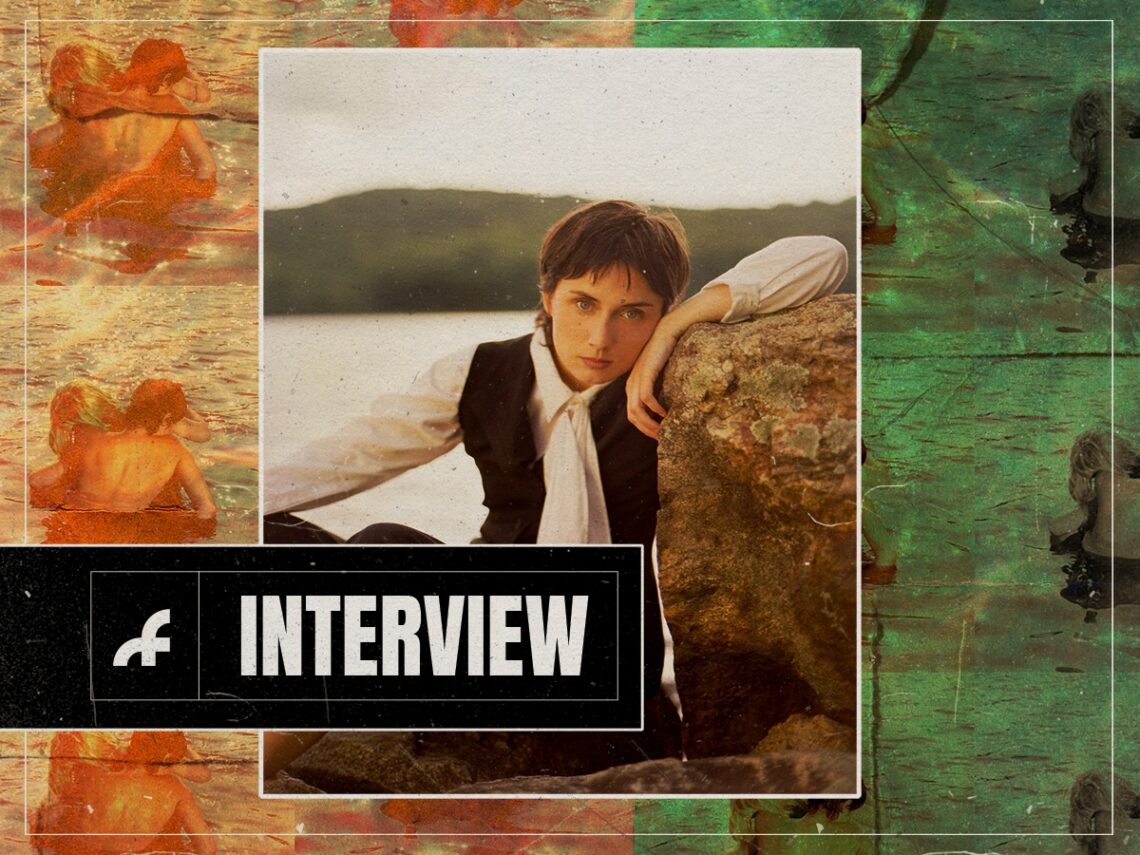
Katy Kirby discusses reactive music, self-discovery and the outdated tradition of marriage

“Stop whistling, please; I love you, but it’s very distracting,” Katy Kirby’s voice comes from just out of the small frame that a Zoom call allows. We speak a few days before the release of her album, Blue Raspberry, a profoundly personal and intricate project. Despite the looming release, Kirby seems incredibly relaxed as she re-enters view. “Sorry, Logan was whistling as he was doing the dishes, like, noise cancelling headphones on, and he has a really haunting and beautiful whistle, and it’s very distracting. OK, anyway…”
Logan is one of her bandmates who helped to write and produce Blue Raspberry. The album is difficult to quantify, both proactive, reactive and practice in self-discovery. It sees Kirby process previous relationships, explore her first queer one and evaluate the outdated practice of marriage. For something that has become so personal, it’s interesting that the title track, which set everything in motion, was initially created to be a concept.
“I was definitely just kind of writing the song,” she said, “I think where it first started to come from, or where the title came from, was an exercise. I pulled a bunch of notes out of my phone, and I wrote them down all in one piece of paper; I don’t know; it seemed like a good idea. So I did, and there were some themes that seemed to connect, and I remember writing down ‘Blue Raspberry’ for some reason. It must have been a note somewhere. Yeah, just hearing that little refrain, I was like, that’s nice, and I was kind of trying to write a song like that. That’s kind of how it started. I would turn to it whenever I was trying to write a love song about a woman.”
Following completing the track, Kirby realised that love songs about women went far beyond the confines of sound. “I had written it as an exercise, and I didn’t really realise that I was queer until after,” she says. “It didn’t start to feel personal until I had started dating someone and then I was on tour, and I sang that song and thought of her. That’s really the moment it started to feel personal.”
What happened next was Kirby using the album as a means to get out her anger following her last relationship and trying to articulate how she felt about her first queer one. Kirby was very open to experimentation with this record, which is why, despite being incredibly cohesive, each piece has its own personality. Some of that came naturally, whereas with other tracks like ‘Hand to Hand’, she felt some pushback.
Kirby revealed: “I wasn’t sure if I liked that song for a long time, and it felt really risky to me because we made some kind of weird choices that I wasn’t sure about, but I think that they paid off, so I’ve really come round to that song.”
The choices, in particular, were two-fold, both sonically and lyrically. Sonically, they were how she could achieve the brooding atmosphere that rings through. She said: “I didn’t know if I could pull off that sort of spookiness. I’m not a very spooky person, generally, but it’s kind of an ominous-sounding song in parts. When I was living in Alberto Sewald’s house, who produced it with me and Logan, he lived next to some train tracks in Nashville. There were a lot of train noises near his house.”
Adding, “One night, I was alone… this train came by, but it wasn’t all a train. I don’t know what it was, but it made this crazy noise. It was really dark, so I couldn’t see all of the tracks, but it was the scariest noise I’ve ever heard. It happened to be in the key of the song, so we used it.”
There were also challenges presented lyrically, as, throughout the track, Kirby touches upon her scepticism surrounding relationships, especially heterosexual ones. They’re feelings that are tough to put into words, so putting them into her work was another level of complexity.

Kirby noted: “It was weird; I just never felt so pessimistic. Particularly pessimistic about heterosexuality because it seems to have a lot more baggage. Also, just pessimistic at the idea that people can be good to each other for a long period of time… I was just thinking about how miserable most people who have been married throughout history were, and I was like, ‘Damn, why do we just keep doing that?’
“I just tried to work some of that out. Oh, at the same time, two people who I really respect and whose relationship I really respect and think is beautiful were like, ‘Yeah, we’re engaged now.’ One of them wrote this beautiful poem about it, and I was like, ‘Damn, that’s a gorgeous poem about y’all deciding to get engaged.’ I felt so suspicious. They’re still doing fine, as far as I’m aware… I was simply not having it on the days that I wrote that song, with coupling in general, but especially heterosexual coupling, and especially marriage.”
When you break love down to its bare bones, pessimism surrounding it is pretty understandable. On one hand, it opens you up to extreme highs, a feeling as indescribable as it is special. Equally, being vulnerable to those highs also exposes you to the potential of lows. In that sense, love is surrounded by happiness and sadness, which this album, particularly its instrumentation, captures incredibly well.
A few tracks are exempt from this, but generally speaking, the beauty that is captured with the sound of this album, if you apply happy or sad lyrics to it, would still work. In the same way one piece that reminds you of someone can make you happy at one moment and sad at another, this song encapsulates the complexities of opening up. “I think that definitely reflects how we approached the instrumentation. We did really try to honour the song.”
Kirby was able to make use of a wide range of instruments, from guitars and keyboards to a whole string section. This mass arrangement contributes to each track’s individuality, as some are incredibly stripped back and fragile, whereas others are heavy, rock-infused and almost indestructible.
She explained: “We mostly went full in, in the process of listening to stuff over and over and over again, it’s easier to identify which parts of an arrangement are overburdening something. So, I think we went full in initially, and Alberto and Logan made a lot of those decisions because that’s really where their talent lies. I was advocating for pretty big arrangements on a lot of these, and they were both very smart about how they preserved parts of that but didn’t overburden the songs. I don’t even know how they did that, but they’re very good at it, and I am not, and that’s why it’s their job.”
This Katy Kirby album is more than just good music; it’s a real-time exploration of discovery so personal that it almost feels like a privilege to be given access to it. If you ever needed proof that music can speak to you on a level deeper than just words alone, then this is it, knowing that the writer got as much out of it as you. Blue Raspberry, which started life written down as a random burst of consciousness on Kirby’s phone, ironically, is worth making a note of.
