


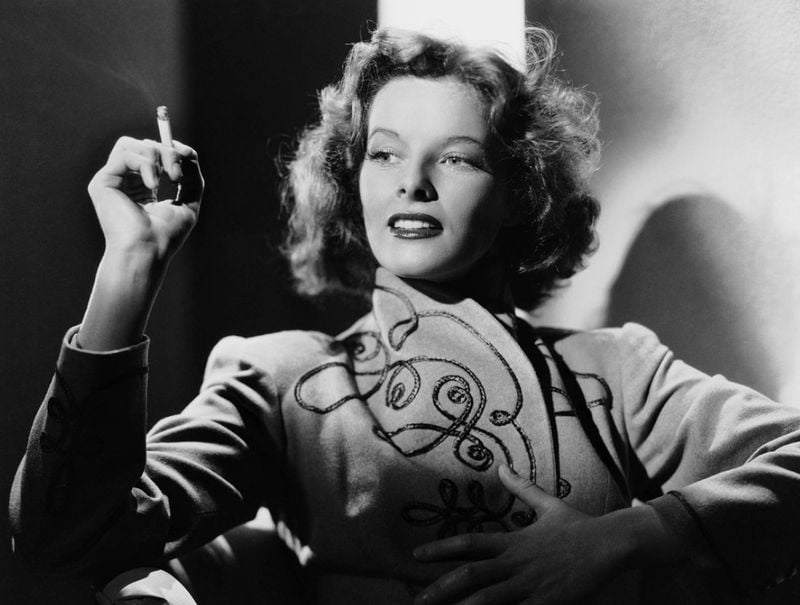
Six definitive films: The ultimate beginner’s guide to Katharine Hepburn

“I’m a personality as well as an actress. Show me an actress who isn’t a personality, and you’ll show me a woman who isn’t a star.”
A trailblazer in Hollywood with her motor mouth, incredible talent and unusual presence, Katharine Hepburn has won a record number of Oscars (four to be exact) with twelve Academy Award nominations, which is the highest after Meryl Streep. Hepburn was way ahead of her time in unimaginable ways and ushered the sense of the new, independent Hollywood star.
Her unique features complemented her bizarre personality. She was resented by many due to her non-conformist attitude but she never gave in to the demands of the inherently patriarchal film industry and did not settle to be the sweet, demure heroine. Instead, she was well-aware of her talents and gained complete control over herself. Haughty and deserving, she never attended any of the award shows and barely made contact with the press which led them to call her names. Did she care? Never.
Hepburn channelled her relentless energy and indomitable spirit to gift cinema with some exceptional characters which made her the star that she is. Her spiritedness arose from the liberal atmosphere she grew up in. A product of “two very remarkable parents”, Hepburn’s childhood saw her engaging in athletic activities which were not very usual for ladies in those times. She had a knack for acting and left university to fulfil her desires. Despite initial flak and rejection for her shrill voice and unusual presence, Hepburn persevered.
After not finding work for a long time following her successful performance in The Czarina, Hepburn gained recognition after her theatrical performance in The Warrior’s Husband. It was this very performance that helped her secure her first Hollywood role in A Bill of Divorcement where her exceptional talent catapulted her into stardom. She has never looked back ever since, delivering exceptional performances. Although her career faced a bit of a dip, she resuscitated it on her own and was back with a bang, winning two Oscars in a row in films like Guess Who’s Coming to Dinner and The Lion in Winter.
However, in the years that followed, media houses and columns were not very kind to her. She was always a private person and distanced herself from unwarranted gossip-mongers as she found the engagement in such social scenes superficial and a waste of time. Her headstrong nature often led her to be called bossy. “I strike people as peculiar in some way, although I don’t quite understand why. Of course, I have an angular face, an angular body, and, I suppose, an angular personality, which jabs into people,” she said.
Her personal life irked immense interest but it is safe to say that despite her failed relationships with quite a few men, she eventually began a wonderful relationship with the legendary Spencer Tracy. She often proclaimed how she “would have done anything for him”. In a fruitful relationship that resulted in nine great collaborations, the actress was blindly in love with the actor and their relationship was one of the highly publicized Hollywood romances. After he passed away, Hepburn said that their twenty-seven years together was “absolute bliss” to her.
Hepburn, fiercely independent and absolutely fearless, often proclaimed how she would welcome death and said it “must be wonderful, like a long sleep”. After showing signs of dementia towards the end, she left the cinematic world hollow after departing in 2003. The characters she played, in all their glorious independence, strong will and intelligence, cemented her legacy, making her a pioneer actress whose portrayal was a direct commentary on the position of her sex in society.
On what would be this legendary actor’s 113th birthday, we take a look at six definitive films which would help us understand the versatility and pure talent Katharine Hepburn possessed.
“Why slap them on the wrist with feather when you can belt them over the head with a sledgehammer.”
Six definitive films of Katharine Hepburn:
A Bill of Divorcement (George Cukor, 1932)
The film revolves around the complications that ensue when a psychotic husband returns home to find his wide engaged to another man. Englishwoman Meg Fairfield’s husband Hilary suffers from hereditary psychiatric problems and has been confined to a mental hospital for nearly fifteen years; Meg has obtained a divorce from him on grounds of insanity and plans to marry her fiance Gray. Suddenly, Hilary breaks out of the mental hospital and returns home to find his wife betrothed to another man that sends him into a state of frenzy. His daughter, Sydney, learns how insanity is genetic in her family and is mortified. Hilary’s presence, thus, alters the plans for the Christmas holidays.
With her performance in the theatrical production of The Warrior’s Husband, Katharine Hepburn was noticed and asked to audition for this film. The director, despite the production company’s head’s doubts, was jolly impressed by her and wanted to cast her. While the production head was worried about her high wages as well as whether the audience would be receptive to her, Cukor was convinced of the talents that lay within her oddities. He was not wrong as Hepburn’s role as Sydney, who soon learns that she too is doomed to the fate of her father, garnered attention and brought her to the spotlight. Her distinguished performance with its vulnerabilities left an everlasting impact on the audience and made her a well-known star as well as gifted her a lifelong friendship with Cukor which came to fruition as they made ten more films together.
“It’s in our blood, isn’t it?”
Morning Glory (Lowell Sherman, 1933)
Hailing from a small town, Eva Lovelace dreams of making it big on the stage and eventually Broadway. Despite possessing talent and flair for acting, she is constantly spurned by producers and bogged down by actresses who have been in the industry longer than they can imagine. The moral corruption of the theatre industry is brought to light as Eva struggles to be accepted in a theatrical adaptation by Joseph Sheridan who eventually falls in love with her. Her pursuit of fame and the need to make it big on-stage suddenly comes to a stagnancy. However, when the starlet required to star in the play taps out due to arguments, Eva finally gets the chance to shine on stage and prove her mettle.
Hepburn’s character is charming, dangerous and neurotic; she harbours the vivacious dreams of a naive, romantic girl who wants to kill herself on stage for a dramatic farewell to her life. She attained stardom with her very third film which won her an Academy Award for the Best Actress. Hepburn had insisted on playing Lovelace’s character due to the connection she felt with it- she, too, had been rejected numerous times before being offered a role. Although she never made it to the ceremony, she was overjoyed and went on to give Hollywood some of its most memorable and layered characters.
“I’m not afraid! I’m not afraid of being a morning glory!”
Little Women (George Cukor, 1933)
Adapted from Louisa May Alcott’s popular novel of the same name, the film revolves around the lives of the four March sisters; Meg, Jo, Beth and Amy- as they gradually transition from childhood to adulthood and feel the weight of the world being thrust upon their shoulders in form of ambition, marriages, societal norms, loss, grief and love. Forming a close bond with their neighbour Laurie, who is smitten by the carefree and ambitious Joe, the girls navigate their way through the world amidst the Civil War serving as the backdrop. While the 1930s were severely criticised for the vulgarity of content, this film was refreshing and attracted crowds, becoming one of Hollywood’s greatest successes to date. Katharine Hepburn played the role of Jo with unforgettable energy and sheer brilliance.
Hepburn found herself in Jo. The character’s spiritedness, fierce independence and the constant pursuit of trying to live her life according to her own terms resonated with Katharine’s personality. Both are wildly independent and seek to make distinguished contributions to their career. Hepburn was extremely proud of her work and confidently stated to “defy anyone to be as good [a Joe] as I was”. Cukor, too, heaped her with praises by calling her a “human dynamo” and an “artistic bully” whose “vigour of [her own] mind and the intensity of [her] attitude towards her own work” set her apart from the rest.
“If wearing hair up means becoming a lady, I’ll wear it down until I’m 100 years old.”
Suddenly, Last Summer (Joseph L. Mankiewicz, 1959)
Adapted from Tennessee Williams’ eponymous play, the film revolves around the trauma and psychological turmoil inflicted upon a socialite named Catherine Holly after she witnesses the gruesome death of her cousin Sebastian during a vacation in Europe, and she subsequently gets committed. Sebastian’s mother and Catherine’s aunt, Violet Venable, wants to cover up the details regarding her son’s untimely demise and bribes the young surgeon Dr. John Curowicz to perform a quiet lobotomy on her niece. However, intrigued by the dysfunctional events, John attempts to investigate deeper before acting out the orders.
In one of the most outrageous films of her career, the script dabbles into the taboo realms of insanity, incest, prostitution and cannibalism. It has a homosexual undertone and emphasises the importance of liberation in truth. Hepburn plays the dangerous Violet. While Williams’ play hinted at certain bizarre tropes, Mankiewicz and his crew took it further by imposing “Freudian imagery” to add to the shock value. Montgomery Clift played the role of a young surgeon and the actor was treated poorly on set which enraged Hepburn and subsequently caused a rift between her and Mankiewicz after she spat at his face following the end of production.
“To say my son was looking for God … you’d think ‘Oh a pretentious young crackpot.’”
Guess Who’s Coming to Dinner (Stanley Kramer, 1967)
Hepburn had taken a hiatus to take care of Spencer Tracy and came back to work on her ninth collaboration with him. Although she never watched the film as it carried the agonising memories of Tracy who passed away 17 days after the filming, the film was a huge commercial success in Hepburn’s career, winning her the second Academy Award for Best Actress. The film deals with the concept of interracial marriages which was a taboo in the United States back in the day. Sidney Poitier recalled how Hepburn went an extra mile to assure everything was in order. Since Tracy’s failing health made production difficult, she would work with him on his lines and put in extra effort to make sure disruptions do not occur.
During a time when interracial relationships were unacceptable and looked down upon, a white woman named Joanna Drayton gets engaged to an older, black widower and brings him home to meet her parents. Despite their initial shock, Joanna’s mother, Christina, wars up to John and welcomes her daughter’s decision while her father, Matt, who is more orthodox, is stalled at crossroads. The Draytons’ approval will change the course of Joanna’s life which pushes Matt into further throes of confusion. Although his peers encourage him to be supportive, with John’s parents’ arrival, things get a bit more complicated as they too, like the Draytons, are shocked; John’s mother is supportive while his father is disgruntled.
“It’s not that I don’t want to know you, Hilary, although I don’t.”
On Golden Pond (Mark Rydell, 1981)
Norman and Ethel follow their annual tradition of spending the summer at their cottage by a lake named Golden Pond. They are welcomed home by the loons on the lake and this imagery becomes quite pertinent in the end. Norman begins to suffer bits of memory problems and soon after their daughter Chelsea arrives with her fiancee and his son, Billy. Chelsea, who is eager to please her father yet is intimidated by his overbearing acts, cannot seem to get in his good books while Billy manages to become his favourite. Tension runs high between the father-daughter duo and Ethel must step in and ease things.
Although they were both trailblazing icons of American theatre, Katharine Hepburn and Henry Fonda met for the first time on Rydell’s set. Hepburn won the fourth Oscar for her distinguished performance as the saucy and verbose mother who spent her time resolving conflict and easing the tension between her cranky husband and daughter. Hepburn, who was in her 70s during the shooting of this film, proved her determination and perseverance by performing all stunts, including the diving sequence, on her own. Rydell recalled how Hepburn was injured just five weeks before the shooting schedule commenced yet with her tenacity and vivacity, showed up. Rydell also recounted how her professionalism was unparalleled and it was a delight to shoot the sequences between Henry Fonda and Katharine Hepburn as “they were remarkably supportive of one another”.
“Sometimes you have to look hard at a person, and realize he’s doing the best he can.”
