


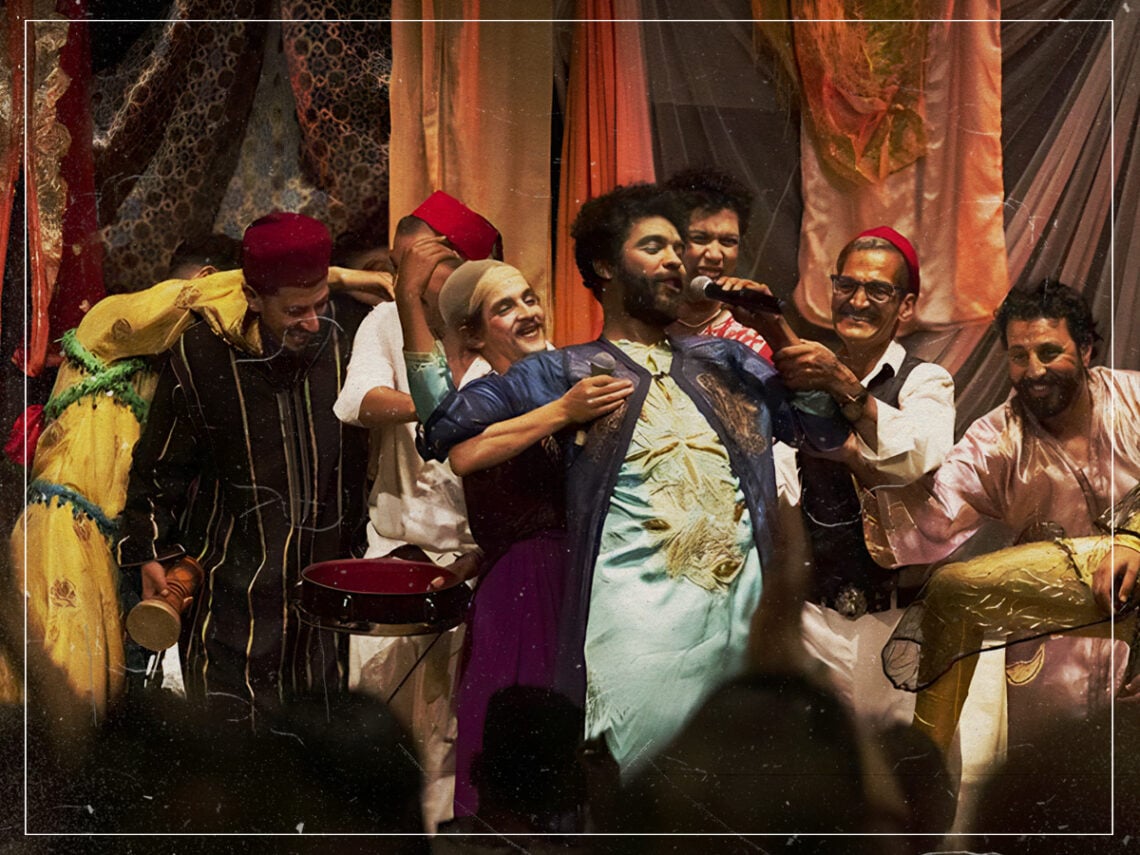
Kabareh Cheikhats: bringing cabaret to Morocco

Among the patriarchal structures and social conservatism of Moroccan society lies a group of performers seeking to reimagine the country’s musical traditions using drag and cabaret. Kabareh Cheikhats combine colourful cabaret theatrics with traditional aita, a folk music tradition that originated in the countryside of Morocco.
Kabareh’s origins lie within the theatre. Its leader, Ghassan El Hakim, reportedly wanted to produce a play in 2014 in which a group of men who dream of becoming female entertainers, known as ‘cheikhats’, would perform folk tunes. Unfortunately, the play never materialised, but El Hakim managed to make the dream of the group come to life anyway.
Three years on from the beginning of the project, Karabeh Cheikhats took to the stage for the first time. Based in the port city of Casablanca, the all-male group is characterised by its incredible use of make-up, jewels, embroidery, and colour. Kabareh perform in drag but maintain their everyday beards and moustaches while paying tribute to the folk tradition of aita.
Significant challenges are faced by the LGBTQIA+ community in Morocco. Same-sex relationships in the country remain illegal. Police forces are said to disproportionately target the community, and the general public attitudes towards homosexuality are overwhelmingly negative. As such, going on stage dressed in drag and performing a traditional Moroccan sound has proven to be more than a little controversial.
The fearlessness of El Hakim and his group of performers, as they get up on stage bedecked in jewels and stunning make-up, is one of the most punk rock things imaginable – even if the music leans more towards Moroccan folk. According to El Hakim, the first time the group performed was a seriously nerve-wracking experience. He told PAM: “The night before, I was sleeping, and I said to myself, ‘You’re a little crazy to do this. You put ten people on stage, dressed as women and wearing make-up’, and I said to myself: ‘We are going to be stoned.’ There is a second voice that says to me: ‘What do you know? you are not doing anything wrong.’”
Kabareh has managed to avoid the bulk of criticism as a result of their homage to cheikhats. The story of the women who brought ‘aita’ from the countryside is incredibly important to the country of Morocco. It is a story that has survived for centuries, even under colonial oppression and the influence of invading forces. It is not even the first time the story has been portrayed by men dressed as women. Prominent Moroccan actor Bouchaib El Bidaoui, for instance, portrayed cheikhats back in the 1960s, facing very little backlash.
El Hakim and his Kabareh Cheikhats are set to continue to celebrate the Moroccan history of cheikhats, while also bringing in 21st-century realness for years to come. Their performances have proved fairly popular in Casablanca, the economic capital of the country, in addition to spreading across the globe through the Internet.
