


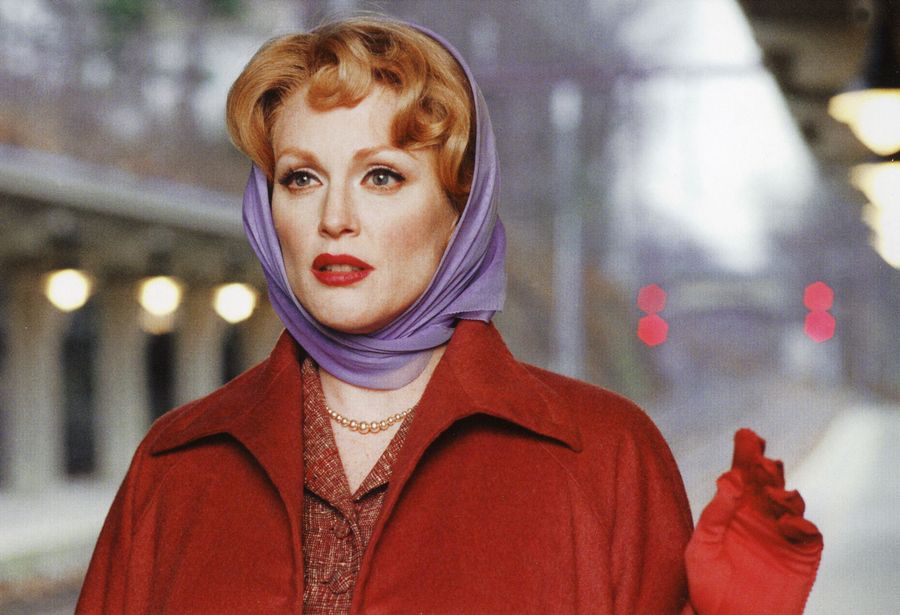
Six Definitive Films: The ultimate beginner’s guide to Julianne Moore

Among the greatest female actors in cinema history, Julianne Moore should be rubbing shoulders with the very best, tussling for a spot on the podium beside the likes of Tilda Swinton, Meryl Streep, Frances McDormand, Lesley Manville, Ingrid Bergman and Kathy Bates. Having starred in some of the most iconic movies of modern cinema, there’s no doubt that Moore has helped to shape the industry in the 21st century.
Whilst to many casual film fans, she may be known for playing the sinister President Alma Coin in the final two films of the Hunger Games franchise, as well as appearing alongside Jeff Goldblum and Vince Vaughn in the 1997 sequel, The Lost World: Jurassic Park, Moore has long been an essential player in American arthouse cinema. Working with the likes of Robert Altman, Todd Haynes, the Coen brothers and Paul Thomas Anderson, the actor has developed a truly impressive filmography.
A darling of the Academy Awards, having been nominated for an Oscar five times, for 1997s Boogie Nights, 1999s The End of the Affair, The Hours and Far From Heaven in 2002, Moore has only walked away with an Oscar on one occasion, winning for 2014s Still Alice. Though, award, or no award, there’s no taking away from Moore being one of the very best actors of contemporary cinema.
Take a look at our list of the actor’s six most definitive films below, tracking how Moore has risen from a promising young star to one of cinema’s very best.
Julianne Moore’s six definitive films
Short Cuts (Robert Altman, 1993)
Having enjoyed early success in a variety of TV shows, Julianne Moore entered the movie industry in John Harrison’s 1990 film Tales from the Darkside: The Movie before working alongside Harrison Ford in The Fugitive three years later. That same year, she was chosen specifically by filmmaker Robert Altman to appear in Short Cuts, a movie based on short stories by Raymond Carver.
Despite being surrounded by iconic actors such as Andie MacDowell, Tim Robbins, Jack Lemmon and Matthew Modine, Moore stood out from the crowd and received a good deal of critical acclaim. Known for Moore’s explosive monologue in which she reveals her feelings towards her cheating husband in a fit of rage, Altman’s film shows the actor in one of her most expressive and emotional roles.
The Lost World: Jurassic Park (Steven Spielberg, 1997)
The mid-1990s showed Moore flourish into the esteemed actor we know today, taking on a number of challenging roles, including in Louis Malle’s Vanya on 42nd Street in 1994 and Todd Haynes’ complex drama Safe in 1995. Both these performances would help to bolster the actor’s star persona in the eyes of the industry, with the influential filmmaker Steven Spielberg soon taking notice of her talent, casting her in The Lost World: Jurassic Park.
Starring in the sequel as Sarah Harding, a behavioural palaeontologist, Moore helps to elevate the somewhat weak film that nonetheless proved to be a key movie in her development as a Hollywood actor.
Boogie Nights (Paul Thomas Anderson, 1997)
Indeed, the late 1990s were a time of considerable growth for Moore, starring in Paul Thomas Anderson’s celebrated follow-up to 1996s Hard Eight, Boogie Nights. Collaborating with one of the greatest contemporary directors, even if she didn’t know it yet, Moore appeared as the star Amber Waves, a key character in Anderson’s period piece that takes place in the 1970s porn industry.
Exposing the secrets of being a pornstar and the kind of life led by them, Moore’s character came out of the ensemble classic as one of the most memorable additions, considerably helping her career as an actor as the 1990s were coming to a close.
The Big Lebowski (the Coen brothers, 1998)
Shortly following the release of both Jurassic Park 2 and Boogie Nights, Moore completed her glittering late-’90s trio with the Coen brothers’ iconic slacker film The Big Lebowski. Starring alongside Jeff Bridges, John Goodman, Steve Buscemi and Phillip Seymour Hoffman, Moore added another string to her bow with a marvellous comedy role, expanding her portfolio as one of Hollywood’s most exciting actors.
Playing the role of Maude Lebowski with a brilliantly silly deadpan approach, Moore steals every scene she appears in, becoming increasingly funny throughout the film as she interacts with Jeff Bridges’ clueless, ‘Dude’.
Far From Heaven (Todd Haynes, 2002)
Having set herself up for success at the end of the 20th century, Moore continued her extraordinary form following the turn of the new millennium, appearing in Ridley Scott’s crime drama Hannibal in 2001, followed by the cult favourite sci-fi Evolution in the same year. Twelve months later, she would impress once again in her second Todd Haynes film, Far From Heaven, co-starring Patricia Clarkson, Viola Davis and Dennis Quaid.
Nominated for four Academy Awards, including Best Leading Actress for Moore, the movie is considered to be a classic of the new century, as well as a significant release in the filmography of Haynes.
Still Alice (Richard Glatzer, Wash Westmoreland, 2014)
Moore’s career simply grew from strength to strength throughout the early 21st century as she took on more challenging collaborations with the likes of Alfonso Cuarón in 2006s Children of Men, Tom Ford in 2009s A Single Man, and Lisa Cholodenko in 2010s The Kids Are All Right, to name just a few. Never settling for easy paydays, Moore also impressed in the 2013 remake of Carrie, where she played the villainous Margaret White, as well as David Cronenberg’s dark social satire Maps to the Stars, where she played a fragile LA suburbanite.
Still, her greatest modern performance came in her Oscar-winning part in Richard Glatzer and Wash Westmoreland’s 2014 movie Still Alice. In this delicate and heartwarming film, Moore plays the titular Alice Howland, a linguistics professor at Columbia University, who is diagnosed with the early onset of Alzheimer’s disease. Moore’s performance is nothing short of extraordinary, perfectly embodying the body and psychology of someone going through the disease.
To this day, Moore continues to impress, being a shining light in otherwise mediocre flicks Maggie’s Plan, Wonderstruck and Gloria Bell. Indeed, no matter where she crops up, a performance from Julianne Moore is always worth your time and money, stopping you in your tracks as you sit still and admire a master at work.
