


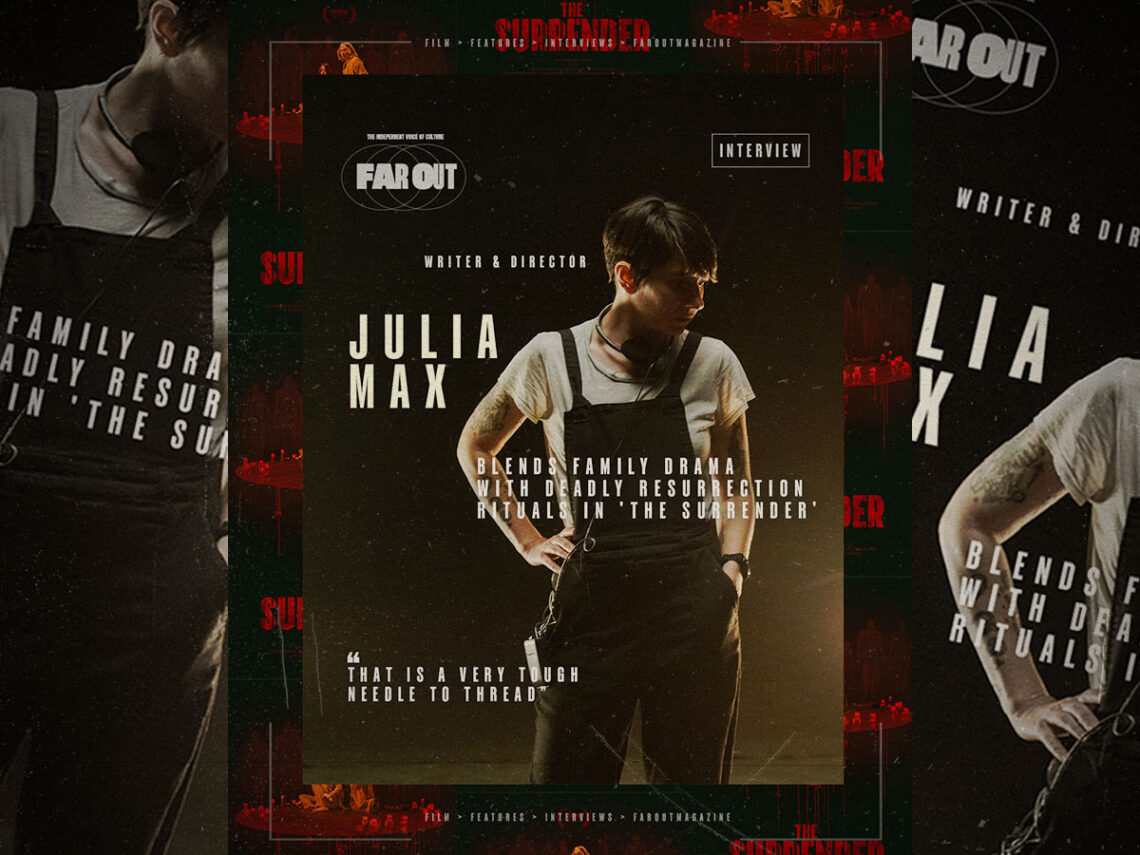
“That is a very tough needle to thread”: writer and director Julia Max blends family drama with deadly resurrection rituals in ‘The Surrender’

Making a movie can often be a lengthy and time-consuming process, especially for a first-time feature filmmaker. However, Julia Max’s The Surrender has come together fairly quickly, all things considered.
The atmospheric and intimate horror film, shot in the summer of 2024, premiered at the South by Southwest festival in March 2025 and will premiere on Shudder on May 25th. Then again, it sounds like it was a race to the finish line to have the film ready in time for its first screening.
“It is incredibly exciting but very surreal,” the writer, director, and producer admitted. “I mean, we finished making the movie about a week before SXSW, so this whole experience has just been such a whirlwind, and I’m just really excited for it to get out there and see what people think.”
Although The Surrender marks her feature debut, Max has several short films under her belt, but it was definitely worth asking what chain of events conspired to see her go from working behind the scenes on the animated and decidedly family-friendly Swan Princess series of animated films to writing, producing, and directing an intense and unnerving horror flick in the space of only a few years.
“Yes, well, I think that’s the difference between a day job and a passion project,” she laughed. “Swan Princess was a wonderful day job for me for many years, and really helped me learn a lot about film, the different aspects of it, but yes, writing and directing, that is definitely where I want to be, especially with horror.”

Rooted in family drama, The Surrender finds Kate Burton and Coby Minifie’s mother and daughter, Barbara and Megan, dealing with the death of Vaughn Armstrong’s patriarch, Robert, in very different ways. The latter wants the former to move on, only for Barbara’s reluctance to embrace her husband’s death to yield terrifying consequences.
Instead of dealing with her grief in the usual way, Barbara hands over a large sum of cash to a mysterious figure known only as ‘The Man’ to prepare a resurrection ritual that has the potential to bring Robert back from the dead. This being a horror movie, things don’t go according to plan.
The story was inspired by Max’s personal experience following her stepfather’s passing and what she and her mother went through during their grieving process. It gradually evolved into a hybrid of supernatural chiller and mother/daughter tale that ratchets up the tension with each passing scene.
“Ultimately, this was inspired by what my mother and I went through,” she acknowledged. “But as soon as you bring on the actors, and especially our incredibly talented actors, and get to rehearse with them, that’s when we really get to make those characters their own people, rather than shells of me and my mother.”
As much as The Surrender is a horror movie, it’s also an incredibly identifiable film. There’s at least one element of Megan and Barbara’s relationship and their way of processing grief that everyone will recognise, resonate with, or sympathise with in one way or another. Having that dynamic as a constant anchor made it much easier for Max to up the ante when the supernatural shit eventually hits the fan.
“I believe that it’s so important for you to have an emotional connection to films,” she explained. “Those are the ones that always hit me the hardest and stick with me long after the movie ends. So, having that emotional core and having a grounded reality in that emotional core was incredibly important, and I think it helped all of our actors navigate through the craziness that ensues in this movie.”
It was key for The Surrender to stand on its own merits as a family drama, regardless of its heavy occult influence and horror trappings. The two-hander between Minifie and Burton would always make or break the film, especially when the first half is almost entirely about the two characters, but Max was always supremely confident in her two leads.
“This film lives or dies by the performances of the mother and daughter,” she agreed. “We decided to try to find our Megan the daughter first, and as soon as Colby auditioned, we were all just so blown away by her performance. I’ve never seen anything like it. It was just like lightning in a bottle. You’re just like, ‘Oh, that. That’s her. That’s it.’ Once we knew who we had as Megan, we could start looking for the mother role. And I had a two-hour conversation with Kate Burton over Zoom, and by the end of it, I was just like, ‘That is our Barbara.’ And as soon as we got her in a room with Colby, you could just see that chemistry immediately.”
At the complete opposite end of the scale, Neil Sandilands plays ‘The Man’; any dialogue he says is either a whisper or imperceptible. Still, the character has plenty of screen presence, with Max’s instructions to the actor going far beyond the baseline of “be as intense as ominous as possible.”
“Oh, Neil is so fantastic. I love him so much,” the director said before revealing how they formed the character. “We had a whole secret storyline going on with him that we didn’t tell anyone about, and I don’t think anyone watching the film would get it, but we definitely had a whole kind of secret life for him that we didn’t share with Kate and Colby.”

Like many horror movies, Megan and Barbara are led into their predicament by a series of questionable decisions, whether they do something they were explicitly warned against or the fact the entire ritual happens on the advice of a yoga instructor called Deb, who had a word in Barbara’s ear about knowing a guy who could resurrect the dead.
The difference between The Surrender and other films of its ilk is that Max was always intent on ensuring the actions of the characters were justified by spending its opening act establishing and developing them, causing her to thread a delicate needle between ‘horror movie logic’ and staying true to the protagonists to bring the story in the direction she envisioned.
“I think that is a very tough needle to thread, but it’s so important,” she reasoned. “I don’t think the horror elements that unfold, and the last third of the film work, if you haven’t grounded it sufficiently in reality. There are a lot of wonderful horror movies where it’s just bonkers from start to finish, and you buy into that reality because it’s so out there. But with this, in order for the emotional core to land, we had to really make sure that it started off in a very grounded, believable reality, and that we didn’t ruin that suspension of disbelief.”
To keep The Surrender grounded, at least within the genre’s context and parameters, Max enlisted an ‘occult consultant’, Kevin Wetmore, which necessitated some highly specific conversations to ensure that everything that unfolds before, during, and after the ritual has some semblance of factuality and realism.
“Primarily, his main help was finding the actual chants used in the movie. I wanted them to feel authentic and real without being easily identifiable, and I wanted them to feel ancient without feeling specific to any one particular culture. And he’s a dear friend of mine, and I called him up when I was writing this, and I was like, ‘Hey, do you by any chance have any resurrection rituals lying around that you know about?’ And he’s like, ‘Oh yeah, what kind do you want?'”
Naturally, Wetmore had “a bunch ready to go,” although Max did admit she didn’t want to use them verbatim: “I did alter some of the word order slightly, just in case! You don’t want to actually summon something.” Fortunately, no evil entities or spirits were raised during the making of this film.
Another difference between The Surrender and other demonically inclined horror movies is that it isn’t fully explained how the ritual works. It doesn’t really need to be within the confines of the narrative, but Max was fully aware of the ins and outs, dos and don’ts, which she didn’t include onscreen to avoid getting bogged down in exposition or over-explanation.
“I think there’s a tendency in film to want to over-explain and spoon-feed the audience, but I don’t think it’s necessary,” she offered. “And I think if you trust your audience to be smart enough and go with you, they’ll get it without you explaining every tiny detail. And it’s usually when you get bogged down in those details that more problems arise. And suddenly people are thinking about the minutia of something, as opposed to the emotional, macro scene that’s happening, you know what I mean?”
As a lifelong horror aficionado, Max was inspired by some of the classics. The Surrender has a slow-burning, almost chamber-piece feel of classic 1960s and 1970s horror, but there are certain scenes and moments that evoke titles like Rosemary’s Baby, Pet Sematary, Park Chan-Wook’s Stoker, and even giallo, something she was thrilled was noticeable to this viewer, at least.
“Absolutely! Oh my gosh, I love that you spotted those. That’s great,” she exclaimed. “I’d say some other big ones that, more than anything, gave me confidence not to try to rush through it was A Dark Song. I love that movie so much, and that’s a real slow burn, and I thought it worked so well. And so it was like, ‘No, you can let things land and give it a minute.’ Relic was also very inspiring to me, just because that is another mother, daughter, grandmother, intergenerational story that worked tremendously well.”

There were other “surprising inspirations” for the filmmaker that weren’t even horror films: “Like Jeanne Dielman and Black Swan and Blue Valentine, which really influenced the camerawork. In terms of the actors, Who’s Afraid of Virginia Woolf was a huge touchstone for us, which I think might have been particularly strange for Kate Burton, since her father and stepmom [Richard Burton and Elizabeth Taylor] played the roles in the film.”
The first shot of The Surrender is eye-catching, featuring a gruesome creature feasting on… something. It was a deliberate tease of what’s to come, with Max relaying that it was included to let the viewer know that despite the first act revolving solely around Megan and Barbara’s fracturing bond, their patience will be rewarded for investing in the characters before the scary stuff comes along.
“It’s one of those very tricky balancing acts with horror, because you need to let people know that they’re in a horror movie early on. I feel like horror audiences are willing to be very patient, as long as they know it will get scary, I promise. We tried several versions of the script where we tried to bring in more horror elements earlier, and it just didn’t fit. It felt very shoehorned in. And so this felt like the most elegant way of making that promise to the audience, that things are going to get crazy. Just be patient, and we’ll get there.”
Jumping ahead to the ending, and avoiding spoilers, the film finishes on an open-ended note. The final shot could be interpreted in several different ways depending on the individual experience of watching The Surrender, which required another delicate balancing act from Max.
“It’s difficult to strike that balance between leaving something open-ended so that people are able to take away their own interpretations of it, while also giving an ending that’s still satisfying and feels like an ending,” she offered. “Because sometimes, if it’s too open-ended, it leaves the audience just going, like, ‘Wait, what? What am I supposed to do with that?’ So I’m hoping that I struck that chord for people.”
The writer and director believes she settled on “a clear ending without specifying exactly what happens next.” As much as she’s enjoyed “hearing different people’s interpretations of what happens,” the wildest response to The Surrender‘s last scene came from her mother, of all people. It’s ever-so-slightly spoilery, but less so than other perspectives, seeing as Max hardly agrees.
“She had this wild theory about Megan,” the filmmaker recalled. “She was like, ‘Oh man, I really love how Megan just becomes like a ghost.’ And I was like, ‘What?’ She was like, ‘Yeah.’ And I was like, ‘Oh. I guess that’s a way to interpret that. That’s not how I would have seen it, but OK.’ So that was an interesting one.”
As for everyone else, Max would prefer it if they fell into two camps: “Either optimist or pessimist, on how they see that ending. It’s fun to see where people’s heads go, but my mom was the only one that I was like, ‘I have no idea where you got that one, but I love it, and kudos to you.’ That’s the joy of art and filmmaking, isn’t it?”
All of Max’s short films were rooted in genre to various extents, whether horror, sci-fi or fantasy, and The Surrender continues in that vein. She plans to continue mining it because, from her viewpoint, more conventional or straightforward dramas don’t offer as much leeway to tell the stories she wants to tell.
“I love genre films because they allow you to deal with heavier subject matters that if you were to do in a straight drama might feel too heavy handed, and so, as you were saying, with The Surrender, the beginning is very much a drama, but I think having it become a horror film allows you to tap into some of those emotions in a way that most audiences might not want to actually sit through if it was a straight drama. So I do think that horror, in particular, is a wonderful lens through which to craft those stories.”
With her first feature in the can, Max already has several irons in the fire for her follow-up. While she can’t give too much away, a script she’s currently working on called Dead Rabbits would be “the one that I would want to make next,” and it would keep her on a spine-chilling trajectory.
“It’s another slow-burn horror film,” she hinted. “A lot of the other projects I’m working on are a bit more commercial, but this one is just wonderfully weird, and I love it so much, and I just hope and dream that I can make it someday. It is very much my interpretation of Rosemary’s Baby, but in a very different way. That would probably be the one that is at the top of my list, most excited to make right now.”
