


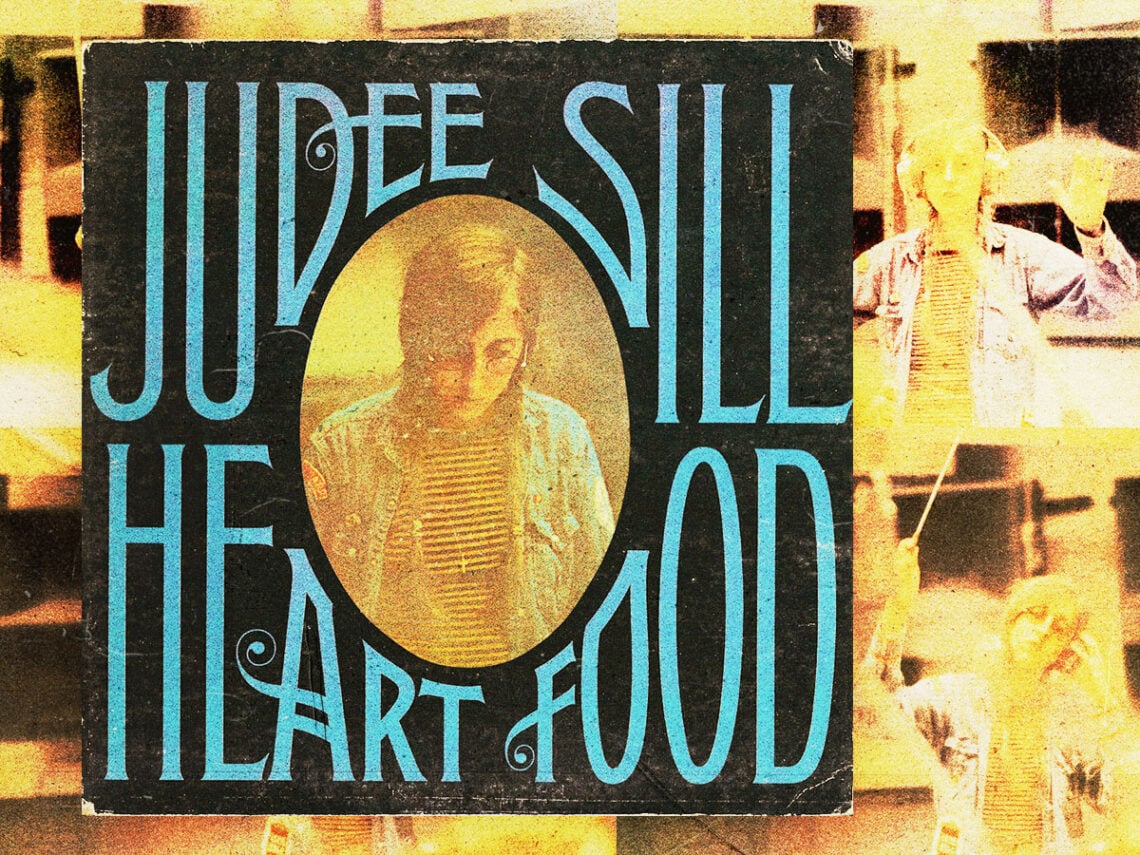
Judee Sill – ‘Heart Food’

The late 1960s and early ’70s Californian folk scene gave rise to some incredible talents, such as Crosby, Stills, Nash and Young, and Joni Mitchell. However, under the beating sun, among the mountainous stretches, certain voices got lost. One of these was Judee Sill, who enjoyed a brief period of slight success before passing away in 1979 from a heroin overdose – her music fading into relative obscurity.
Yet Heart Food, Sill’s second and final record, released in 1973, is an essential encapsulation of the period, reflected in the singer’s passionate declarations of religion, faith and love alongside a lucid conjuring of an ideal America.
The album opener ‘There’s a Rugged Road’ instantly encapsulates this feeling, with a country twang welcoming Sill’s potent lyrics: “There’s a rugged road on the prairie/ Stretchin’ all across the last frontier/ There a stranger strives solitary/ Blessed is the lonesome pioneer”. Sill’s protagonist heads towards his destination, loaded with determination, ignoring the “people far below chasin’ pleasures”. The singer’s tale of individualism and faith wouldn’t sound out of place emanating from a cowboy saloon.
Sill provides us with one of the record’s most breathtaking moments early on with ‘The Kiss’, which channels religious imagery, a common theme that runs through her work. Describing the song during an appearance on The Old Grey Whistle Test as “about the union of the opposites that we all have, and the kiss the symbol of the union,” Sill contrasts heartbreaking and hopeful words: “Stars bursting in the sky/ Hear the sad nova’s dying cry/ Shimmering memory, come and hold me/ While you show me how to fly”. The gentle melodies and tender strings are simply mesmerising, and whether you’re religious or not, it’s hard not to find beauty in the track.
Heart Food takes a more upbeat turn on ‘The Pearl’, which is one of the album’s most optimistic and joyous moments. Sill layers her voice, evoking a sense of community, as she realises that the mysterious “pearl” she has been searching for has “been there all the time”. Sill frequently returns to natural imagery, which sits in perfect harmony with her religious persuasions. On ‘Down Where the Valleys Are Low’, the singer further layers her vocals, this time to create a gospel effect, taking inspiration from rhythm and blues groups.
Side One ends with the country-influenced ‘The Vigilante’, which feels like a sequel to ‘There’s a Rugged Road’. This also feels like one of the album’s most Christian moments, with Sill describing a man with a strong sense of faith, “Though I have seen him climbing mountains with so heavy a load/ He always lends a helping hand and he walks on the good road”. Similarly, ‘Solider of the Heart’, which utilises fuller, pop-oriented instrumentation, sees Sill praise a strong, devoted figure, who she wishes to be with, and be more like.
On every song featured on this album, Sill’s distinctive voice stands out – it’s the kind that you rarely hear these days, totally carefree yet warm and unmistakably American. Again, whether you’re religious or not, Sill’s songs provide listeners with universal messages of faith and resilience, anchoring down her messages with swirling imagery of the natural world, bringing her sentiments to life with vivacity.
On ‘When the Bridegroom Comes’, penned by Sill’s then-boyfriend David Omer Bearden, Sill performs with just a piano, delivering a song that feels like it should’ve been an American classic. However, perhaps the record’s most impressive moment – so good that its obscurity is basically criminal – is ‘The Donor’.
The eight-minute track features rapturous layered vocals, wrapping the listener up in an ecclesiastical frenzy as she repeats “Kyrie eleison, Kyrie eleison”, which translates to “Lord, have mercy”. The sheer beauty of Sill’s performance makes this an album highlight, interestingly ending the record with a depiction of God that isn’t so glorious. During a live performance at the BBC, she explained that she hoped the song “would somehow musically induce God into giving us all a break, cause I was getting a little fed up by this point”.
Heart Food is a sublime folk gem which reveals layers of unearthed and underappreciated genius. From the phenomenal ‘The Kiss’ to the hauntingly perfect ‘The Donor’, Sill’s record reflects a complex and masterful artist whose time was truly cut short too soon.
