


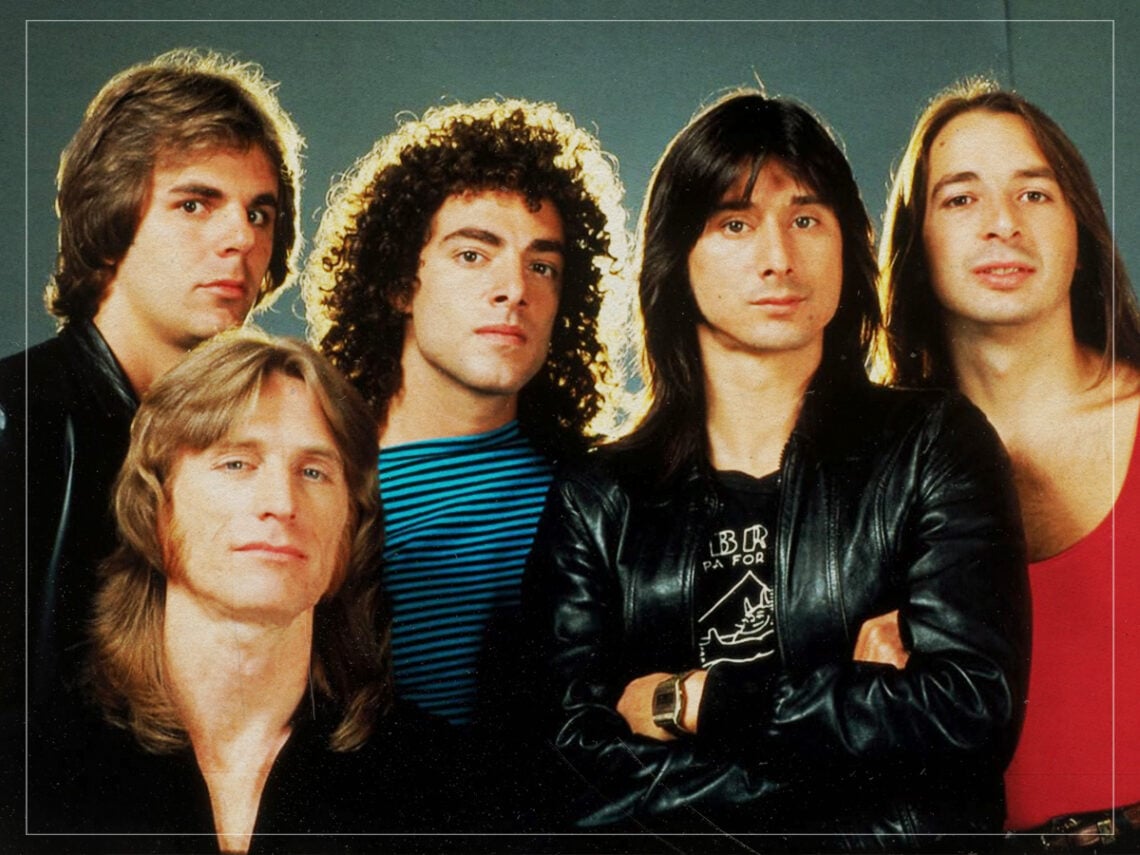
‘When You Love A Woman’: the Journey hit that took 15 years to find meaning

Because of the ubiquity of ‘Don’t Stop Believin’’, having been used in countless TV shows from The Sopranos to Glee, you’d be forgiven for thinking that Journey were a staple in the Billboard charts.
However, despite its immense popularity, having gone platinum 18 times in the US, it only managed to reach a peak position of number nine upon its original release in 1981, with the singles either side of it, ‘Who’s Crying Now’ and ‘Open Arms’ being the more successful singles to be taken from Escape. It’s one of those tales of a band who you’d assume were lapped up by every household across a nation, but who, during their initial run as a band, endured far less success than one may have expected.
This, of course, didn’t make their pursuit of success run as smoothly as one may have hoped, and their inability to ever top the main chart in the US is reflective of how tough they found being in a band that probably ought to have had much more acclaim. This lack of a number one hit eventually forced the band to go on hiatus between 1987 and 1995, but when they returned with their tenth album, Trial By Fire, those who had been fans of the group before were encouraged by this dramatic return, thinking that it would mark the start of a new chapter and bring them the attention they’d always deserved.
Frontman Steve Perry had been the driving force behind their initial separation, citing mental and physical exhaustion as his reason for wanting to step away from the music industry, so for him to have had a change of heart after an eight-year break surely meant that he had gone through a rejuvenation of sorts and was ready to go full throttle once again. Unfortunately for him, this return to the spotlight didn’t exactly go as planned, and Trial By Fire would be the only album he contributed to after their reformation.
It wasn’t as though they’d misjudged their decision, seeing as they managed to reach number one on the Billboard Adult Contemporary chart with ‘When You Love A Woman’ and climbed to number 12 in the main chart rundown, but something wasn’t quite right as far as Perry was concerned. Not only had he been diagnosed with a degenerative hip condition that required surgery, which he was reluctant to have, but his love for music hadn’t returned in the way he’d hoped.

On the surface of things, ‘When You Love A Woman’ appears to be your standard ballad about having gone through multiple heartbreaks, eventually resorting to convincing yourself that the right person is out there for you. However, if you dig a little deeper into the lyrics, is it secretly a case of Perry coming to a realisation that he’s once again had his heart broken by the music industry, realising that he isn’t where he ought to be, or is it just a song coming from a place of utter confusion?
Journey’s first split wasn’t the first time Perry had questioned his faith in pursuing music, with his first band, Alien Project, having disbanded when their bassist was killed in a traffic accident. Around this time, Perry was ready to call it quits when he received a phone call from Journey’s management asking if he’d be interested in joining, which he had to be encouraged to respond to by his mother. Journey evidently gave him a new lease of life for a period of time, only for him to have his dreams shattered again when he came to the realisation he needed to walk away in 1987.
This brings us to the opening lines of ‘When You Love A Woman’, which begins with “In my life I see where I’ve been / I said that I’d never fall again / Within myself I was wrong / My searching ain’t over, over.” While the context of the rest of the song makes it appear as though he’s grieving for the end of a relationship, it could quite easily be him coming to the realisation that he’s returned to a situation that isn’t right, and this is his way of secretly admitting that he made a mistake.
Perry would eventually have his arm twisted and would be forced to step away from the band in 1998 after having made them cancel multiple gigs due to his health concerns. He wouldn’t make a return to releasing his own music in 2018, only contributing to collaborations in the interim. The reason for his sudden return was, quite simply, finding actual love.
Throughout his career, Perry had been in a number of relationships, but none of them serious enough to turn into a marriage. Evidently looking for something serious, his unlucky pursuit of love appeared to mirror his pursuit of musical satisfaction, and it wasn’t until he met psychologist and breast cancer survivor Kellie Nash in 2011 that he discovered what it meant to truly be in love. Nash’s cancer had already returned by the time they met, and would take her life a year later, but in that short space of time, Perry had learned so much about the joy of true love and how it interacted with his art.
In a 2018 interview with The Guardian, Perry divulged that he knew full well that their relationship wouldn’t be forever, and that the loss was crushing to him. “I grieved for two years,” he revealed. “It was a whole new level of broken heart. It was completely fucking broken. I worked through that and, the next thing I knew, I started writing music.”
If anything, what ‘When You Love A Woman’ represents is a man who was completely and utterly lost; unable to find love in his personal life and in his chosen career. It’s evident that Perry was uncomfortable, yet unable to express the discomfort for what it really was, and only after realising what it was that was missing from his life a decade and a half later would it all make sense to him.

Never Miss A Tale
The Far Out Classic Rock Newsletter
All the latest Classic Rock content from the independent voice of culture.
Straight to your inbox.