


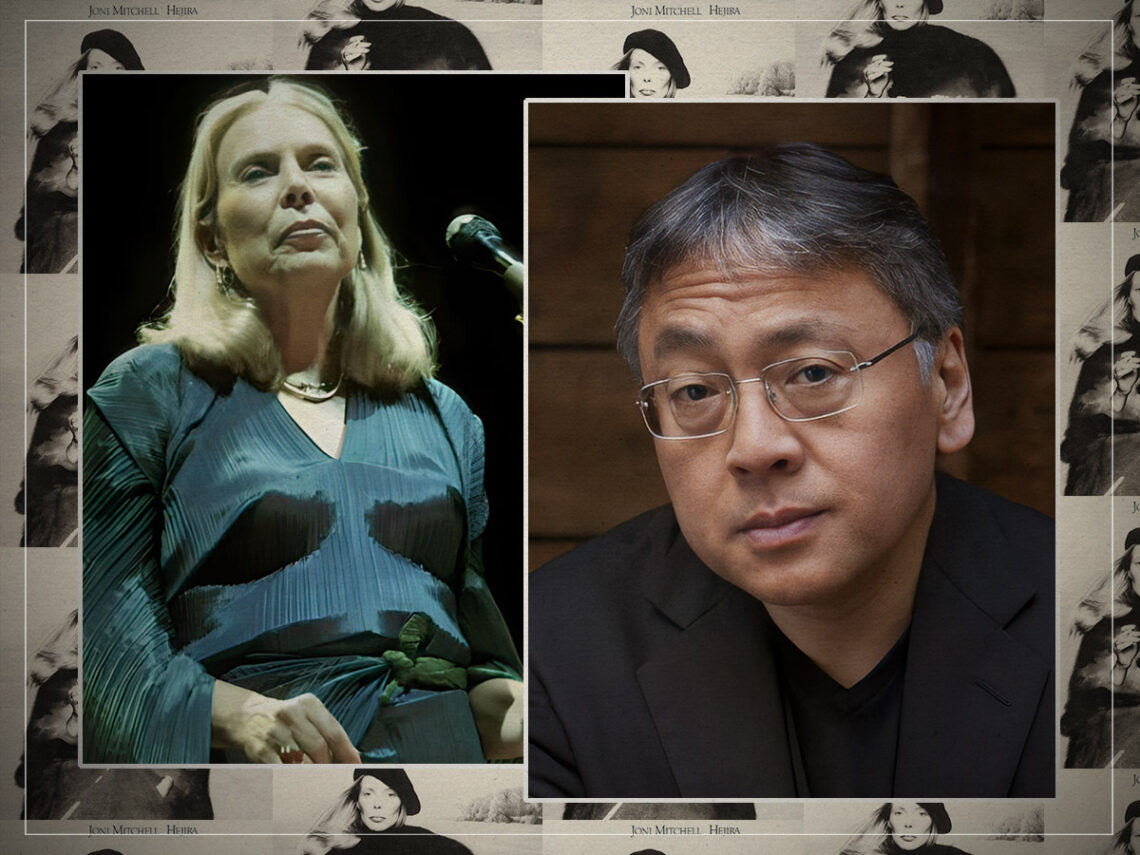
‘Hejira’: Joni Mitchell’s greatest album, according to Kazuo Ishiguro

Authors and artists have so much in common. Music palpates through the bones of everyday life, and you simply cannot create authentic and well-rounded characters in novels and prose amid a soundtrack of silence. That’s where Kazuo Ishiguro found his greatest point of convergence with the work of Joni Mitchell.
On the face of it, a contemporary fiction writer and a folk singer don’t seem like they would have a lot to relate to each other, but music has played a pivotal role in not only shaping Ishiguro’s work but also adding to his canon. Ishiguro himself is a seasoned jazz lyricist, previously describing this work as an “enormous influence” on his fiction, as “with an intimate, confiding, first-person song, the meaning must not be self-sufficient on the page. It has to be oblique, sometimes you have to read between the lines.”
If there’s anyone who might resonate with that sentiment, it would be Mitchell, whose songs are known for their effervescent imagery just as much as their searing heart. In this sense, it’s no wonder that the songstress, as well as his own experiences of penning lyrics, has affected Ishiguro – they’re ultimately cut from the same artistic cloth – but as with any great cultural connection, his relationship with her back catalogue is worth delving into.
Ishiguro reflected on his memories of the musician in a 2022 interview, where he said: “When I first started to listen to Joni Mitchell in the 1970s, I was looking much more at her lyrics and I probably didn’t relate to them as much as I related to people like Leonard Cohen or Bob Dylan. I understand now that she’s a more abstract kind of artist, and that the music is possibly much more important in the mix.”
Yet being able to relate this to his own personal life and tastes was also clearly important for the author, as his jazz proclivities piqued his attention on Mitchell at a particular crossroads in her sonic journey, with a record that he still listens to “over and over again”. He mused: “For me, Hejira is her great album. I understand her much better at that juncture of music and lyrics. I’m not just looking at lyrics with music backing them. She is a great musician and great composer, and she really pushed the boundaries.”
Certainly, it would be the mark of a true wordsmith to recognise the genius of something when the rest of the world turns its back. Hejira, released in 1976, seemingly came as the downturn to Mitchell’s most prolific period. Her venture into a jazzier realm, away from the confines of folk, had the effect of alienating some – except Ishiguro. As he put it, “She was ahead of her time, as they say. It’s a cliché, but it was true in the case of those crossover albums between folk rock and jazz that she created.”
There has always been something compelling and endearing in Mitchell’s appeal – whether that’s in jazz, folk, or anything in between. What stands out most strikingly, though, is that every corner of the artistic scene has come to worship her majesty, ranging from rock stars to novelists. In many ways, Ishiguro is just joining the back of a very long queue in his appreciation, but between her effervescence and his own literary take on the world, he knows they share an intrinsic connection.
