


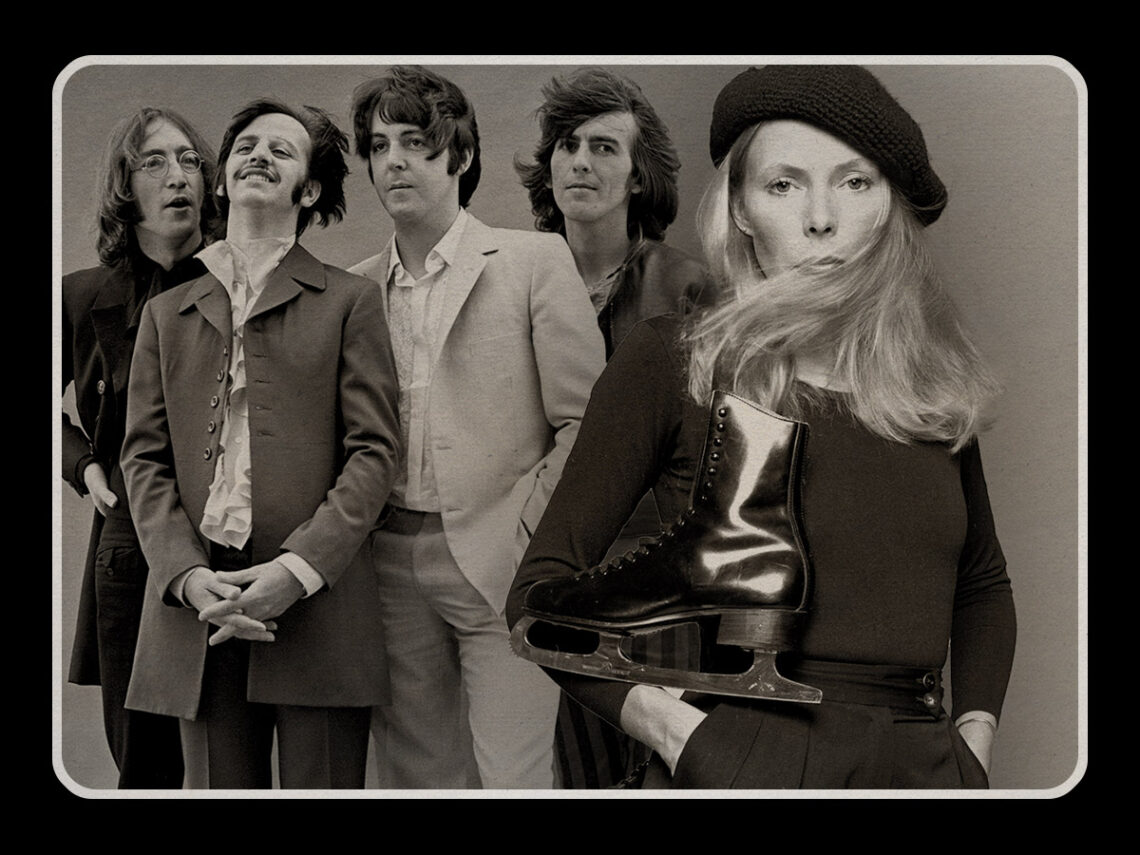
The Beatles album Joni Mitchell calls her favourite: ‘I played it over and over’

Canadian singer-songwriter Joni Mitchell has managed to achieve what others can only dream of: enduring relevance of the highest order.
Drawing from jazz, folk, classical and rock, she made her name writing, recording, and performing songs that tapped into the societal and philosophical issues of the counterculture movement. And yet, she managed to avoid fixing herself to that generation that came of age in the late 1960s. Even today, she continues to draw a legion of new, young fans with everyone from Taylor Swift to Harry Styles hailing her as a hero.
Rather than dating with time, her exploration of themes such as heartbreak and disillusionment has allowed her to take on universal appeal. Unlike many of her contemporaries, Mitchell dared to grab the Bob Dylan-era folk rulebook and write out her own story on its coffee-stained pages.
She took inspiration from everyone from Jaco Pistorius and Herbie Hancock to the folk musicians of her own nation, such as Gordon Lightfoot, and, in doing so, crafted something utterly unique – a subtle form of protest music that captured the imagination of music fans around the world.
At that time, another group was taking inspiration from the American folk tradition of the late 1950s and early ’60s: The Beatles. In an interview, Mitchell described how her favourite album by the pioneering four-piece developed as a result of their fascination with artists of that era: “Rubber Soul was the Beatles album I played over and over,” Mitchell began. “I think they were discovering Dylan, and the songs often had an acoustic feel.”

As Mitchell correctly pointed out, at this time in The Beatles’ career (1965), John Lennon was growing weary of the group’s status as a pop music phenomenon. The stadium tours, teeny-bopper hits, and relentless TV appearances were all starting to feel a little hollow, so he looked for inspiration in the coffee house culture of New York’s Greenwich Village, where artists like Bob Dylan had made their name.
Compared to the rampant commercialism that had defined Beatlemania, Dylan’s fanbase seemed a more intellectual bunch. The songwriter’s music carried a philosophical weight that attracted Lennon’s attention immediately. With his minimal approach to instrumentation, Dylan allowed the socially aware and politically radical undertone of his lyrics to take centre stage.
The Beatles quickly went about writing songs that might capture the same subtlety that Dylan had managed to achieve. Indeed, they were so successful that Dylan famously accused Lennon of plagiarism on the release of ‘Norwegian Wood’, with even the bespectacled Beatle explaining that he was “very paranoid” about becoming too similar to his hero.
But, for Joni Mitchell, the song was an important fixture of her early live set, and she knew it was pointing her happily in the direction of greater originality. “I used to sing [‘Norwegian Wood’] in my coffeehouse days in Detroit before I started writing for myself,” she said.

Adding: “The whole scenario has this whimsical, charmingly wry quality with a bit of a dark undertone. I’d sing it to put some levity in my set. I got a kick out of throwing it in there amongst all these tragic English folk ballads. Besides, I have Norwegian blood!” she concluded. Brevity is the right word.
With Rubber Soul, The Beatles managed to transform themselves from teen idols to exploratory pioneers, foreshadowing the increasingly experimental albums that would define the band’s output in the next few years. So, not only was it musically important to Mitchell, but this sense of redefining yourself as an artist never left her.
Each album in the Canadian’s career differs from the last. She even changes the medium, often leaving music for a moment to focus on visual art and so on. In truth, she would argue that her back catalogue, much like The Beatles’, simply reflects her changing as a person. As she put it, “My opinions do tend to change. You know, they change with more input. Ideas expand.”
Rubber Soul finds the Fab Four at the genesis of this notion. They were also becoming more complete and well-rounded. As George Martin would explain, “We were thinking about the albums as an entity of its own and Rubber Soul was the first one to emerge in this way.”
Rather than a collection of songs, it was a body of work with its own soul and personality. Mitchell not only recognised this but also mastered it herself on Blue.

Never Miss A Beat
The Far Out Beatles Newsletter
All the latest stories about The Beatles from the independent voice of culture.
Straight to your inbox.