


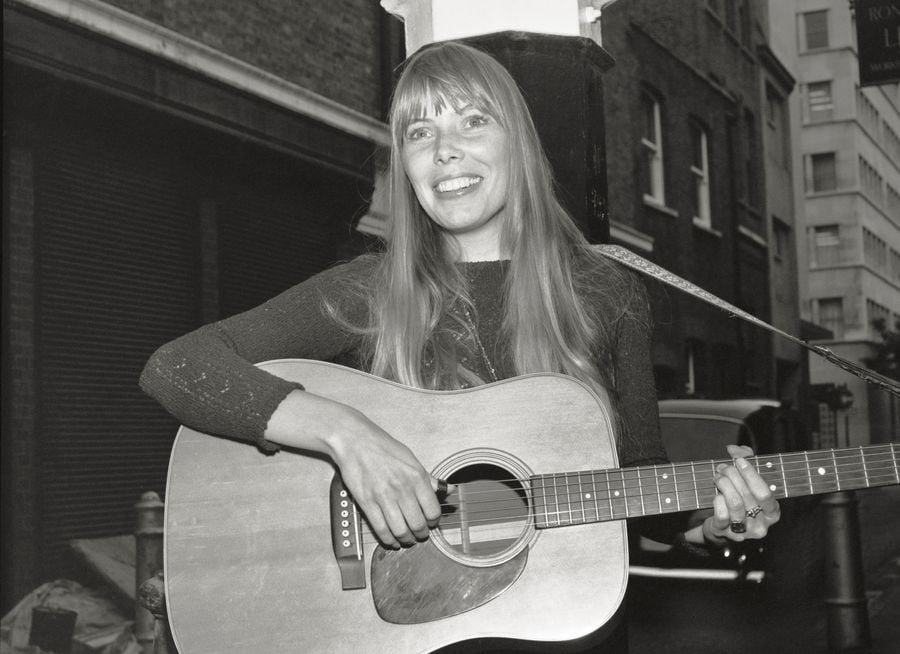
Joni Mitchell on the day the counterculture revolution died

Laurel Canyon in the late 1960s was where everything came together and everything fell apart: bands, relationships, the Earth’s crust, you name it—everything was coalescing, and that led to fractures. The fractures, in truth, were inevitable, considering everyone was playing music, taking drugs and having sex with each other in a creative, liberated frenzy. It was all very Californian, and for a time, this counterculture revolution reverberated around the world, signified by the beauteous music of Joni Mitchell and her cohorts.
It made perfect sense really, as Joni Mitchell once claimed to have read in a dogeared book: “Ask anyone in America where the craziest people live and they’ll tell you California. Ask anyone in California where the craziest people live and they’ll say Los Angeles. Ask anyone in Los Angeles where the craziest people live and they’ll tell you Hollywood. Ask anyone in Hollywood where the craziest people live and they’ll say Laurel Canyon. And ask anyone in Laurel Canyon where the craziest people live and they’ll say Lookout Mountain. So I bought a house on Lookout Mountain.” And frankly, if you ask anyone outside of the States where the craziest people live, they’ll tell you America—so we’re dealing with some of the craziest in the world here.
It takes a certain sort of crazy to kickstart a revolution, and the one in California was a liberated triumph. However, it rose up so quickly on such a shaky premise that it was always possible for Rome to burn. Joni Mitchell would capture this demise in her 1971 album Blue. Ostensibly it is a breakup album, but it was, in fact, more about moving on in general.
For Joni Mitchell, the album does not only capture the end of a relationship but the end of an era. “It’s a description of the times,” Mitchell proclaims in Michelle Mercer’s novel Will You Take Me As I Am. “There were so many sinking, but I had to keep thinking I could make it through the waves. You watched that high of the hippie thing descend into drug depression. Right after Woodstock, then we went through a decade of basic apathy where my generation sucked its thumb and then just decided to be greedy and pornographic.”
If the zeitgeist that spawned the album was the beginnings of an opiate-induced jaunt following the prelapsarian slide of the ‘60s, then Blue rings out as the defiant last word, like some glorious dirge in requiem to that loss of innocence. Those holding power to account had lost their way, the chaos underneath the love of Woodstock signified this. As she warned, “The worst are full of passion without mercy” and “What happened to this place?/Lawyers and loan sharks/Are laying America to waste”
The corporate creep and sudden lack of compassion were noted at Woodstock—the festival billed as its pinnacle. For instance, when Pete Townshend was asked about the cultural impact of Woodstock and what it changed, the guitarist was forthright in his response. He explained: “Well, it changed me, I hated it. I took my six-month-old child, and it was very weird. I didn’t like it all. They dumped us out of a limousine into six feet of mud, and we stood there for five hours waiting to go on.”
He continued: “I drank a cup of coffee, and five minutes later, I’m on an LSD trip, unwillingly. They put LSD in the coffee, LSD in the mud, if you fell over and accidentally drank some muddy water, you were on a trip.” His bandmate Roger Daltrey would damningly add: “Woodstock wasn’t peace and love. There was an awful lot of shouting and screaming going on. By the time it all ended, the worst sides of our nature had come out. People were screaming at the promoters, people were screaming to get paid. We had to get paid, or we couldn’t get back home.”
For Mitchell that was the end, but the upshot was that she would bring us one of the most beautiful albums of all time. When peace and love crumbled and cynicism or else comatose upheaval seemed to arise in its wake, Mitchell felt out of time and out of place. “I was being isolated, starting to feel like a bird in a gilded cage,” she told Rolling Stone. That same sense of entrapment of fame, increasing commercialism, and industry cajoling seemed to riddle her thinking when it came to relationships at the time. Blue was total emancipation from it and the sound will also be one of comfort.
