


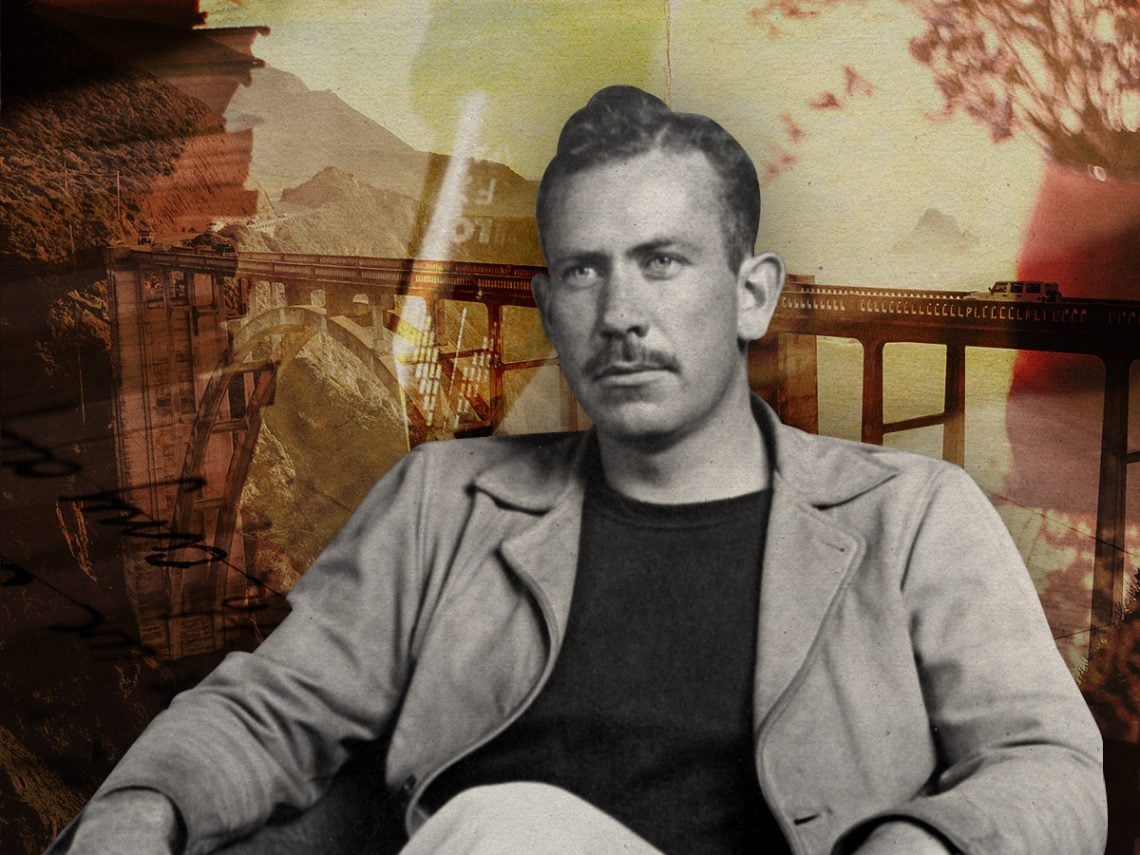
On the trail of John Steinbeck in Salinas and Monterey, California

“The Salinas Valley is in Northern California. It is a long narrow swale between two ranges of mountains, and the Salinas River winds and twists up the centre until it falls at last into Monterey Bay.” So begins John Steinbeck’s 1952 novel East of Eden.
Steinbeck was simply one of the greatest English language writers of all time. His works primarily concerned the working classes of the first half of the 20th Century and the moral minutiae of their everyday lives. In 1962, he was awarded the Nobel Prize in Literature, with the committee praising his “realistic and imaginative writings, combining as they do sympathetic humour and keen social perception.”
Late last year, I traced the Salinas Valley by the rather laborious public transport, and as the river did, so too did I wind up amongst the remains of the tin shacks of Cannery Row and Monterey Bay. I began the journey by travelling to Salinas from San Francisco by train.
My first port of all, seeing as the day was already getting on due to the long train journey, was to take lunch at the Steinbeck Family House – where the legendary writer was born in 1902. I sat down at the table and ordered a slice of sweet cherry pie and coffee. Pretty soon, the old ladies who worked there began to make a fuss of me, happy that I’d made the pilgrimage to visit my favourite author’s home. One of them (I forget her name) showed me around the house; Steinbeck’s bedroom, the room in which he was born, swathes of old photos and the family’s piano.
After lunch, I went downstairs into the gift shop, where an old Remington Noiseless typewriter lay alongside a sign that said “do not touch”, which only made me want to touch it more. I bought some pencils as a souvenir and talked with the cashier about my trip all the way over here. Shortly after, I then headed for the National Steinbeck Centre on Main Street. I’d been fortunate enough to work with the Centre previously as part of their Young Authors’ Writing Programme a few years back, and as result, I got a tidy discount on the way in. Before heading into the main exhibition, I watched a short documentary on the Salinas Valley and Steinbeck’s relation to it. However, I couldn’t help but feel somewhat disappointed by what was inside. I had been expecting artefacts, notebooks, pens, anything relating to the actual author, but all I found was information about his works and life, most of which I’d some semblance of knowledge of anyway. Which was, of course, insightful, but I could help but feel that the exhibition was more designed for children than for those making a long pilgrimage to one of the “giants of American letters”.
Still, the staff were very kind indeed and even gave me a free book from the gift shop. It was time to get out of Salinas and head to Monterey, the setting for another of Steinbeck’s novels, Cannery Row. Hanging about in the bus station, I noticed that Salinas had largely fallen into a state of decay, with several homeless people lining the streets, asking for change – like much of California, it seemed. This seems pertinent because of what I found in Monterey. Steinbeck writes in Cannery Row: “Cannery Row in Monterey in California is a poem, a stink, a grating noise, a quality of light, a tone, a habit, a nostalgia, a dream. Cannery Row is the gathered and scattered, tin and iron and rust and splintered wood, chipped pavement and weedy lots and junk heaps, sardine canneries of corrugated iron, honky tonks, restaurants and whore houses, and little crowded groceries, and laboratories and flophouses.”
He continues: “Its inhabitant are, as the man once said, ‘whores, pimps, gamblers and sons of bitches,’ by which he meant everybody. Had the man looked through another peephole, he might have said, ‘Saints and angels and martyrs and holy men’, and he would have meant the same thing.”
However, what I found were largely luxury restaurants and hotels. Monterey had evidently become a tourist destination, which makes an awful lot of sense because the scenes of the Pacific Ocean were simply breathtaking. I made my way down from my motel into town via bus and walked down the shoreline until I arrived at Cannery Row.
As expected, there were no canneries left, no lingering smell of sardines, just doughnut shops and restaurants and a few bars. That’s not to say that I could not feel the history of the place. Unlike many of the places I visited during my month in California, I could feel that Steinbeck had once walked the streets on which I stood.
I walked up and down the shoreline until the sun dipped below the horizon, at which point I grabbed a meal from a nearby pub and headed back to the motel. The following day I was heading back to San Francisco for a few more days before coming back to London. It was a pleasure to go and feel the ghost of John Steinbeck in Salinas and Monterey, to walk on the same earth as he had, but I couldn’t help but feel that the paradigms of the two places had shifted somewhat. The onetime affluence of Salinas had been replaced by dereliction, while the luxury demands of tourists had freshened up the “stink” of Monterey. Still, the trip was a luxury in its own right and will not be forgotten in a hurry.
