


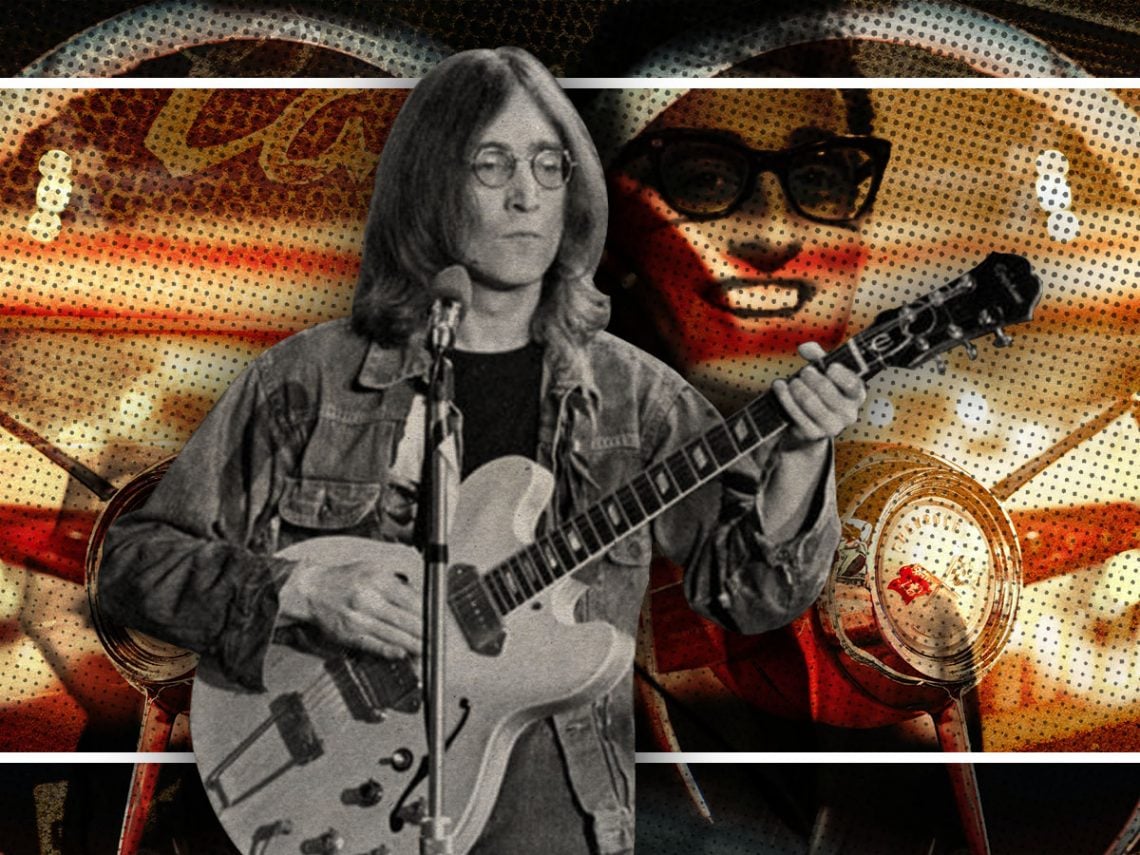
Watch John Lennon singing Buddy Holly’s ‘Maybe Baby’, 1972

Buddy Holly’s ‘That’ll Be the Day’ may well be the most important rock song in history. I make this bold assertion for one very important reason: it is the track that convinced John Lennon and Paul McCartney to write music. “Most of the stars then were kind of good-looking guys,” McCartney told Ronnie Wood. There was a certain vapidity to this that Buddy Holly disavowed and happily donned his jam jar glasses, giving the confidence to the near legally blind Lennon to do the same.
“The other reason we loved Buddy,” McCartney continues when eulogising his inspiration, “was that he wrote. He wrote his stuff. Elvis didn’t write his stuff—we loved Elvis, but he didn’t write his stuff. Buddy wrote, and played, and played the solos. He was a self-contained guy which is what we were trying to emulate.”
So, they set about literally doing that, to begin with. “The first thing that we could not work out was the beginning of ‘That’ll Be the Day’. I think George came along and got it,” he says. But in the act of not being able to figure it out for a while, Lennon and McCartney decided to try and fulfil their own dream of being self-contained stars. After all, if you can do it, then it’s easier coming up with your own tunes rather than trying to reverse-engineer the notes from existing ones.
Thus, Buddy Holly always held a fateful place in the lore of their lives, and Lennon never forgot the early creative impetus that the great Crickets rocker provided. “Buddy Holly was the first one that we were really aware of in England who could play and sing at the same time—not just strum, but actually play the licks,” Lennon once said. Adding: “He was a great and innovative musician. He was a ‘master’. His influence continues, I often wonder what his music would be like now, had he lived…”
Well, as Lennon sits with Yoko Ono in 1972 with an Apple Records camera present, you get a glimpse of how it would’ve been if Holly took a grungy route. The times were tempestuous for Lennon. There were active threats of him being deported from the US, and the recently released Some Time in New York City was received mildly.
With that in mind, Lennon seems to delve into the reverie of the past with a brief strumming tribute to his hero. The song still has the lingering visceral quality of his punky political tunes of the time, with distortion and Ono’s avant-garde vocal improvisation reinventing the melodic ditty as an angular piece.
The 1957 anthem is given a gritty edge, but the wholesomeness of the hero-worshipping and nostalgic sentiment still shines through. It’s like Lennon is happily lapsing back to simpler times and pretty tunes, but his jagged backbone is unmovable. The second element that shines through with aplomb is the simple truth of the brilliance of the track, as Lennon said, Holly is a master.

Never Miss A Beat
The Far Out Beatles Newsletter
All the latest stories about The Beatles from the independent voice of culture.
Straight to your inbox.