


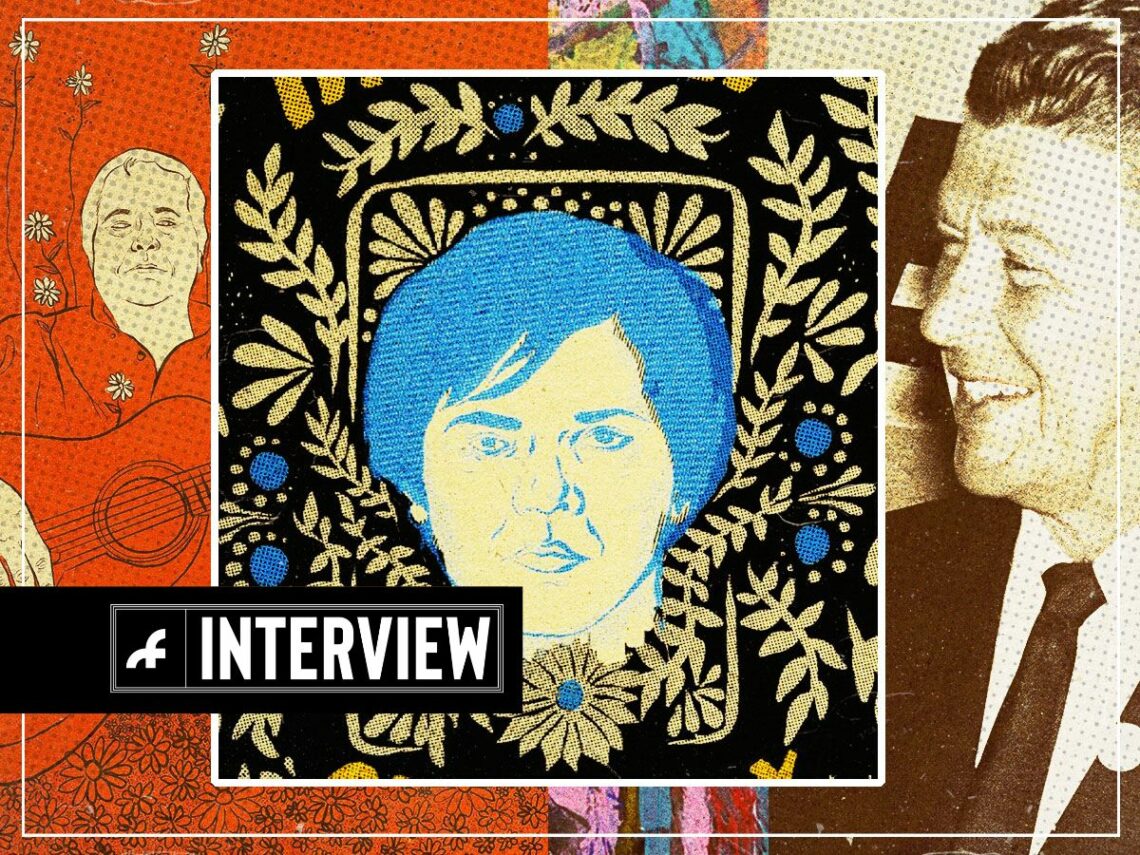
From Presidential assassination to YouTube sensation: John Hinckley on why “music is my salvation”

When it comes to John Hinckley Jr’s music career, there will always be an elephant in the room: he tried to assassinate President Ronald Reagan. He may well be a different man now, a rehabilitated and re-energised man, but if a past like that doesn’t linger over a new musical enterprise, then nothing will. Part of Hinckley’s own battle to be a premiere YouTube folk icon is reconciling this fact.
On March 30th, 1981, Hinckley fired six shots at Reagan as he left the Hilton Hotel in Washington DC. His aim: to impress Jodie Foster. Thankfully, his aim in a more literal sense was equally wayward. Although Reagan was badly injured by a ricocheted bullet that hit him in the chest, and several of his staff were also wounded, nobody was killed in the attack. Hinckley was later deemed not guilty by reason of insanity and was committed to a psychiatric unit for institutional care.
In 2016, when he was considered no longer a threat to the public or himself, he was released and finally able to pursue his dream of folking himself to kingdom come, offering the world the redemption of ditties. When he looks back, which he doesn’t like doing often, he sees a different person. He tells me: “I had a lot of depression and alienation going on back then. I was trying to make it in the music business, but my mental issues were preventing me from going about it the right way.” Not going about it in the right way cost him 35 years of his dream. But for the last seven, he’s been diligently chasing it down.
In part, this is because he feels like he owes music. “Even in my darkest hours,” he says, “I had my music to keep me going. It was when I gave up on the music that I crashed. Music is my salvation. I am trying to redeem myself through my music and art.” That began in earnest in December 2020, when he appeared on YouTube in his living room singing, “When every couple settles down, goodness will be found,” with his original number ‘Majesty of Love’.
His music harks back to the style of his earliest inspirations. “It was always the Beatles,” he tells me. “As a first-generation Beatles fan, it was so exciting to follow everything the Beatles were doing. Bob Dylan has also influenced me a lot. The Beatles and Dylan inspired me to write my own songs.” Under that steam, he’s rolled out a relatively prolific stream of songs from ‘You Let Whiskey Do Your Talking’ to ‘A Different Side of Me’ and ‘I Sing My Songs’ in the last few years. “I’m trying to stay in the folk music vein,” he explains.
There is a sense in his dulcet, camera-staring soliloquies that he is not only looking to create music that honours his heroes and offers him the deliverance of a creative outlet but also to actively re-invent himself. “I express myself best through my music. I want to show the world that I am a different person from the wreck in 1981. I thought I could re-introduce myself through YouTube, Spotify and Twitter,” he tells me in his typically concise fashion.
But aside from the tenets of his art that can be elucidated with his punchy soundbite responses, there are also peculiarities beyond the obvious in the mix too. For instance, observant viewers will have noted that when he stations himself in the living room of his humble abode, multiple clocks will be in view, and likewise over on Twitter, he seems to exhibit a compulsion to paint cats. Why?
Once more, even his response to these oddities is decidedly to the point. Regarding the clocks, he simply says: “I used to sell clocks at an antique mall. I have a lot of them.” And as for the cats, he points out: “I have a cat, and I took care of feral cats when I was at the hospital.” It is this enigmatic nature central to Hinckley that embellishes his music with an aura of puzzlement. There is a simultaneous naivety and complexity on display that confounds as he strums and sings his gentle serenades of peace, reminiscent of watching the fast-walking race in the Olympics, where the simplest thing is subverted by an alluring aberration.
This outsider singularity and sweet sincerity have enamoured Hinckley with a growing number of fans. However, his past has made his journey to a pop sensation a complex one. “I’m still looking for a proper gig. Music venues keep cancelling on me. I’ve sold out venues, but the venues seem to get backlash, and they cave,” he comments. “Once the concert is announced, they cancel. It’s happened about ten times. I have a following in the UK and Europe, so if I get an offer from outside the States, I’d accept it.”
Despite these setbacks, Hinckley remains determined to grace the world with his musical message of harmony. “I want to do some shows,” he says. And to those that would argue his concerts are rightfully cancelled, and the world has no place for Hinckley’s music, he simply says: “To my critics: listen to my songs!” In truth, all they would hear is a downright insistence to strive for both personal and global peace—a persistent hope at the heart of every single thing he has ever done as an artist, with the implacable exception of his paintings of the same bedraggled cat.
To those that want to listen, he says: “I have a vinyl album out called Redemption. I have a CD out called Never Ending Quest. All of my songs are on all of the music streaming sites.” Hinckley also informs to me that there is a documentary about him and his music due out later this year, but at present, he has no details at all to share.
Whether the dream of being YouTube’s redeemed mega-star, the harbinger of four-chord salvation, can indeed transcend the lingering levels of infamy that have called a halt to his gigs remains to be seen. However, it is clear that the dichotomy between how he is handled harmoniously online and the barriers of oppression he faces in the real world is an obverse paradigm of the internet age that makes him an eternally interesting folk. A YouTube sensation could prove a bridge too far, but he is certainly a fascinating cult figure with an uncanny story to tell, no matter how bluntly he does so.
