


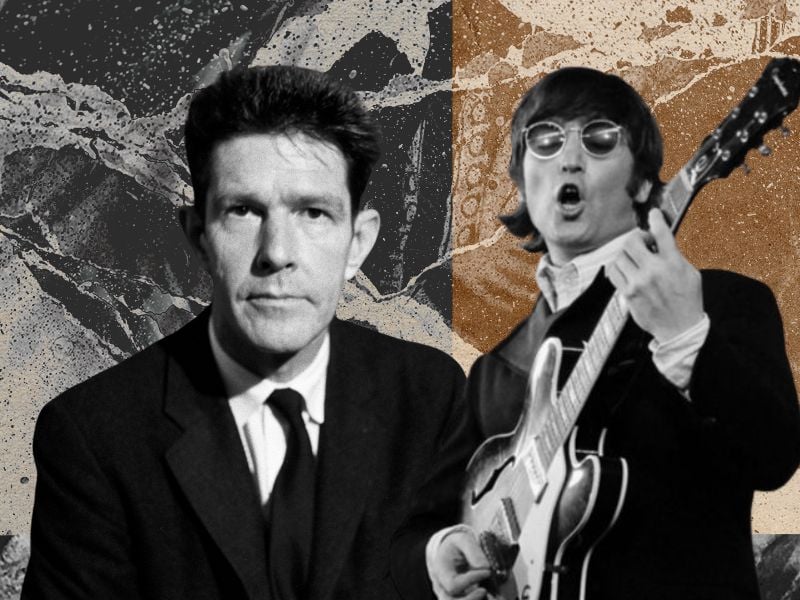
The business of revolution: John Cage and The Beatles

On August 29th, 1952 virtuoso pianist David Tudor walked into a packed concert hall in Woodstock, New York, sat down at a grand piano and – rather anti-climactically – did absolutely nothing. He opened the lid of the instrument; he shuffled his stool into position; he even prepared blank score sheets for recitation. But, for four minutes and 33 seconds, he didn’t play a single note.
This was the latest work by avant-garde composer John Cage: the era-defining ‘4,33’. The composition was, in a way, an attempt to broaden the parameters of Western music – the motivating principle behind much of Cage’s work. If household objects could be used to make music – something he’d already experimented with in 1940 – why couldn’t silence itself?
Many are surprised to learn that John Cage drew as much inspiration from The Beatles as they did from him, interacting with ‘the fab four’ as musicians and with their songs. In the mid-’60s, for example, Cage bent over backwards to get his hands on manuscripts of their music for his notations collection, a project that he had begun for the benefit of the Foundation for Contemporary Performance Arts, which he founded in 1963. He reached out to both McCartney and Lennon, but, in the end, it was Yoko Ono who handed over the music and lyrics to seven songs: ‘The Word’, ‘Eleanor Rigby’, ‘I’m Only Sleeping’, ‘Yellow Submarine’, ‘Good Day Sunshine’, ‘And Your Bird Can Sing’, and ‘For No One’.
Ono met Cage while still married to her first husband, Toshi Ichiyanagi, who often took her to the composer’s classes at the New School in the 1950s. Cage had been a student of Edgard Varèse and, notably, Arnold Schoenberg. In his 1973 book Silence: Lectures and Writings, Cage recalls that after studying with the German expressionist composer for two years, he was told that he would never write a great work without a feeling for harmony. “I explained to him that I had no feeling for harmony. He then said that I would always encounter an obstacle, that it would be as though I came to a wall through which I could not pass. I said, ‘In that case, I will devote my life to beating my head against that wall.'”
After graduating, Cage pioneered a non-conventional use of musical instruments, taking the odd-ball energy of Finn de Siecle composer Erik Satie to new heights through experiments with prepared piano, toy instruments, household objects, and, indeed, silence. As The Beatles would later discover, Cage’s transcendence of artistic norms was infectious. “What Cage gave me was a confidence that the direction I was going in was not crazy, Yoko Ono told Hans Ulrich Obrist in 2001. “It was accepted in the world called “the avant-garde.” What I was doing was an acceptable form. That was an eye-opener for me…”
When Cage approached Yoko to procure manuscripts from The Beatles, she was probably a little taken aback. The composer had previously shown little interest in popular music. However, by 1966, he’d noticed a pleasurable blurring of high and low art, and it seemed popular musicians were leading the charge. Paul McCartney had previously turned down Ono’s request, not wanting to part with the manuscripts, so he suggested that she ask Lennon, who, by good fortune, she met just a few weeks later at an exhibition at the Indica gallery. Paul and Yoko were acquainted prior to the gallery opening precisely because they moved in the same circles, with Paul becoming interested in Cage’s work as early as 1966. It’s thought that it was Paul’s interest in the composer’s methods that influenced the chaotic orchestrations of the Sgt. Pepper’s track ‘A Day In The Life’. Lennon would later embrace Cagian techniques in several tracks from the band’s final years, including the surrealist sound collage ‘Revolution 9’, which wouldn’t have been possible without Cage’s experiments with randomness in the 1950s and his subsequent exploration of musique concrète methods.
Sgt. Pepper’s was enough to convince Cage of The Beatles’ genius. The autumn after the album hit the shelves, the composer wrote a letter to Patricia Coffin, senior editor at Look magazine, who was then working on a piece about the ‘fab four’. “My impression,” he began, “is that the Beatles’ place is not so much in the world of serious music as it is in the world of revolution. I think that serious musicians would do well to follow their example in this respect. That is, I think our proper business now—whether we’re ‘popular’ or ‘serious’ if we love mankind and the world he inhabits—is revolution.”

Never Miss A Beat
The Far Out Beatles Newsletter
All the latest stories about The Beatles from the independent voice of culture.
Straight to your inbox.