


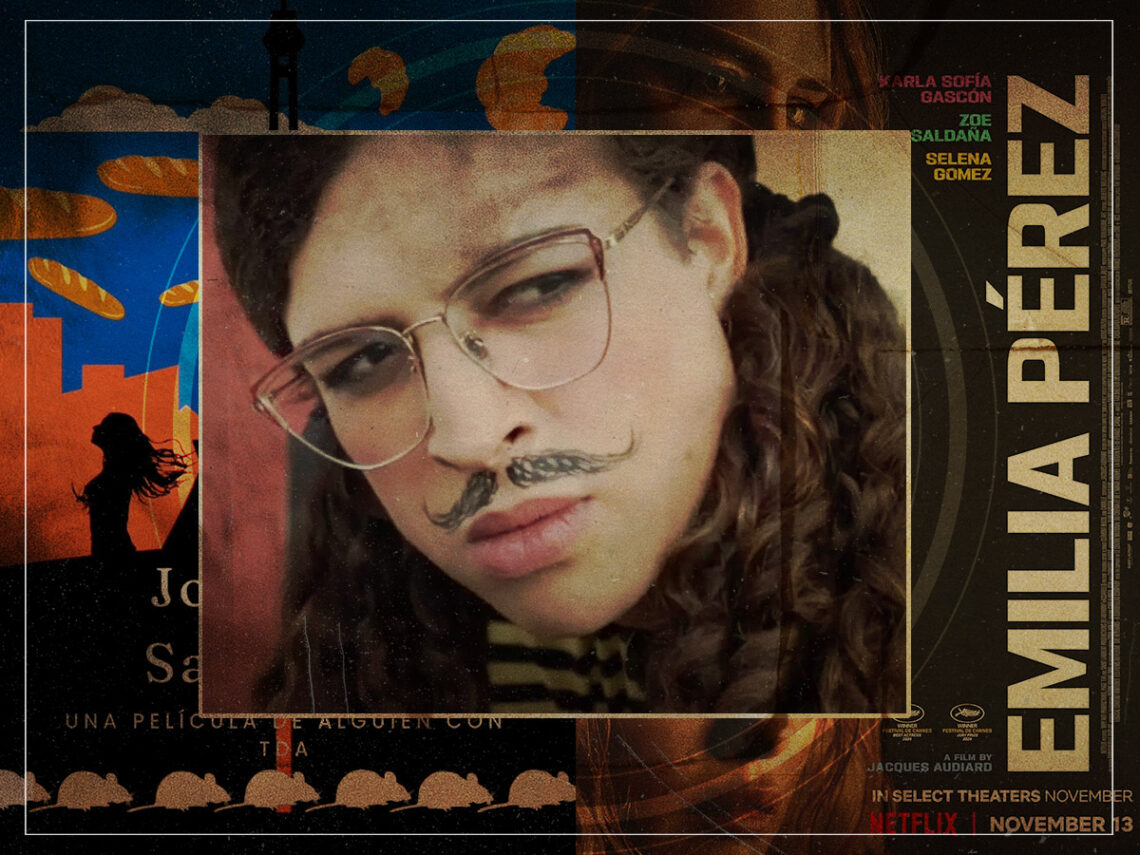
‘Johanne Sacrebleu’: the musical Mexico made as a not-so-friendly response to ‘Emilia Pérez’

Last week, Jacques Audiard’s Spanish-language musical Emilia Pérez was nominated for 13 Oscars, putting it second only to Joseph L Mankiewicz’s All About Eve and James Cameron’s Titanic for most-ever nominations. Set in Mexico, the film stars Karla Sofía Gascón as a cartel leader who hires a lawyer (Zoe Saldaña) to help her start a new life as a woman. Since it premiered at the Cannes Film Festival last year, it has earned rave reviews and already amassed a hoard of awards.
Not everyone loves the film, though. Some of the criticism has stemmed from the depiction of Gasón’s character. Even though the actor is trans, activists have criticised the movie for perpetuating negative stereotypes. However, the bulk of the controversy boils down to cultural authenticity and exploitation. Despite being a Spanish-language movie set in Mexico, Emilia Pérez was directed by a French filmmaker, filmed in Paris, and stars no Mexican actors in the three lead roles. It also centres around an all-too-familiar narrative about the country’s struggles with drug-related violence.
Speaking to the BBC, Mexican screenwriter Héctor Guillén criticised the film for turning the tragedy of his country into cinematic glamour. “There’s a drug war, nearly 500,000 deaths [since 2006] and 100,000 missing in the country,” he said, adding, “You are taking one of the most difficult topics in the country, but it’s not only any film, it’s an opera. It’s a musical.”
He went on to point out that when the film won four Golden Globes earlier this year, the real-life crisis that it depicts went unmentioned. “Part of the plot is about mothers [searching for their disappeared children]: one of the most vulnerable groups in Mexico,” he said. “And there were zero words in the four Golden Globe acceptance speeches to the victims.”
In the swirl of condemnation surrounding Emilia Pérez, one critic is choosing to fight fire with fire. Trans content creator Camila Aurora has directed a short film that is a not-so-subtle clap-back at Audiard’s rampant use of Mexican stereotypes. Called Johanne Sacrebleu, the 30-minute musical is set in France and follows a trans woman who is the heiress to the country’s most prominent baguette company, who falls in love with Agtugo Ratatouille, the heir to the biggest croissant company.
As this description suggests, the film is full of French stereotypes, from striped black and white shirts to accordion music. It is also full of specific jabs at Emilia Pérez, including a French voiceover spoken with an exaggeratedly bad accent, no doubt referencing the heavily criticised Mexican accents in Audiard’s movie. It was also filmed in Mexico with an entirely Mexican cast. Just three days after it was posted on YouTube, the project has already amassed over a million views.
Aurora’s work may be destined to go viral and outlive the cultural impact of Emilia Pérez, but even if it doesn’t, it is quite possible that Audiard’s film will lose big at the Oscars in March. The voting body of the Academy has grown increasingly diverse and international in recent years. In 2014, it was 94% white and 76% male, according to The Atlantic.
Now, approximately 61% are white, and 54% are male, with a much greater representation of directors outside the US, including many from Central and South America. Whether this helps channel the vote toward other nominees, such as the Brazilian drama I’m Still Here, remains to be seen, but that film’s star, Fernanda Torres, already bested Gascón for ‘Best Actress’ at the Golden Globes.
