


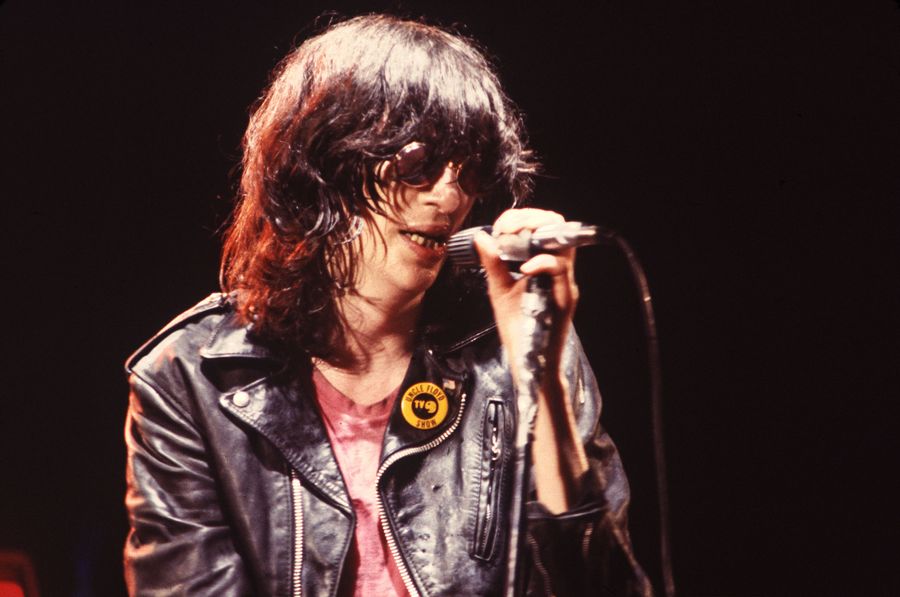
Listen back to Joey Ramone’s beautiful cover of ‘What A Wonderful World’

One of the things that made Joey Ramone’s music – both with and without The Ramones – so brilliant was that there was always a palpable sense that he was trying to reach back into childhood. Those two-minute punk anthems he used to crack out with The Ramones were void of pretence and self-glorification; the overall objective was to bounce around.
Where other punk groups became somewhat puritanical, Joey refused to be pigeonholed; transcending judgement and categorisation until his death in 2002. Of all the tracks that encapsulate Joey’s stunning capacity for joy, one of the most moving is his take on Louis Armstrong’s ‘What A Wonderful World’, the title track from Don’t Worry About Me – released posthumously in 2002.
Joey’s cover of the 1967 jazz classic shouldn’t be as heartwarming as it is. A straight-up punk reimagining filled with chugging guitars and swooping vocals, the single was imbued with heightened significance following its creator’s death. Recorded at the very end of his life, it sees Joey revisit a song he would have heard playing on the radio while he was growing up. Of course, the sentiment of Armstrong’s original song shines through too, lending the track an optimism rare in the world of punk.
Louis Armstrong was also nearing the end of his life when he recorded ‘What A Wonderful World’ in 1966, which is perhaps why the song carries such a poignant sense of near-divine revelation. With its lush orchestral backing, the track was the perfect swan song for a man who had started his recording career in 1923 at the height of the jazz age and came to embody the beating heart of American jazz throughout the 1940s, ’50s and ’60s.
Composed specifically for Armstrong by Bob Thiele and George Weiss, ‘What A Wonderful World’, was written amid political unrest in the US. For a long time, Armstrong had been viewed as someone with a knack for bringing people of all races together – although his penchant for “clowning” made (and continues to make) a lot of Black people very uncomfortable. The belief was that this uplifting ballad might help quash some of the turmoil; it didn’t, of course, and it only became a hit in the US after the singer’s death.
On release, the song immediately took on a diverse array of meanings. For Armstrong himself, the track seems to have reflected the importance of community. According to the Louis Armstrong House museum in New York, life in his neighbourhood was one of the main inspirations behind his tender vocal: “I saw three generations come up on that block,” he said. “They’re all with their children, grandchildren, they come back to see Uncle Satchmo and Aunt Lucille. That’s why I can say, ‘I hear babies cry, I watch them grow, they’ll learn much more then I’ll never know.’ And I can look at all them kids’s faces. And I got pictures of them when they was five, six and seven years old. So when they hand me this ‘Wonderful World,’ I didn’t look no further, that was it.”
