


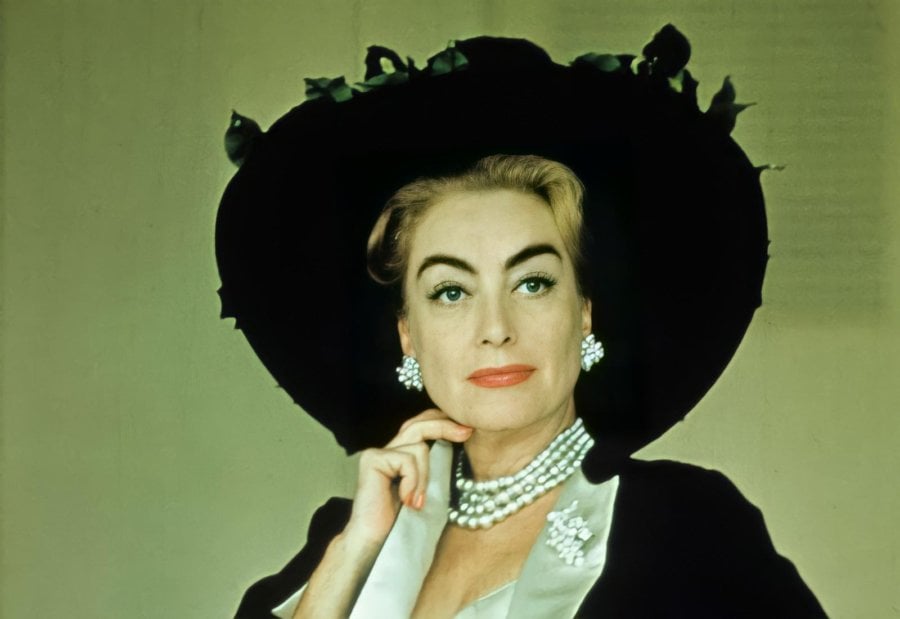
Six definitive films: A beginner’s guide to Joan Crawford

American actress Joan Crawford established herself as one of the best performing artists of her time and enjoyed a successful career that lasted more than six incredible decades. From costume dramas to film noir and the horror genre, Crawford’s filmography is impressively varied, consisting of nuanced performances and multiple accolades.
Born in San Antonio, Texas, Crawford trained as a dancer and started her career in the entertainment industry by working in travelling theatrical companies. She managed to secure a contract with Metro-Goldwyn-Mayer, which paved the way for her meteoric rise to the top. Screenwriter Frederica Sagor Maas once said: “No one decided to make Joan Crawford a star. Joan Crawford became a star because Joan Crawford decided to become a star.”
Crawford’s legacy is a complicated one — especially due to her daughter Christina Crawford’s allegations that the great actress had abused her children and neglected them because she was obsessed with fame. After suffering a heart attack in 1977, Crawford passed away, leaving her two eldest children out of her will: “It is my intention to make no provision herein for my son, Christopher, or my daughter, Christina, for reasons which are well known to them.”
On the 44th anniversary of her demise, we revisit the works of Joan Crawford as a tribute to her indelible impact on the history of cinematic tradition.
Joan Crawford’s 6 definitive films:
The Unknown (Tod Browning – 1927)
Tod Browning’s 1927 silent horror film is often referred to as the “most disturbing” work out of his eight collaborations with Lon Chaney at MGM. It stars Chaney as Alonzo the Armless, a carnival knife thrower who falls in love with the popular Nanon (played by Crawford).
“Although fascinated by the grotesque, the deformed and the perverse, Browning (a former magician) was a debunker of the occult and the supernatural,” wrote Vivian Sobchack. “Indeed, Browning is more interested in tricks and illusions than the supernatural.”
The Women (George Cukor – 1939)
A film adaptation of the eponymous 1936 play by Clare Boothe Luce, The Women, comprised an all-female cast and was set in the high society of Manhattan. It is a scathing critique of the vapid lives of bored housewives who resort to the scandalous to find some purpose in their meaningless existence.
Cukor said of Crawford: “Joan Crawford was a great movie personality. You can photograph her from any angle. From any side, anywhere, under any conditions…she always looks good. But her real talent is the way she moves. All she has to do is walk across a room, from one side to the other, and you notice that something very special is happening…..the way she carries herself, the way her arms move…..the position of the head.”
Mildred Pierce (Michael Curtiz – 1945)
Starring Joan Crawford and Zachary Scott, this 1945 film noir is based on James M. Cain’s novel and follows the struggles of a woman (played by Crawford) to be financially independent and raise her children on her own after her husband leaves her. For her brilliant exploration of female liberation, Crawford won the Academy Award for Best Actress.
“When I started the tests on Mildred Pierce, I heard my star was very difficult. So I say, okay Crawford, Curtiz will be more difficult,” the filmmaker revealed. The result was the development of a professional relationship between the two that was rooted in mutual respect.
Sudden Fear (David Miller – 1952)
Based on Edna Sherry’s novel, David Miller’s neglected 1952 thriller stars Crawford as a wealthy woman who finds out that her new husband wants to kill her to get his hands on her money. Crawford’s brilliant work was acknowledged as she earned an Oscar nomination for Best Actress.
“You want to bring the audience in so close to you. You want to put them in your lap, in the palm of your hand,” Crawford explained while talking about the effective manipulation of audiences to provide the greatest cinematic effects.
Johnny Guitar (Nicholas Ray – 1954)
Nicholas Ray’s 1954 western is a wonderful film adaptation of Roy Chanslor’s book. It tells the story of Vienna (Crawford), a determined saloonkeeper who the locals dislike. She puts up a resistance with the help of the mysterious Johnny Guitar (Sterling Hayden).
Ray recalled, “One night Joan Crawford got drunk and threw Mercedes McCambridge’s clothes on the highway. She was absolutely great at work, but sometimes anger won over her temperament. They were very different and Crawford hated McCambridge.”
Whatever Happened to Baby Jane? (Robert Aldrich – 1962)
This 1962 psychological horror film is a fascinating part of Crawford’s career. It featured her collaboration with her longtime rival – Bette Davis, which contributed massively to its success. The use of mentally volatile older women in Whatever Happened to Baby Jane? was so influential that it spawned a subgenre of its own called “psycho-biddy”.
In an interview, Aldrich elaborated on his philosophy of cinema while talking about a crucial scene from the film: “when somebody comes in and lays the dead bird down in front of her, I wanted to delay her reaction, so there’s time for the cut to Crawford and then back to her reaction. Film is a time arrester. In fact, both reactions would be happening at the same time.”
