


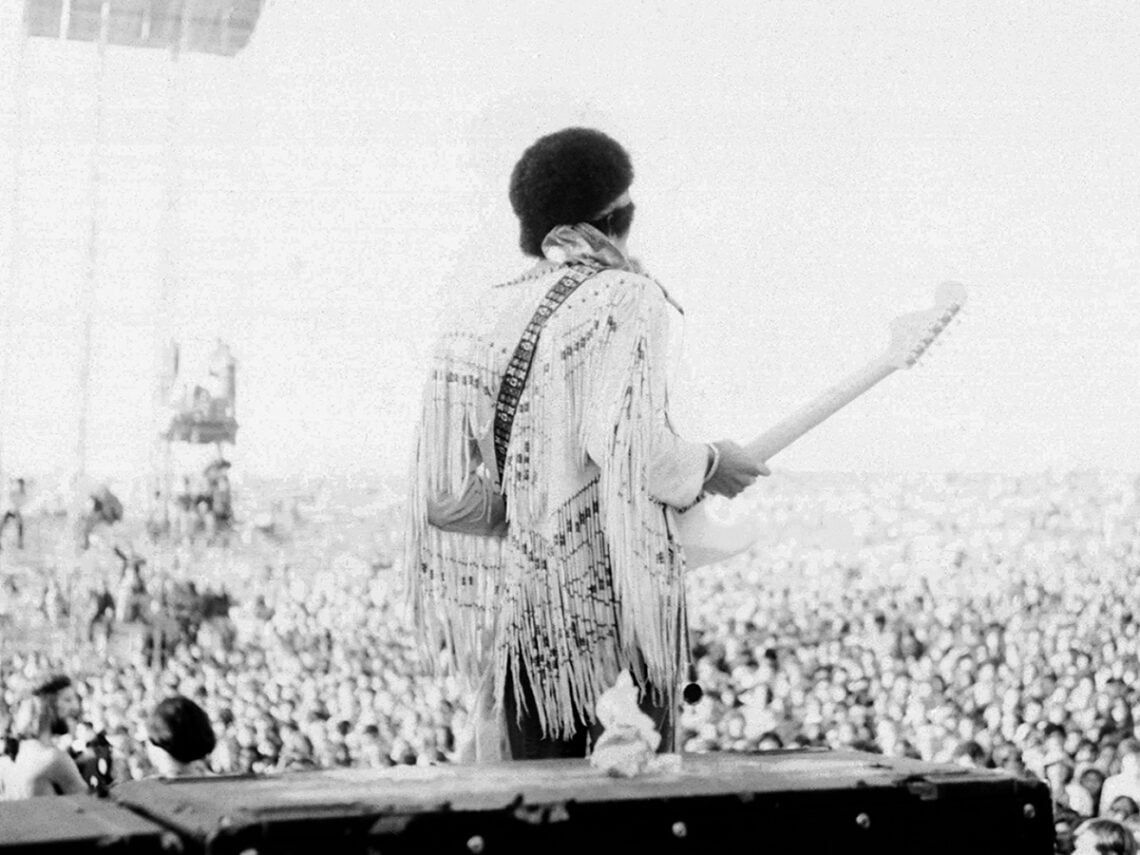
Why did Jimi Hendrix perform ‘Star Spangled Banner’ at Woodstock?

Billed as ‘three days of peace, love and music’, Woodstock was anything but. If you wanted to be mean about it, the festival that defined all festivals going forward was a colossal disaster from start to finish. It just had really, really good branding ever since. Of course, I’m only half joking. It’s just as well Jimi Hendrix defined his entire career and the chaos of the late 1960s with a single guitar solo because otherwise, washout barely covers it.
Seriously though, the show itself was hell to organise, nobody has a good story about playing there, and, let’s be real here, would anyone who attended it remember it if there wasn’t a documentary crew there filming it? It’s probably for the best they forgot; I mean, who wants to remember being stuck in three feet of mud with 400,000 hippies? Some of the stories are phenomenal, though, so it’s at least got that going for it.
The traffic was so bad that musicians were forced to walk 28 miles to get on site until they were helicoptered in from a nearby military base. Creedence Clearwater Revival played at half two in the morning to no one because the whole event was asleep. Bob Dylan, who lived nearby, spent an entire week in his house surrounded by hippies unsuccessfully trying to bully him into playing. Then we get the series of unfortunate events that was The Who’s time in upstate New York.
The Who arrived and were promptly told they wouldn’t be going on stage until deep into the early morning. Then Roger Daltrey found out the hard way that every single drop of liquid on site, down to the ice cubes, was laced with LSD and was tripping an ungodly amount of balls when their set began.
Then, somehow, halfway through their set (admittedly an absolute classic), things got even worse. Abbie Hoffman decided that now was a great time to start protesting John Sinclair’s prison sentence into Pete Townshend’s microphone. The man clearly hadn’t read up on what Ol’ Peteykins likes to do with guitars and was then tenderly and intimately introduced to Townshend’s Gibson SG face first.
By the time Jimi Hendrix and his extended backing band, ‘The Gypsy Sun and Rainbows’, took to the stage as the final act of the weekend, it was well and truly not the weekend anymore. Due to rain delays, Hendrix went on at 8.30am Monday morning to a crowd roughly a tenth of the size it had been two nights previous. Hendrix decided to reward the true believers who’d stuck through to the bitter end with one of the defining moments of the entire 1960s.
For about a year, Hendrix had been dropping an ungodly loud, feedback-soaked version of ‘The Star-Spangled Banner’ into his set. The Woodstock version, captured and put as the climax of Michael Wadleigh’s seminal documentary about the festival, became an icon of 1960s counter-culture. The virtuoso’s own way of saying what the Vietnam War had done to his country’s legacy. What was once proud and beautiful was now a perverted, frightening distortion of its former self.
This isn’t more hippie posturing, either. Hendrix was a veteran with old friends from the 101st Airborne division he served in until 1962, fighting in Vietnam. If you asked him why he played it, though, as Dick Cavett did on his television show a few weeks after the concert, he would only reply in his typical understated manner. “All I did was play it, I’m American, so I played it . . . it’s not unorthodox. I thought it was beautiful.”
