


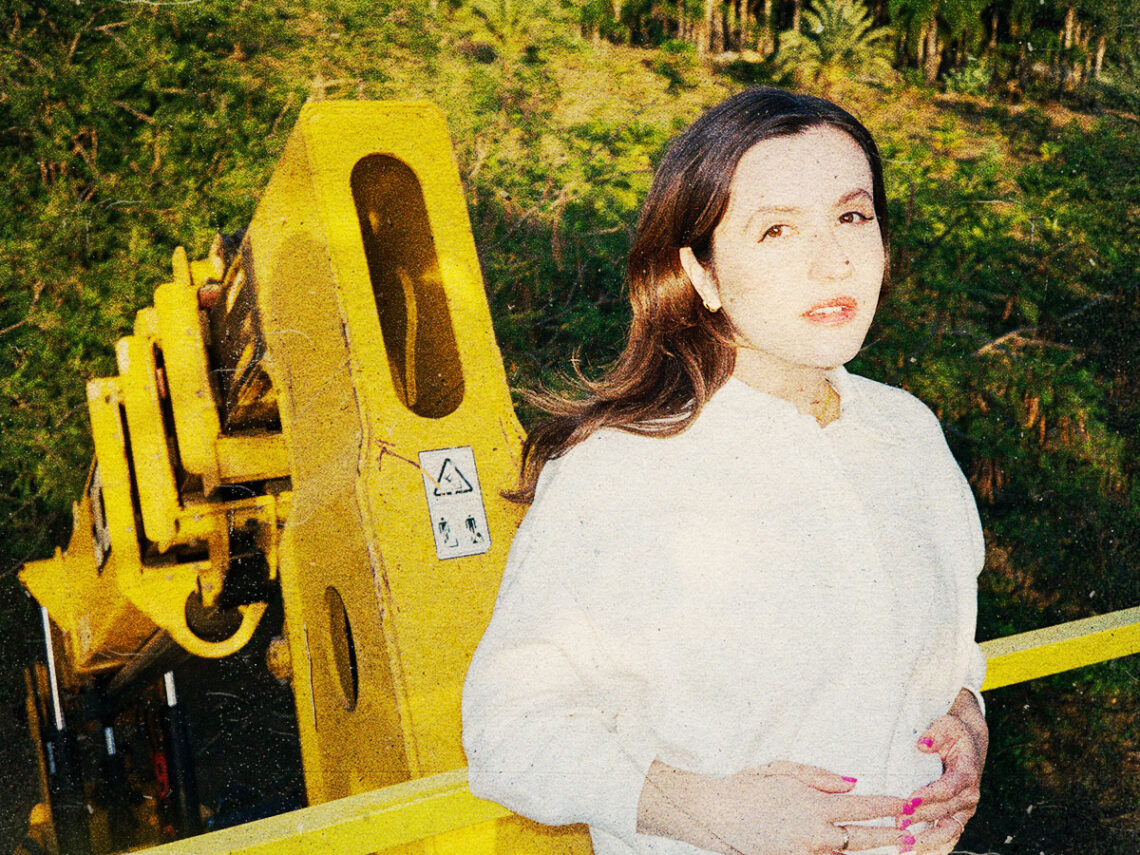
Jessy Lanza – ‘Love Hallucination’ album review: a glimmering evolution from anxiety to trust

Canadian electronic songwriter and producer Jessy Lanza has unveiled her fourth album, Love Hallucination, via the British electronic label Hyperdub. It’s a glittering portrait of anxiety and a movement towards self-trust, soundtracked by her usual mix of upbeat club-focused beats and slower, softer and more seductive soundscapes.
Following on from the critical success of All the Time, Love Hallucination sees Lanza lean further into the airy techno-inspired pop-infused electronica of her previous album. Though it lacks some of the bite tracks like ‘It Means I Love You’ and ‘VV Violence’ from her sophomore record, Oh No, Love Hallucination demonstrates Lanza taking full ownership of her music, overcoming her anxieties, and embracing her emotions through the sleek superficiality of electronica.
Lanza dubbed the record a “trust fall”, as it collates a number of songs she wrote for other artists. Instead of gifting them to others, though, she took them on herself in an exercise of self-trust and confidence. She steps out of her comfort zone lyrically and sonically, sharing, “I’ve never written explicitly about orgasms or played saxophone on one of my records before, but these choices made sense on Love Hallucination”.
The record’s opening track ‘Don’t Leave Me Now’ immediately plunges us back into the agitated electronica that is so key to Lanza’s sound, but it’s also a statement of her evolution and surrounding anxieties. Pounding but nervous drums underscore layers of optimistic piano notes, glitchy vocal samples, and Lanza’s ethereal repeated request, “Don’t leave me now”. It sets out the themes of anxiety and trust that pervade the record. The track was the first to be released ahead of the LP, which clusters all three single singles at the beginning.
‘Midnight Ontario’, the second single, is slightly less agitated. It breathes anxiety and confidence simultaneously, with occasional moments of dissonance punctuating Lanza’s declaration that, “Nothing is for sure”. ‘Limbo’, a disco track which served as the album’s final single, also marks the last entry in her anxiety trio. True to its name, it finds Lanza in limbo between fight or flight: “I could spend the night or I could go, I could live my life in limbo”.
As she spells out, “L-I-M-B-O”, the accompanying instrumentals are conversely calm and controlled. Lanza uses watery imagery to reflect her anxious floating between options, crying into her pillow and comparing the difficulty of saying no to “getting water from the moon”.
Track four, ‘Casino Niagara’, continues this theme of water, but also represents the effort’s first real break from anxiety. Opening with a callback to her last album, she states, “All the time”, over elegant synths and feigned sighs and moans. ‘Casino Niagara’ slows the record down, with more minimal drums allowing the sensual vocals to take the spotlight. Lanza gushes, “Ah, don’t stop now”, amidst a whispered refrain of “tell me, tell me” and moan-like vocalisations.
Following on from the sultry, ethereal soundscape of ‘Casino Niagara’, ‘Don’t Cry On My Pillow’ almost sounds like a filler track at first. Lyrically, it’s a straightforward break-up track with verses that boldly state, “Don’t use my car”, and “Don’t call my mom”. The chorus is softer, lamenting, “You’re unkind sometimes, when I needed you, you left me behind”. It builds a climax which layers the line, “Don’t cry on my pillow” calling back to earlier lyrics on the record.
‘Drive’ is a soft pulsing electronic track punctuated by Lanza’s usual drum machine and ethereal vocals. It features those fun, low synthy moments that make Lanza’s music so uniquely her own. The whirring intro to ‘I Hate Myself’ subsides to allow playful, descending synths to take their place as Lanza dejectedly repeats the title. It’s a low self-esteem anthem for the electronica girls.
‘Marathon’ features a cheeky, glimmering opening which includes a statement of the title accompanied by giggles before falling deep into club-ready electronica. Perhaps surprisingly, it also includes the aforementioned saxophone, building to a solo over which Lanza clicks and sings, “You talk too much, you don’t like to listen, no”. Her final word, “Marathon”, echoes out as the soundscape returns to hallucinatory, minimal electronica and rising synths. It’s a track that’s full of fun and freedom — a highlight of the record.
The record closes with ‘Double Time’, another demonstration of Lanza’s adeptness in soft, minimal electronics. As on ‘Marathon’, the lyrics are more certain than much of the album, refuting change and declaring, “Still I want you”.
Love Hallucination is a record full of agitation, emotion, and new-found confidence under the cover of superficial, synthy electronica. Like most of Lanza’s discography, it’s the perfect soundtrack for late, contemplative drives and club nights alike. Love Hallucination is essential listening for alternative electronic fans looking for a dose of effortlessly glitzy sonic neuroticism.

Never Miss A Beat
The Far Out New Music Newsletter
All the latest New Music from the independent voice of culture.
Straight to your inbox.