


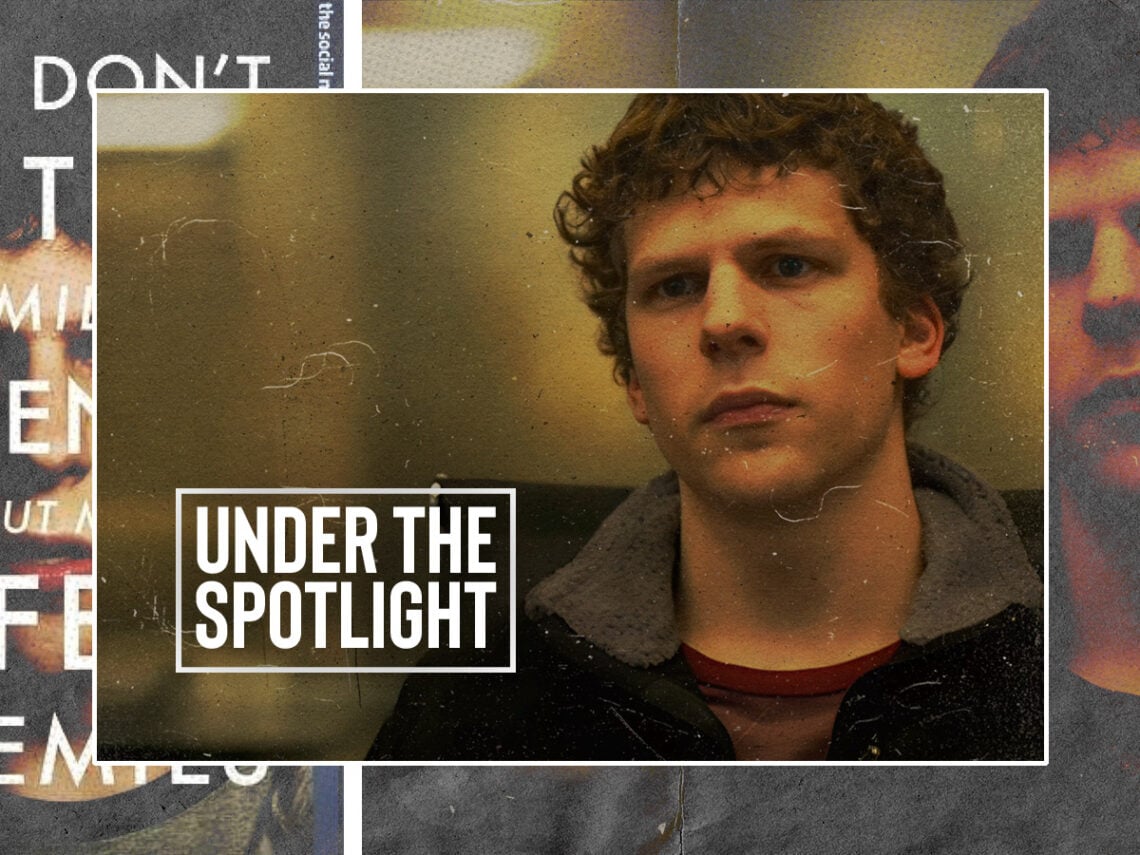
Under the Spotlight: Jesse Eisenberg in ‘The Social Network’

“Erica, the reason we’re able to sit here and drink right now is cause you used to sleep with the door guy,” Mark Zuckerberg tells his girlfriend in the opening moments of David Fincher’s The Social Network. In a barely three-minute scene, he goes on to dismiss, insult, and diminish her at every opportunity. His eventual apology is a feeble attempt to backtrack on his harsh words, delivered with sincerity levels as low as Eduardo Saverin’s shares by the end of the film.
Between Aaron Sorkin’s words and Jesse Eisenberg’s performance, we immediately learn to hate Zuckerberg. When Erica delivers her final, scathing line, “You are probably going to be a very successful computer person…” it’s all the more impactful for it. There’s no disputing that our main character is an asshole, but that’s not Eisenberg’s viewpoint when preparing for the role.
“Every character I play has to be the hero of his own story,” he told The Daily Beast. “The way we’re all heroes of our own lives”. Believing that he was the hero when every other element of the film worked against that argument, Eisenberg was able to deliver a performance that, at once, channelled the conflicting nervousness and conviction of the world’s youngest self-made billionaire.
Though the lead actor was unable to meet his subject – Facebook were, expectedly, not willing to cooperate with the film – he studied photos and videos of the Facebook founder, listened to his interviews constantly, and even took lessons to master his inhuman straight posture. Eisenberg found that Zuckerberg contained a similar uncomfortable, fidgety nature to his own and used that likeness to his advantage.
“It wasn’t important to us that Jesse do an impersonation of Mark Zuckerberg,” writer Sorkin told LA Times. “Jesse came to work knowing the scene he had to do that day, and how he prepared – whether it was listening to Mark’s voice, fencing or standing on his head – was entirely up to him.”
Between his discomfort and his character study of the real-life CEO, Eisenberg naturally fell into the nerdy, youthful uncertainty below Zuckerberg’s character without becoming a caricature. He starts out as this flip-flop-wearing, twitchy, techy Harvard student, bitter about female rejection and desperate for social success, but he quickly devolves into a far more sinister figure.
As the courtroom scenes unravel, it becomes more and more apparent that Eisenberg was the perfect casting decision. His acting style lent itself to Sorkin’s fast-paced, witty dialogue. He masterfully punctuates quippy lines like, “If you guys were the inventors of Facebook, you’d have invented Facebook,” and delivers dead-pan responses with ease.
“Your best friend is suing you for $600 million,” the Winklevoss’ lawyer tells him in a court scene. “I didn’t know that. Tell me more,” he responds with disinterest and a defiant look. Each line he delivers contains a nervous desperation to prove that he is the most intelligent person in the room and that he doesn’t care about anyone but himself. This tendency is only elevated throughout the film, as Eisenberg’s performance becomes more and more calculated and cold.
Eisenberg is at his most brutal when juxtaposed with Andrew Garfield’s performance as Eduardo Saverin. In the evolution of their relationship from college best friends to social media co-founders to court rivals and enemies, Mark’s lack of care for his friend becomes increasingly apparent. At the climax of the movie, Garfield delivers an impassioned speech, both in the courtroom and in the Facebook offices, expressing the upset Mark has caused him.
In the courtroom, Eduardo is so angered, so hurt by Mark’s actions that he can barely look his friend in the eye. Meanwhile, Eisenberg’s Zuckerberg retains his upright posture, an indifferent look unchanging on his face even as he hears the line, “I was your only friend, you had one friend.” There is no sense of remorse in Eisenberg’s depiction of Zuckerberg, he won’t even grant him a response.
In the Facebook offices, we see Garfield’s even more emotional and enraged performance. As he screams at his friend, slams a laptop down on a desk, and threatens legal action, Zuckerberg barely flinches. The more charismatic, extroverted Sean Parker, played by Justin Timberlake, speaks for him. The Facebook founder only interjects to deliver calm yet calculated statements like, “You’re gonna blame me because you were the business head of the company and you made a bad business deal with your own company?”
As Eduardo blows up, Eisenberg’s performance remains as understated and quiet as ever. There are brief glimpses of regret, of upset that his friendship with Eduardo has come to this, but, ultimately, the most movement Eisenberg awards Zuckerberg in this scene comes with his shock at the laptop slam. Faced with his friend’s wrath and disappointment at his betrayal, Eisenberg still portrays Zuckerberg as struggling to place anything over his own success.
In the film’s final moments, Eisenberg shows a return to that nervous uncertainty that once prompted his various betrayals and business decisions. Hunched over his laptop and sat impossibly close to an empty conference table, Zuckerberg asserts, “I’m not a bad guy.” His delivery lacks the falsified self-certainty that once pervaded his dialogue, phrased more as a question than a statement.
Rashida Jones’ Marylin Delpy leaves him with the words, “You’re not an asshole, Mark. You’re just trying so hard to be,” a line which summarises Eisenberg’s performance. As we leave him refreshing Erica’s Facebook page, he loses the mask that he had deluded everyone, including himself, into believing. He’s not the smartest person in the room, he’s not the daunting CEO who dominates boardrooms; he’s a pitiful 23-year-old who betrayed his best friend and still hasn’t quite gotten over his college girlfriend.
Eisenberg’s performance in The Social Network depicts the seemingly formidable Facebook founder as a man who desperately wants to live up to his “asshole” reputation, delivering scathing, snarky lines with conviction but fidgeting as if struggling against it. His quick-talking protagonist seems at once uncertain and in control, the cold and calculated foil to Garfield’s emotional and intentional Saverin. Understated and unemotional, he embodies the young millionaire.
