


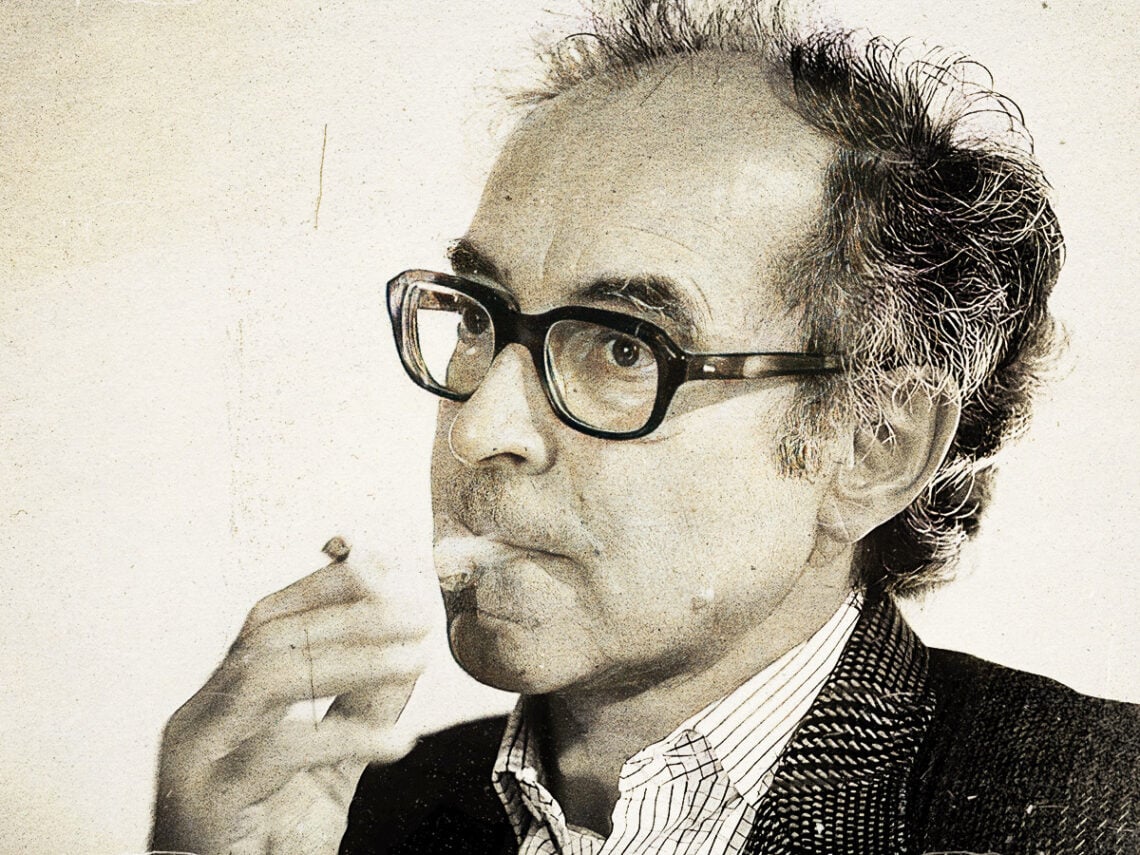
Jean-Luc Godard’s problem with Steven Spielberg: “he’s not very intelligent”

Fed up with the state of mainstream cinema, a group of passionate cinephiles, including one Jean-Luc Godard, most of whom wrote for the film magazine Cahiers du cinema, decided to transform the medium with a new approach. Rejecting French cinema’s ‘Tradition of Quality’, these young filmmakers took an experimental approach to telling new stories, playing with form and aesthetics in an entirely innovative way.
Key figures from the French New Wave included Agnes Varda, Francois Truffaut, Jacques Demy, Jacques Rivette, Eric Rohmer and, perhaps most famously, Godard. With movies like Breathless, Vivre sa vie, Une Femme est une femme, and Pierrot Le Fou, Godard established himself as a radical cinematic voice, becoming increasingly more experimental and political as the years progressed. By the late 1960s and early 1970s, Godard had entered his ‘militant’ period, often working with Jean-Pierre Gorin to make movies inspired by Marxist thinking.
Godard was always outspoken, both politically and regarding his thoughts on other filmmakers and movies, never failing to share his honest opinions. He feuded with several of his contemporaries, such as Truffaut and Varda, earning a reputation for always expressing his feelings, no matter how callous.
The director’s work has significantly influenced every filmmaker who has come after him, consciously or otherwise, yet Godard was often critical of those who have followed in his footsteps. Godard was particularly unimpressed by the movies of Steven Spielberg, known for helming blockbusters Jaws, E.T. the Extra-Terrestrial, Jurassic Park and Schindler’s List. It was the latter that really angered Godard, leading him to call Spielberg a “phoney” and “not very intelligent.”
Talking to Film Comment, he explained, “Schindler’s List is a good example of making up reality. It’s Max Factor. It’s colour stock described in black and white, because labs can’t afford to make real black and white. Spielberg thinks black and white is more serious than colour. Of course, you can do a movie in black and white today, but it’s difficult, and black and white is more expensive than colour.”
He added, “So he keeps faithful to his system — it’s phoney thinking. To him, it’s not phoney, I think he’s honest to himself, but he’s not very intelligent, so it’s a phoney result.” Godard was not impressed with the way Spielberg transformed a story about the Holocaust into Hollywood entertainment, adding, “I saw a documentary, not a good one, but at least you get the real facts about Schindler. [Spielberg] used this man and this story and all the Jewish tragedy as if it were a big orchestra, to make a stereophonic sound from a simple story.”
Godard also discussed Spielberg’s work in comparison to William Wyler: “Spielberg is not capable of doing Schindler’s List the way a regular director, not a genius but a director like William Wyler — who was able, just after the war, to make The Best Years of Our Lives, which today, when you see it, you’re amazed by the fact that in Hollywood some honest people and good craftsmen were able to reach someone.”
He continued, “Cinema as a whole has greater potential than the Wyler picture, but he was 100 percent his potential. Today, that has disappeared. If there was a race, William would do the 100 yards in twelve seconds; Spielberg would do it in two minutes.”
