


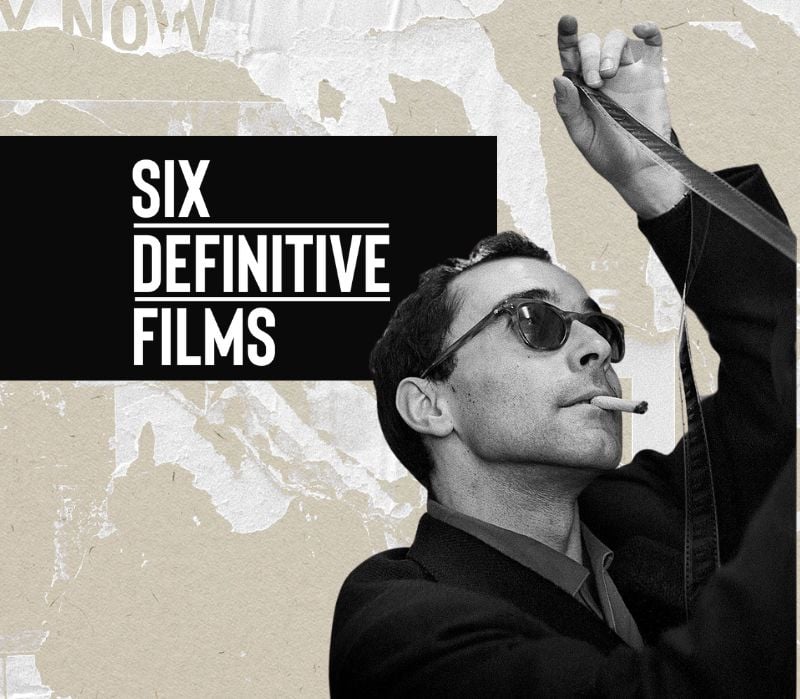
Six Definitive Films: The ultimate beginner’s guide to Jean-Luc Godard

The 1960s was a flourishing period for modern cinema, with the decade of fun, fashion and rock ‘n’ roll leading to dramatic social change where filmmaking, and the work of French director Jean-Luc Godard, forced significant cultural transition. Emerging to popularity at the close of Hollywood’s traditional reliance on the studio system, Godard was an innovative figure who would change the landscape of modern cinema.
A major period of change and disruption for western cinema, 1963 represented the worst year for US film production in 50 years, with only 121 feature films released to 361 foreign releases in the same year. Whilst American cinema went through a period of struggle, French cinema was enjoying a flourishing, frenetic time of great change, with the New Wave movement redefining national cinema for a new generation.
Godard joined such filmmakers as François Truffaut, Jacques Rivette and Agnès Varda, who were each ripping up the rulebook of cinema, redefining the parameters of art for a new generation of creatives. As we celebrate the life and filmography of the late Jean-Luc Godard, take a look at his career through his six most definitive films of all time below.
Jean-Luc Godard’s six definitive films:
Breathless (1960)
Jean-Luc Godard’s Breathless was integral in welcoming a change of cinematic vigour in the midst of American struggles, despite the existence of Truffaut’s The 400 Blows and Alan Resnais’ Hiroshima, Mon Amour, having abided by similar revolutionary spirit years prior. Typified by a youthful rebellious attitude that embraced dynamic, fast-paced filmmaking, Breathless represented a truly modern film using wild jump-cuts and strange camera techniques.
Indeed, Jean-Luc Godard’s very first feature film was among his very best, entering the 1960s with a cool, irreverent charm that would herald a new era for unconventional filmmaking.
Contempt (1963)
The French filmmaker had no intention of slowing down his defiant bid for original filmmaking, releasing such celebrated movies as A Woman is a Woman, Vivre Sa Vie and Le Petit Soldat in the three years between Breathless and Contempt. Each aforementioned film had built a comprehensive mythos of Godard that was celebrated in critical circles, yet it wasn’t until Contempt in 1963 that he would be celebrated in the eyes of the public.
His most commercially successful film, Contempt, starred Michel Piccoli as well as the iconic French film star Brigitte Bardot. Telling the story of a marriage between a screenwriter and a woman, which breaks down after the wife begins spending time with the film’s producer. Toying with concepts of love, art and the struggle of the artist, Contempt remains one of Godard’s most beloved and accessible works.
Bande à Part (1964)
Godard was no one-trick-pony with his next film, Bande à Part, a synthesis of crime, comedy and drama, proving this well beyond doubt. Created under the wing of Anouchka Films, Godard’s new production company he made with Anna Karina, the filmmaker described his 1964 movie as “Alice in Wonderland meets Franz Kafka”. Telling the story of two crooks who have a fondness for Hollywood B-movies and convince a language student to help them commit robbery, this French classic bridges the gap between European and Hollywood cinema, demonstrating how cinema from both sides of the Atlantic inspired each other.
Illustrating the sheer youthful energy of the characters whilst also giving clues as to their nuanced personalities, the film’s dance scene that takes place in the cafe has become an iconic moment in modern popular culture, reflecting the ceaseless playful nature of Godard.
Alphaville (1965)
Almost as if to make a point, Godard’s next film after the celebrated Bande à Part was far different, being slow and deliberately aimless. Une femme mariée may not be Godard’s most memorable piece, but it was shot in four weeks and reflects the artist’s boundless urge for filmmaking, taking downtime before he would once again defy genre with Alphaville in 1965. As a futuristic amalgamation of science fiction, film noir, and satire, the film was a revelation.
Starring Eddie Constantine as a detective who is sent into a city controlled by a giant computer named Alpha 60, Godard’s surprising deviation from form well expressed his frenetic adventurousness.
Pierrot le Fou (1965)
Rampaging through European cinema, Godard immediately followed the celebrated Alphaville with what could be described as the filmmaker’s greatest ever film, Pierrot le Fou. With a complex storyline, distinctive characters and a violent ending that seemed ripped from Hollywood cinema, Godard’s departure from his usual tone was a retrospective piece of work that used his own filmography as a framework for reflection and innovation.
Starring the late Jean-Paul Belmondo, the film follows a man who escapes his boring life and travels along the Mediterranean Sea with a girl, Marianne, as they enjoy the spoils of contemporary life and embrace eccentricity. Colourful and expansive, the film demonstrated a significant change in Godard since the strict, absurdist monochrome work of his debut feature.
Week-end (1967)
As something of a smash-and-grab filmmaker, Godard ended his significant reign in the 1960s almost as quickly as he’d started it, creating his finest work from 1960s Breathless to 1967s Week-end. Colourful and politically charged, the director’s 1967 film followed a Parisian couple who leave on a weekend trip across the French countryside to collect an inheritance, only to witness the greed and over-consumption of the bourgeois.
Featuring revolutionary cinematic techniques, the film, which would appropriately come to an end with a title sequence that read ‘End of Cinema’, marked a definitive mark in Godard’s industry reign from 1960-1967.
Revolutionary, innovative and deliberately self-referential, the work of Godard would go on to inspire countless filmmakers from across the world of cinema, including the likes of Stanley Kubrick and Martin Scorsese, who were too flourishing throughout this period. Indeed, there are few other individuals in filmmaking that had such a colossal impact on the form of the future of cinema.
