


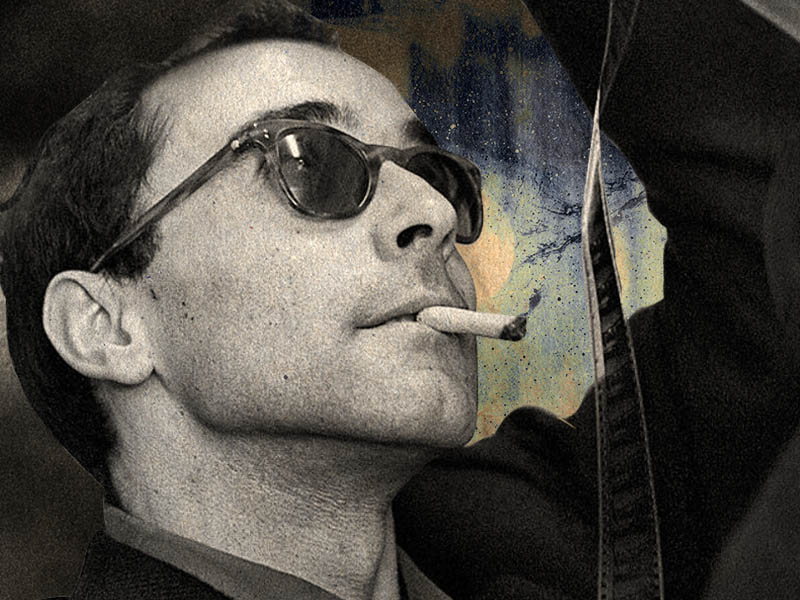
Jean-Luc Godard named his favourite French films “since the Liberation”

When asked if his work as a critic for Cahiers Du Cinema had stifled his imagination, Jean-Luc Godard was careful not to hesitate: “I made me love everything,” he said. “It taught me not to be narrow-minded, not to ignore Renoir in favour of Billy Wilder or something like that. I like them both even though they are extreme opposites.”
When he said those words in 1963, Godard was already the most talked-about director in contemporary French cinema. Such fame must have come as something of a surprise, given that he’d spent the previous decade talking about the work of other directors. Until the release of his breakout feature Breathless, Godard did not make films — he watched them, wrote about them, tore them apart and analysed them at close quarters.
His work for La Gazette du Cinema and the incredibly influential La Cahiers du Cinema gave him the richest possible understanding of post-war cinema and cinematic techniques. Over the years, he provided many recommendations for film lovers. In the 1965 issue of Cahiers du Cinema, for example, he shared a list of the “best films since the Liberation,” by which he meant the liberation of Paris from Nazi occupation in August 1944.
The six-film list contains works by Rouch, Renoir, Bresson and Chabrol, the latter of whom was a contemporary of Godard’s and also wrote for Cahiers du Cinema. The pair met after Godard relocated to Paris from Switzerland in the 1950s. On arrival, he began attending the ciné-clubs that had been gaining popularity among French intellectual circles since before the occupation. In one such club, he met fellow film-enthusiasts Jacques Rivette, Claude Chabrol and Francois Truffaut, all of whom would go on to gain recognition as filmmakers in their own right.
For Godard and his friends, film was everything. It was their daily bread and the fabric of their dreams. Godard, Rivette and Maurice Schérer (AKA Éric Rohmer) founded the film journal La Gazette du Cinema in 1950, but it was to be a short-lived venture. By 1952, Godard was writing for André Bazin’s Cahiers du Cinema, making him the first of the younger critics to be published in the journal, each issue of which was a battleground where critics waged war on one another’s ideas and interpretations.
In his first article, published in September 1952, Godard attacked an earlier article by Bazin, defending the use of the shot/reverse-shot technique employed by Hollywood’s Golden Age directors. Though Godard became a symbol for the excellence of French new-wave cinema, he always held a certain reverence for Hollywood film. In this list, however, he picks only the best French films. You can see read the full list below.
Godard’s Favourite French films “since the Liberation”:
- Le Plaisir – Max Ophüls (1953)
- La Pyramide humaine – Jean Rouch (1961)
- Le Testament d’Orphee – Jean Cocteau (1960)
- Le Testament du Docteur Cordelier – Jean Renoir (1961)
- Pickpocket – Robert Bresson (1959)
- Les Godelureaux – Claude Chabrol (1961)
