


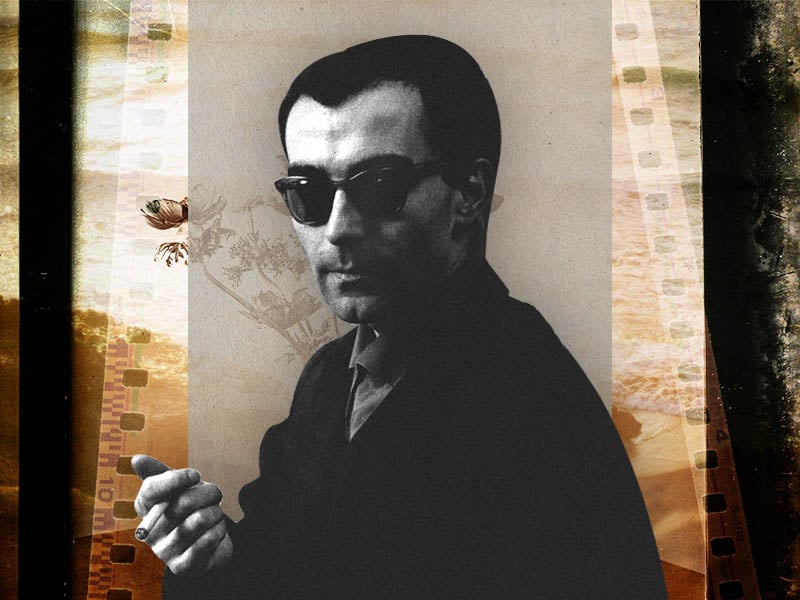
The 10 movies that influenced Jean-Luc Godard most

“Cinema is the most beautiful fraud in the world.” – Jean-Luc Godard (1930-2022).
In the legacy of film lore, the late great Jean-Luc Godard is considered the pioneer of the French New Wave movement. However, he was always keen to express that he wasn’t an inventor, he merely stole treasures with enough discerning to make his inspiration seem original. As he famously declared, “It’s not where you take things from – it’s where you take them to.” This quote itself was a transmutation of the Pablo Picasso quote, “Good artists copy, great artists steal,” a line which was actually also ironically stolen from T.S. Eliot.
In short, authenticity within pop culture is often borne from brazenly celebrating your inspirations and liberally upcycling the art into something new that serves as a glowing addition to our dismal daily lives. This liberal approach to appropriation might have formed the patchwork of his films, but his own stirring tales wove them together. As he once said, “To me, style is just the outside of content, and content the inside of style, like the outside and the inside of the human body—both go together, they can’t be separated.”
The inside of Godard’s work was always fuelled by a sense of daring and rebellion. The aesthetic might have seemed typically French, but he disavowed the history of his country’s filmmaking and dressed the frontier of America in Parisian clothes. He once said that conservative French cinema only “emphasised craft over innovation, privileged established directors over new directors, and preferred the great works of the past to experimentation.”
And Godard was a man who vied against the notion of filmmaking being a craft. “The cinema is not a craft. It is an art,” he said in typical fashion. He was eternally moving the goalposts of film rather than adhering to form. “A story should have a beginning, a middle and an end, but not necessarily in that order,” he declared. This radical approach was informed by daring works like Ernst Lubitsch’s To Be or Not To Be.
Lubitsch’s classic work took everything we knew about performance and turned it on its head. “During the Nazi occupation of Poland, an acting troupe becomes embroiled in a Polish soldier’s efforts to track down a German spy,” the synopsis reads. This prompted Godard to spout, once again in typical fashion, “to be or not to be. That’s not really a question.”
This notion of using cinema as more than a display of craft and a means of entertainment also came to the fore when he feasted upon the prescience of The Great Dictator. Chaplin’s film had obvious skill, but it was the point behind it that made it all the more prescient.
Thus, with this in mind, he turned toward other forms of subversive cinema. One of the earliest you will find is Dziga Vertov’s Man With a Movie Camera from 1929. When he began to focus more heavily on Marxist theory, Godard and Jean-Pierre Gorin gathered a small group of Maoists to form the Dziga Vertov Group. As Gorin later stated: “We adopted the name of Vertov after careful thought. We didn’t want the vulgarity of narrative. If there are characters, it’s bourgeois.” This notion of finding political furtherment from cinema’s beginnings is a paradigm of Godard’s unique arthouse outlook.
Nevertheless, there is also a complexity to Godard’s filmmaking that means even his radical disavowal of narrative was informed by classic stories. One of his favourites being John Ford’s The Searchers. Godard described the film as “a Homeric odyssey,” and frequently lauded its grandeur, heralding it is an American classic.
He said it defined the “mystery and fascination of the American cinema. . . . How can I hate John Wayne upholding Goldwater and yet love him when abruptly he takes Natalie Wood in his arms in the last reel of The Searchers?”
All of these tales informed his style and intent, but there is one that inspired him more than most to get behind the camera. “Once I had seen Journey to Italy, I knew that, even if I were never to make movies, I could make them,” he said of Roberto Rossellini’s 1954 classic (sometimes called Voyage to Italy). This luscious tribute of a film established cinema as an artistic expression and Godard was right behind the movement.
This was further confirmed upon viewing Samuel Fuller’s Forty Guns from 1957. This film is a pastiche of human life in minutia with small-scale tragedy being reflective of the larger whole. When Fuller made an appearance in Godard’s own Pierrot le fou, he is improvisationally asked by Jean-Paul Belmondo what cinema was all about. Fuller answered, “Film is like a battleground: love, hate, action, death… In one word, emotion.” Apparently, this response was so exacting of Godard’s view that he was moved to tears and roused by the kinship to ensure Pierrot le fou was a masterpiece.
That is the key to Godard’s style. The films below are ones that he has openly expressed an influential love for the most, and while they might be an eclectic bunch, behind all of them is a lived-in sense of truth. As Godard once said, “I know nothing of life except through cinema.” His work showed that when it’s done right, perhaps that is all you need. Even a fraud can be passed off as an exacting replica.
The 10 films that influence Jean-Luc Godard the most:
- To Be or Not To Be – (Ernst Lubitsch, 1942)
- The Great Dictator – (Charlie Chaplin, 1940)
- Man with a Movie Camera – (Dziga Vertov, 1929)
- The Searchers – (John Ford, 1956)
- Voyage to Italy – (Roberto Rossellini, 1954)
- Forty Guns – (Samuel Fuller, 1957)
- Dishonored – (Josef von Sternberg, 1931)
- Pickpocket – (Robert Bresson, 1959)
- Life, and Nothing More – (Abbas Kiarostami, 1992)
- Bigger Than Life – (Nicholas Ray, 1956)
