


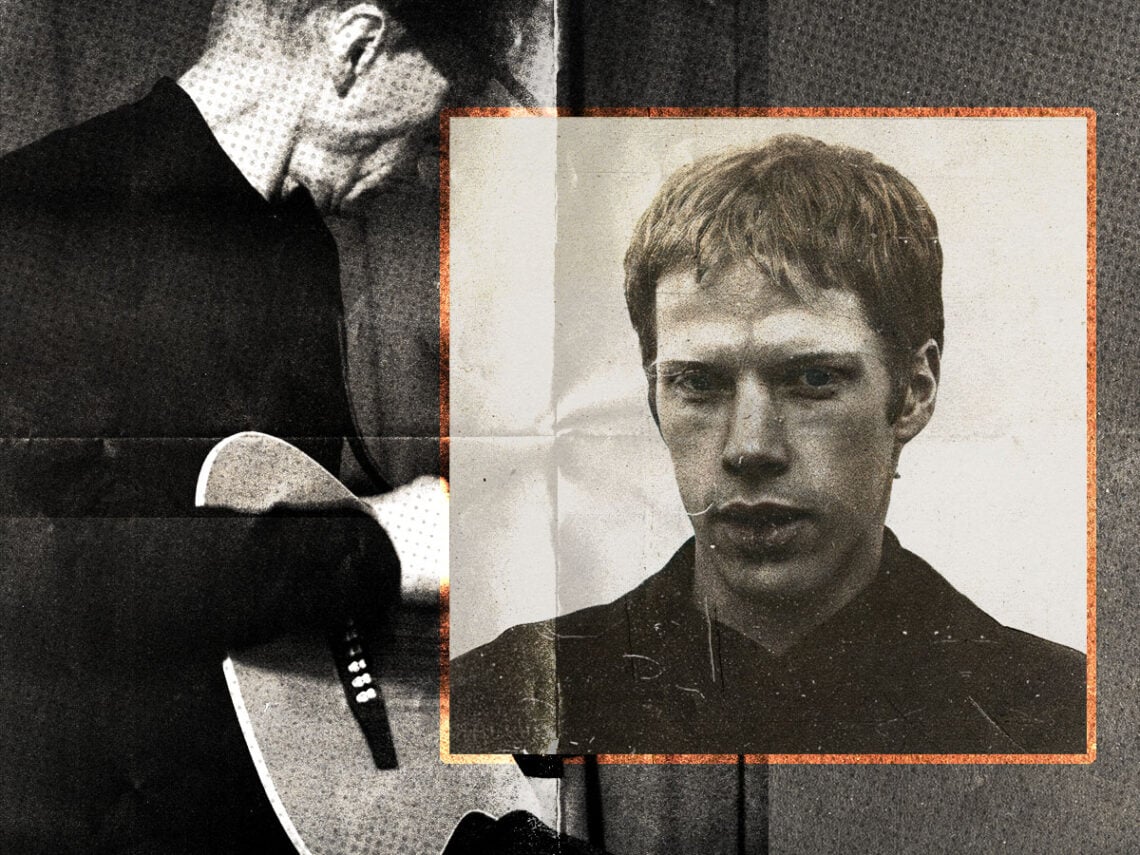
Jandek: The mystery of the worst musician in history

A retired master carpenter once told me about the pained experience he had when teaching the next generation his beloved craft. He recalled subjecting a fine piece of Maple Wood to the haphazard skills of the youngsters and their assaulting tools—stupefied by a state of perpetual cringe, he was forced to watch them get things wrong and do terrible things to the wood, trapped somewhere in a state of pitiful horror and the hope that they might one day get it right and make something beautiful. This same perverse mix of emotions is perhaps what attracts musicians in their droves to the outsider folk artist Jandek’s shows. As he has said himself in one of the few times he has spoken publicly: “If they are seated, they can endure an hour and a half / two hours comfortably. […] It’s easier for them to think, ‘I hate it, but I can’t leave’.”
Since 1978, Sterling Smith from Houston, Texas has been releasing strange songs under the strange alias Jandek. He’s released at least 50 records since then, but it could be many more under different guises or indeed under Jandek and the albums have simply gone missing. All of the music we know of has been released under his self-made label Corwood Industries. All of it sounds oddly horrible. And ‘oddly’, in this instance, is the more operative word than ‘horrible’. Indeed, there are glimpses of beauty in Jandek’s music that strangely obfuscates the whole picture. It’s a bit like listening to Nick Drake while being lobotomised—vital parts of your brain going awry and twisting the sweet music into something torturous.
Therein lies the puzzle of Jandek: if he is capable of flashes of beauty, then how do you explain the whole horrible picture? Is it the music equivalent of J.G. Ballard’s Crash – a book about people who become sexually aroused by car crashes? Is it the notion of music’s engineered prettiness having its nose cut off that appeals? Is Jandek making some postmodern point that the world is full of flashes of beauty being brutalised by mistakes and missteps so why shouldn’t music? Or is there no point to it at all, and Jandek, like a trainee carpenter trapped in their first year of study, knows just enough about music to be bad at it?
That is a mystery that will forever prove hard to decipher given how little we know about the enigmatic musician. Aside from the fact he comes from Texas and was born in 1945, the only tale we have heard about from his early life – thanks to a rare divulgence from the man himself – is that he wrote seven novels as a young man before burning all of them the moment that they were rejected by a New York publisher. Seemingly, this may well have been the moment that he decided to put down the pen and self-publish music instead.
This music then reached writer John Trubee who approached Jandek for a piece in the new music magazine Spin back in 1985. Trubee garners that Jandek is a melancholy machinist who came up with his music alias after talking to a man named Derek in the month of January, he wrote ‘Nancy Sings’ about “a girl [he] came across called Nancy” and a few other curt details, and then Jandek goes away. Journalists can’t reach him, he never performs, and the only tangible knowledge we have of his continued existence is a recurrent river of releases—each of these releases is the same: a stream of free-form folk music that uses its very own open chord structure and often unintelligible but always sad lyrics mumbled meekly over the top.
After a three-year gap from his 1978 debut, Ready for the House, these albums continue at a rate of two to three records per year until 2004 when something peculiar happens. At Glasgow’s Instal Festival, an unidentified act randomly appears alongside avant-garde local musicians Richard Youngs on bass and drummer Alex Neilson. This was Jandek’s first known live performance. It puzzled people. One of the most lingering bewilderments from that day is why after over 25 years did Jandek choose to emerge from the shadows?
Well, firstly, it wasn’t Jandek on stage, it was “a representative of Corwood Industries”, which, given that it is a one-man industry run by the musician known as Jandek, is technically the same thing. But it is perhaps either notable or simple bullshit, that Jandek makes the distinction himself. Given that Jandek’s very first attempt to release music was under the moniker The Units implies that he is preoccupied with the notion of his artistry comprising more than ‘one’ despite its frightening singularity. Why? Once again, we don’t know. Is he trying to hide the Mr Smith behind it all? Is it a delusion of grandeur? Or is it some sort of comment on the outsider musician not really being quite so isolated from the ‘norm’?
That’s the mystery of Jandek, and since he emerged from his neat little house somewhere in Houston, we barely know much more about the formerly reclusive artist. A lot of his shows have even been announced without bearing his name. So, in recent years we have come to know him as merely a smartly dressed, ordinary, quiet guy with an ordinary, quiet house and an ordinary, quiet life and he may well have a family a quiet, ordinary family. He is also a wise sage, and his discourse is intelligent, revealing that there is sincerity behind his music as opposed to the work of someone who doesn’t know any better. So, in essence, are we to conclude that the enigma of Jandek is solved by virtue of him being an artist who wanted to remain enigmatic for reasons unknown but predictably myriad?
Well, that’s the wonder of Jandek and his beautifully horrible music: for decades the question was, who is Jandek? And now that he is out in the open, the question is, who is Jandek?
