


Revisiting Jamie Babbit’s candy-coloured queer classic ‘But I’m A Cheerleader’

Jamie Babbit’s debut feature, But I’m A Cheerleader, mainly recieved negative reviews upon its release in 1999. However, just over 20 years later, the film is now regarded as a cult classic, significantly helping to redefine the possibilities of LGBTQ+ cinema.
The film stars Natasha Lyonne as Megan, an all-American high school cheerleader. After her friends and family suspect that she is a lesbian (based on trivial interests such as vegetarianism and gay musician Melissa Etheredge), Megan is whisked away to a conversion camp, True Directions, by an ‘ex-gay’ played by Ru Paul, who wears a ‘straight is great’ T-shirt. By breaking away from the tradition of many LGBT movies ending with tragedy or heartbreak, Babbit created a film that allowed gay teenagers to be understood and celebrated, which has resonated with countless LGBT viewers since the film’s release. Despite the heavy subject matter, Babbit pokes fun at strict gender norms and homophobia through her satirical lens and intricate mise-en-scene, resulting in a movie that is both funny and optimistic but also one that calls into question oppressive traditional values.
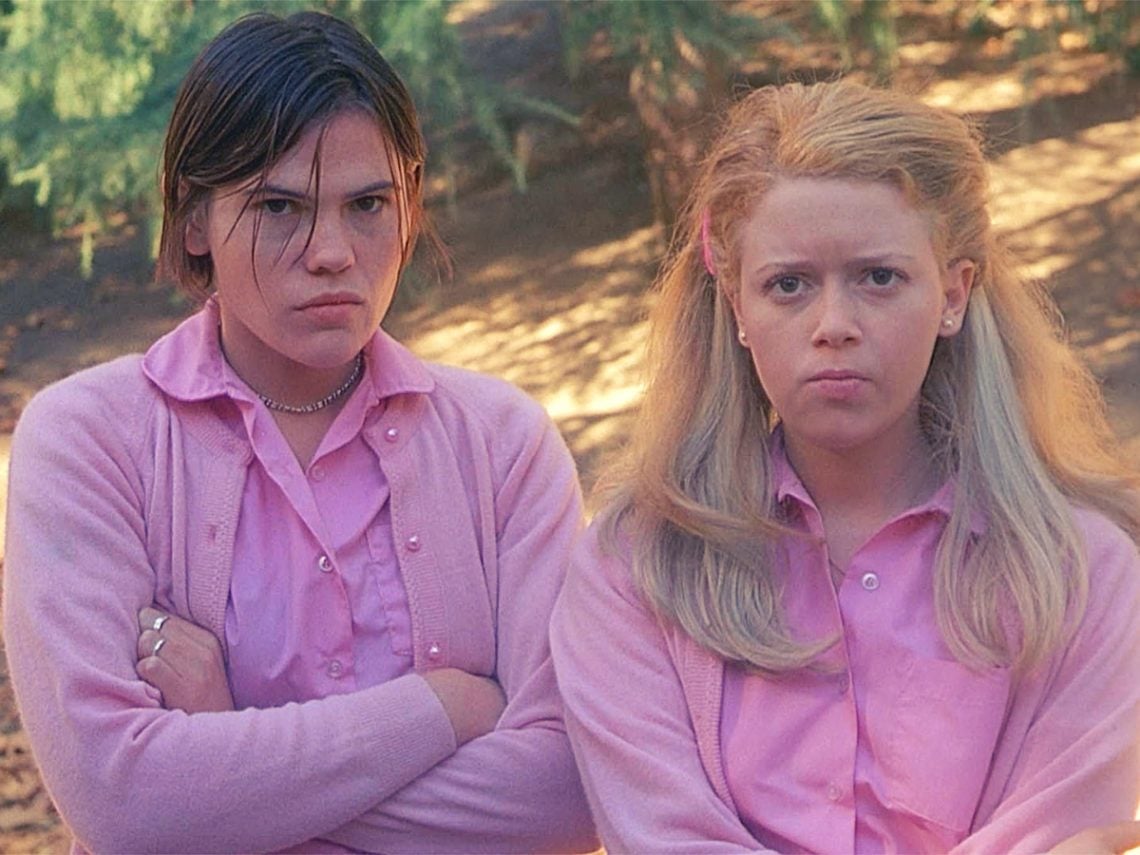
Aiming to create a “gay Clueless“, Babbit wanted to attack lesbian stereotypes through her debut film, stating: “I always wanted to tell a movie about a girl who really embraces her lesbianism, but she doesn’t ride off on a motorcycle at the end. She’s still a cheerleader, girly girl at the end — and just separating the idea of gender from sexuality.” However, the most striking element of But I’m A Cheerleader is the use of colour. Once Megan is transported from her drab, beige home life and school, the world of True Directions is sickeningly colourful and artificial. Megan’s new temporary home is a nightmarish Barbie Dream House, painted in lurid pinks and blues to divide the boys from the girls. During their stay at the conversion camp, run by germaphobe Mary Brown (played excellently by Cathy Moriarty), the teenagers must partake in activities stereotypically assigned to their gender – the boys chop wood, and the girls scrub floors.
Babbit uses colour theory in her attack against gender stereotypes. Mary’s candy-coloured world reflects an obsession with keeping up appearances, yet her son’s blue outfits cannot hide the fact he is gay. Her conversion camp is as flimsy as the plastic sheets covering the girls’ beds, as demonstrated in the relationship that blossoms between Megan and Graham (Clea DuVall). Megan initially denies her homosexuality, yet by partaking in the conversion camp, which emphasises a life that Megan doesn’t identify with, she realises her true identity and eventually embraces her lesbianism. Babbit subverts colour theory to highlight the artificial nature of gender roles further.
When Megan and Graham have sex, the scene is overwhelmingly pink and girlish, contrasting Mary’s rigid enforcement of the colour as representative of feminine heteronormativity. Furthermore, when Megan and Graham become close during a cleaning session, they wear pink outfits with green gloves and aprons in a green room. The stereotypical idea of femininity has become ‘tainted’, yet this doesn’t prevent Megan from remaining ‘girly’ throughout the rest of the film. By subverting colour theory, Babbit propels her film to glorious heights, creating not only a visual feast but a powerful commentary on queerness and the redundancy of conservative gender roles.
Essential to the film is its campiness, which pays homage to directors like John Waters. However, Babbit doesn’t merely rip off his signature style. Instead, her use of satirical humour and unconventional set design is crucial to the film’s message. She explained: “I wanted to make the world of the movie very artificial and polyester. I think it’s a great comment on the artificiality of gender identity.” Amongst the synthetic pinks, purples, blues and greens, the characters are faced with burgeoning feelings of love and attraction whilst grappling with the pressures of the outside world. Although Babbit never trivialises or makes light of conversion therapy’s traumatic nature, she focuses on celebrating queer love and self-identity, which is rarely explored in cinema, especially for teenagers.
Thus, But I’m A Cheerleader remains one of the landmarks of lesbian cinema, paving the way for future films to explore homosexuality with confidence and unabashed bravery. In the face of opposition, Babbit’s film has endured due to its celebration of queer identities and unflinching rejection of normative values.
