


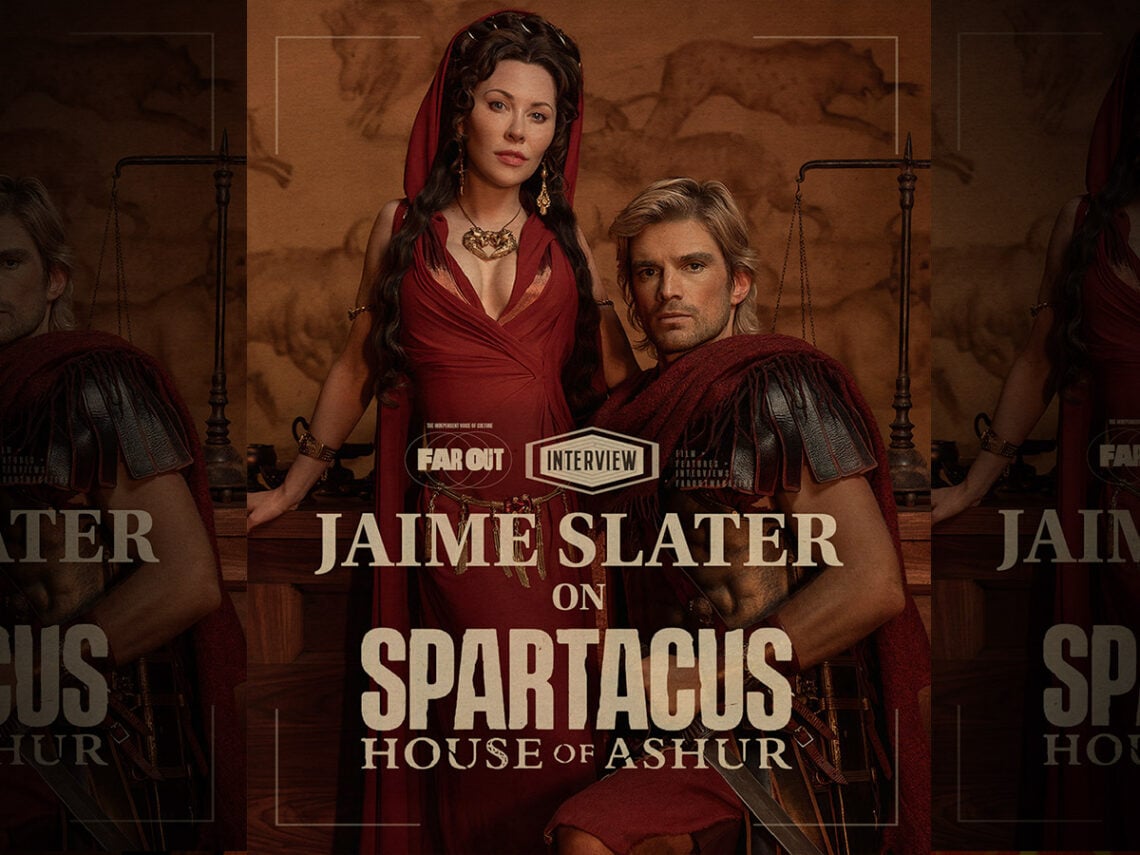
Jaime Slater on ‘Spartacus: House of Ashur’: “We’re the Sid and Nancy of ancient Rome”

After a dozen years away from the screen, blood, brutality, swords, sandals, and sex are back in a big way in Spartacus: House of Ashur, the follow-up to the cult favourite series that won a legion of fans for its violent and hedonistic depiction of ancient Rome and its machinations across four seasons between 2010 and 2013.
Since almost everybody was dead by the time the credits rolled on the final episode of War of the Damned, returning creator and showrunner Steven S DeKnight has applied some creative and mythological licence to explain the reasons for the series pivoting in a brand new direction for its return.
With Nick E Tarabay’s Ashur getting his head forcibly removed from his shoulders in the third run, Vengeance, the eponymous manipulator finds himself confronted by Lucy Lawless’ Lucretia in the underworld, who offers him the chance to be reborn in a “new reality, uncoupled from history.”
Just like that, the title character awakens in an alternate timeline where he’s inherited the aspiring gladiatorial empire formerly overseen by John Hannah’s Batiatus, struck the fatal blow that killed Liam McIntyre’s Spartacus, and no longer has to worry about trying to locate his disembodied cranium.
That doesn’t make it easy, though, with Ashur still forced to work his way from the bottom to achieve his dreams of earning respect and admiration. In good news for anyone familiar with the original series, House of Ashur features everything you’d hope to see in a continuation, from bone-crunching battles and political machinations to backstabbing of both a figurative and literal nature, and no shortage of orgies.
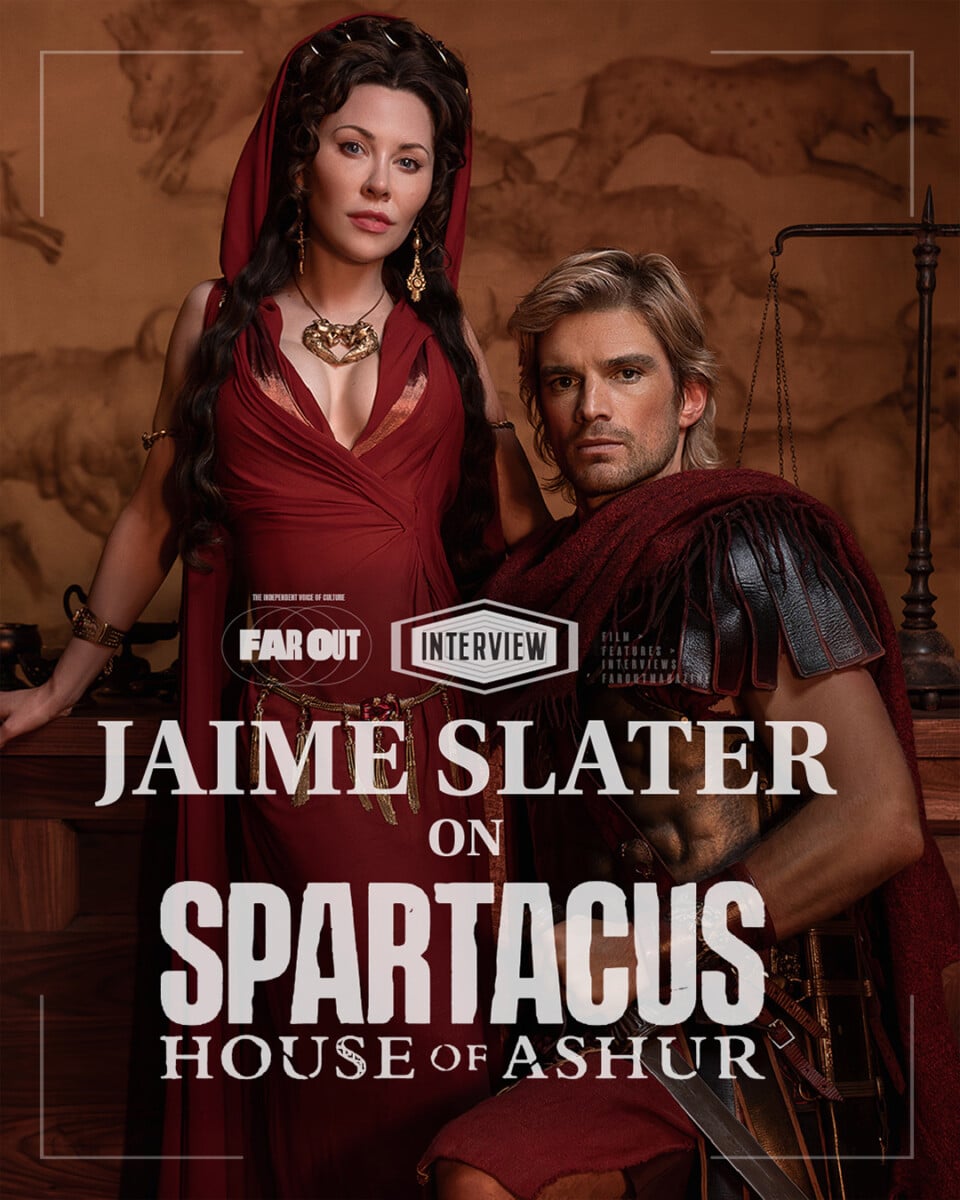
One of the biggest threats to Ashur’s hopes of gaining favour and status arrives at the end of the fourth episode, when Jackson Gallagher’s Julius Caesar descends upon the lanista’s abode. He isn’t alone, with his wife, Jaime Slater’s Cornelia, wasting no time in setting up shop, banishing the homeowner to the margins, and establishing her own den of iniquity, deceit, and duplicity.
There’s always a sense of risk in bringing a popular series back from an extended sabbatical, but Slater has been thrilled with the reception to House of Ashur so far. “It’s been so exciting,” the actor said. “Everybody’s been really enthusiastic and loving each episode as it comes, so it’s been pretty cool.”
That comes with its own sense of relief and validation, because hell hath no fury, on the internet at least, like an original fanbase scorned. Fortunately, Spartacus‘ long-awaited return hasn’t missed a beat, giving existing audiences everything they wanted, and potentially winning over some new converts at the same time.
“We worked so hard on this show, and everybody put so much effort and love into it,” Slater acknowledged. “So, to see it so well-received and reviewed is incredibly heartening and uplifting.” Despite being a newcomer, though, the scheming star didn’t feel any trepidation about entering the show’s highly specific sandbox, narrowing the focus to zero in solely on her contributions.
“I can’t think about that,” the non-trepidatious star explained. “Because my job is so specific and focused on the story I’m trying to tell. So if I start widening my view to all of the possible reactions or thoughts about it, it just becomes a distraction for me.” That’s fair enough, but there were still a few nervy moments when Slater, a self-confessed Spartacus fan, went through the audition process.
“It was quite long for me, and every time you inch closer, it gets a little bit scarier because you can almost taste it, but yet, you’re not sure you have it,” she offered. “Once I landed the part, I think I just started laughing really hard, because it was such a relief and a release to finally have all that pressure behind me, and then getting to look forward to building this character and making something really cool and special.”
That said, Slater did get “so emotional” once she was on set for her first day of shooting, since he “felt like I was catapulted through my TV screen, and it just felt unreal.” Beyond Lawless’ cameo in the introductory scene, Tarabay’s Ashur is the only returning face from the original series, which places the rest of the cast in an unusual position, particularly for what’s ostensibly a legacy show.
On one hand, the actors have a clean slate. On the other hand, almost every member of the ensemble is stepping into something that’s not only already so well established, but has 12 years of expectations to deliver on, which begs the question: Does that make it easier or more difficult for the performers themselves?
“I would say yes, and no,” Slater demurred. “It’s a challenge to make sure you capture the same tone and same world of the original show, but with all of the characters being new, except for Ashur and Caesar, actually, you have a bit of creative freedom in that respect. So there’s a bit of juggling happening.”
Speaking of tone, Spartacus has a very niche one. It’s a period piece, a political drama, and a character study, but it’s also stuffed to the gills with blood, guts, sex, and violence, never mind that it’s always toed the line between straight-faced stoicism and unbridled, uninhibited camp, albeit while trying to avoid the pitfalls of descending into self-parody or winking at the audience, which is a delicate tightrope to walk.
“It’s funny, all the things I love about her and the show initially created a little bit of distance for me, because it’s such an ancient time period and it’s so far from the lens of today,” came the ironic response. “Especially my character; she has no moral compass, no restraints, and she’s quite manipulative and callous.”
“I kind of had to flip it and think, ‘OK, what if I love these things? What if it felt good? What if I enjoy doing these things? What if this world was exciting to me?’ That was really my entry point. I just had to look at it as, ‘This is the norm, and this is fun, and this is what I love to do as this person.'”
Jaime Slater
Slater’s Cornelia is a real historical figure, but since Spartacus has never been renowned for its realism and historians don’t seem entirely sure whether she was Caesar’s first or second wife, it makes it much easier for the actor to put her own stamp on the character without having to worry too much about the facts.
“It really did, actually,” she concurred, with a caveat. “And also, fortunately, the writing of this character is completely fictitious as well. The factual pieces are that she was one of the most well-known women of her time. She was incredibly wealthy and powerful. Other than that, we had a lot of creative freedom.”
As Slater mentioned, Cornelia was rich, famous, and a part of Rome’s high society, but she doesn’t waste any time in establishing herself as House of Ashur‘s master manipulator. Any sense of empathy is non-existent, and she’s got absolutely no interest in anything or anyone that doesn’t further her own ambitions, which gave her plenty to play with when building the performance from script to screen.
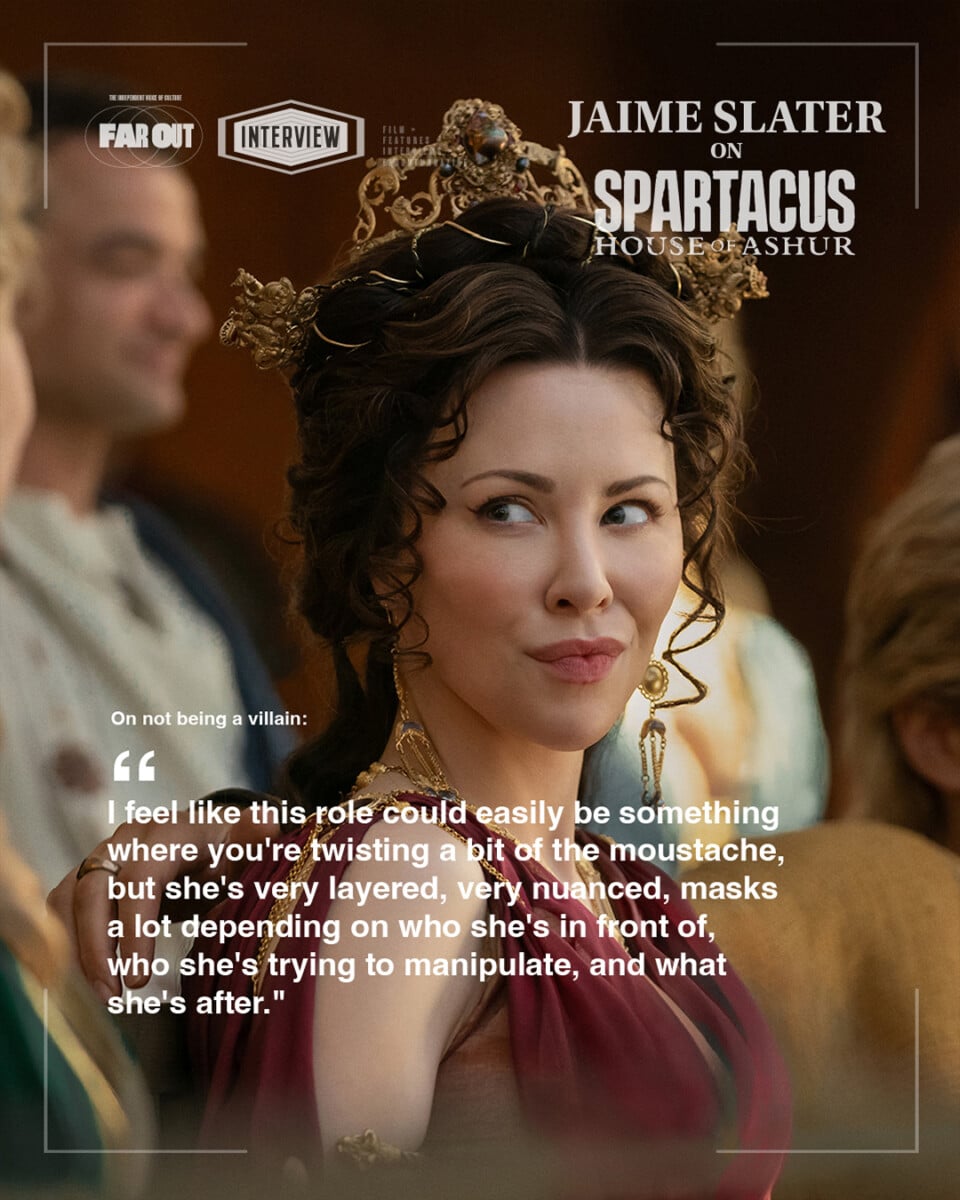
“Yeah, you really nailed it,” she agreed with Far Out‘s accurate assessment. “She’s very ambitious. She’s very shrewd and very intelligent. She weaponises her sexuality. She’s constantly manipulating people, and yes, she’s incredibly powerful, but I feel like people who are in power always want more, and at the end of the day, she’s still a woman in a very patriarchal society.”
Cornelia might have “special liberties and freedoms that most women, or all women, don’t really have,” but she may never be satiated. “She still wants more,” Slater teased. “And she seeks to gain that through elevating her husband, Julius Caesar.” The duo are less of a power couple and more of a ‘we’ll take what we want and who gives a fuck about the consequences of our actions’ couple.
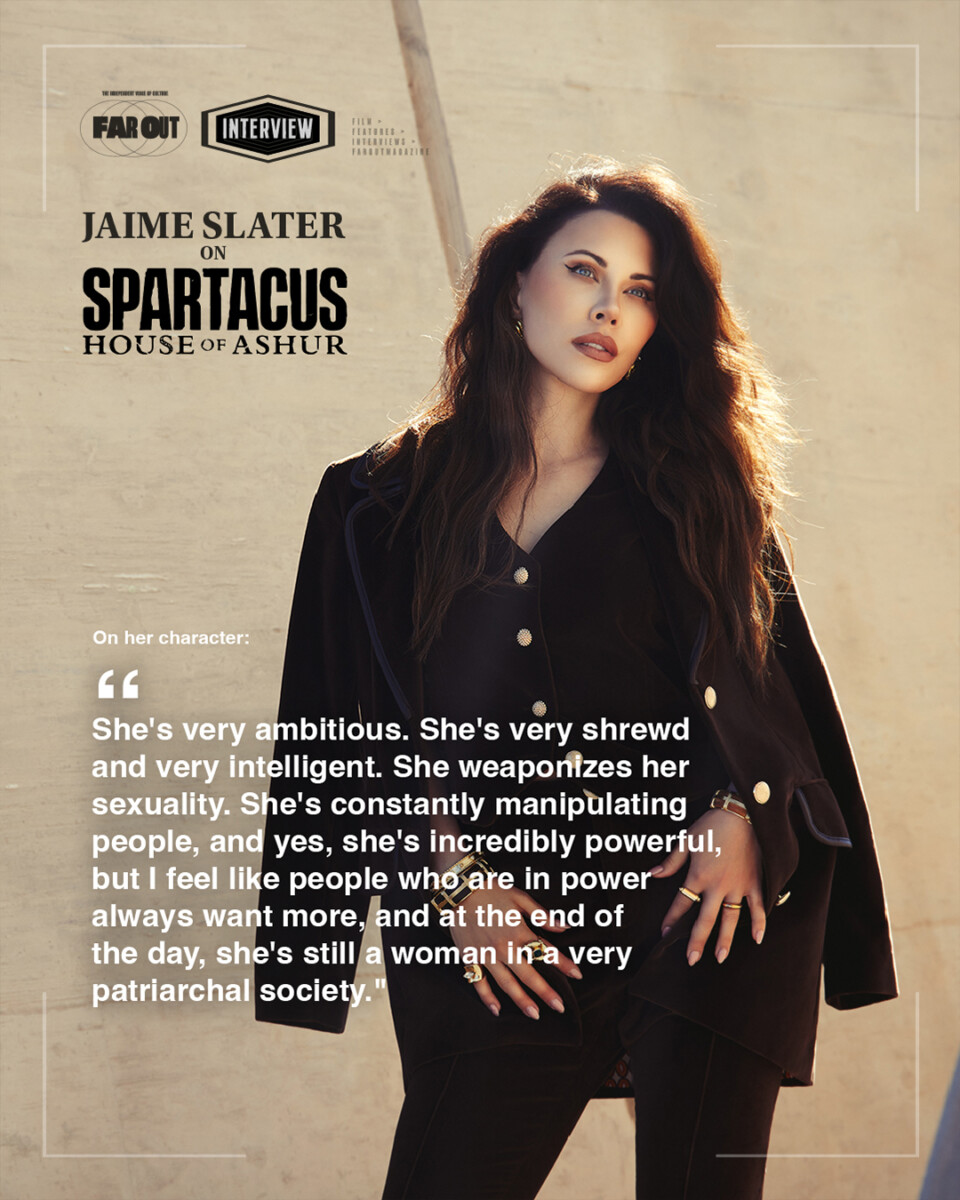
Despite her unscrupulous and scheming nature, though, the actor didn’t want her to come across as a one-dimensional villain. “She’s very nuanced,” Slater added. “I feel like this role could easily be something where you’re twisting a bit of the moustache, but she’s very layered, very nuanced, masks a lot depending on who she’s in front of, who she’s trying to manipulate, and what she’s after.”
With that in mind, in trying to come up with one word that encapsulates Cornelia, Far Out settled on calling her a vamp. Thankfully, since it could have easily gone disastrously wrong and been taken the completely wrong way, Slater was fully on board with the descriptor: “Oh, I love that! Yes, she’s incredibly dangerous.”
As for her onscreen husband? Well, not to put too fine a point on it, but Gallagher’s Caesar is a bit of a shit. He’s more arrogant, egotistical, and blatantly pompous than his spouse, making them an interesting pairing. After all, they’re as bad as each other in letting their status and standing go to their heads, but they go about it by leveraging it to their advantage in completely different ways.
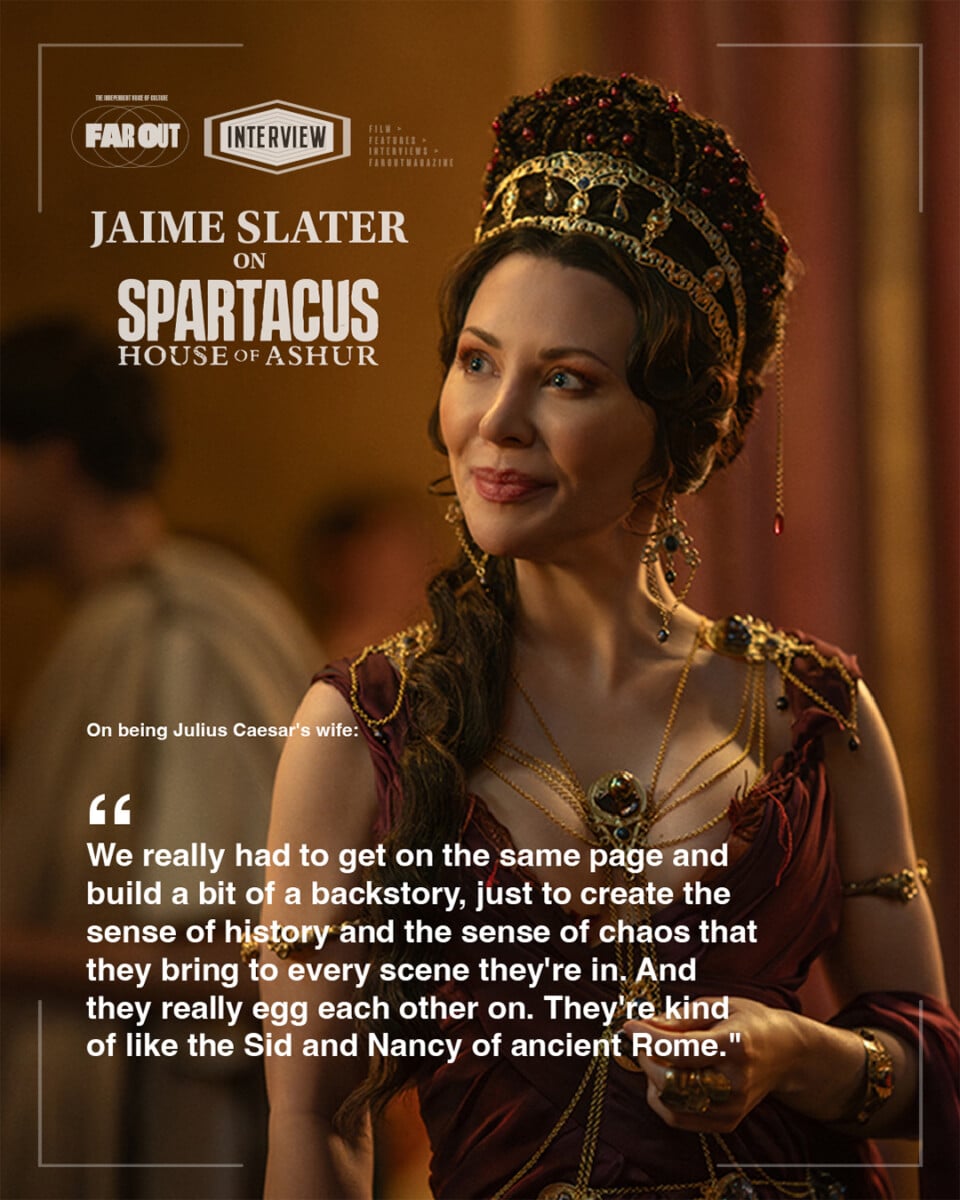
“We really had to get on the same page and build a bit of a backstory, just to create the sense of history and the sense of chaos that they bring to every scene they’re in,” Slater shared. “And they really egg each other on. They’re kind of like the Sid and Nancy of ancient Rome.” That’s a hell of a comparison, and one that she wears as a badge of honour: “Yeah, 100%”
Away from the dust and blood of Spartacus, many of Slater’s other film and television credits have unfolded in heightened realities, whether it’s Netflix’s Jupiter’s Legacy and Daredevil, the giant robots versus giant monsters sequel Pacific Rim: Uprising, or the anthology series Horror Haikus, and there’s a reason for that.
“I love good storytelling, but I’m particularly interested in worlds where you’re completely immersed, and I feel like period and specific genres really easily lend to that kind of immersion,” and there could be more to come if she gets her way. “I love fantasy, and I would love to explore any other time period as well, just playing in a totally different time.”
Since nobody is guaranteed to survive to the end of a Spartacus season, it seems foolish and potentially spoilery to ask about the future. That said, with Cornelia being a completely different character from anyone that Slater has played before, she’s clearly bitten by the bug for playing monsters.
“I view Cornelia as a very specific monster, and that’s been really, really fun to play,” she pondered. “She’s so specific in the way that she’s callous and manipulative, but I think people know what to expect from her. They just don’t know what kind of awfulness they’re going to receive. So I think it would be really fun to play another type of monster in another time period, in another world where it’s maybe more covert.”
