


The secret plot twist Jack Nicholson added to ‘One Flew Over the Cuckoo’s Nest’

Widely recognised as one of the finest actors in Hollywood history, Jack Nicholson has led a long and varied career. Thanks to his bold, inverted eyebrows and cheeky grin, he’s made for the perfect villain on numerous occasions, whether it’s the Joker in Tim Burton’s Batman or Frank Costello in Martin Scorsese’s The Departed.
Nicholson’s scope has also allowed him to flourish in more complex roles, in which he’s neither a hero nor a villain but loses himself to psychological trauma or latent personality defects. Two prime examples of such roles are those in Stanley Kubrick’s 1980 thriller The Shining and Miloš Forman’s 1975 drama One Flew Over the Cuckoo’s Nest.
The latter, adapted from Ken Kesey’s 1962 novel of the same name, followed Nicholson’s seminal, Oscar-nominated appearance in Roman Polanski’s 1974 classic Chinatown. After achieving four nominations, Nicholson finally broke through with a ‘Best Actor’ win for One Flew Over the Cuckoo’s Nest at the 48th Academy Awards ceremony. Impressively, the movie won the “Big Five” that year, becoming the second of just three films in cinema history to do so.
The picture has gone down in history as one of the most beloved, thanks not to a huge budget or big blockbuster moments but to the connection at the heart of the story. Beneath it all, One Flew Over the Cuckoo’s Nest is an exploration of the humanity we all share, and Nicholson exemplifies that in his role.
As Randle Patrick ‘RP’ McMurphy, Nicholson portrayed an amiable convict who conned his way into a softer sentence by feigning insanity. While he quickly becomes the class clown at the psychiatric hospital, urging the other patients to overcome their limiting neuroses, Louise Fletcher’s evil Nurse Ratched is none too amused with his infectious rebelliousness.
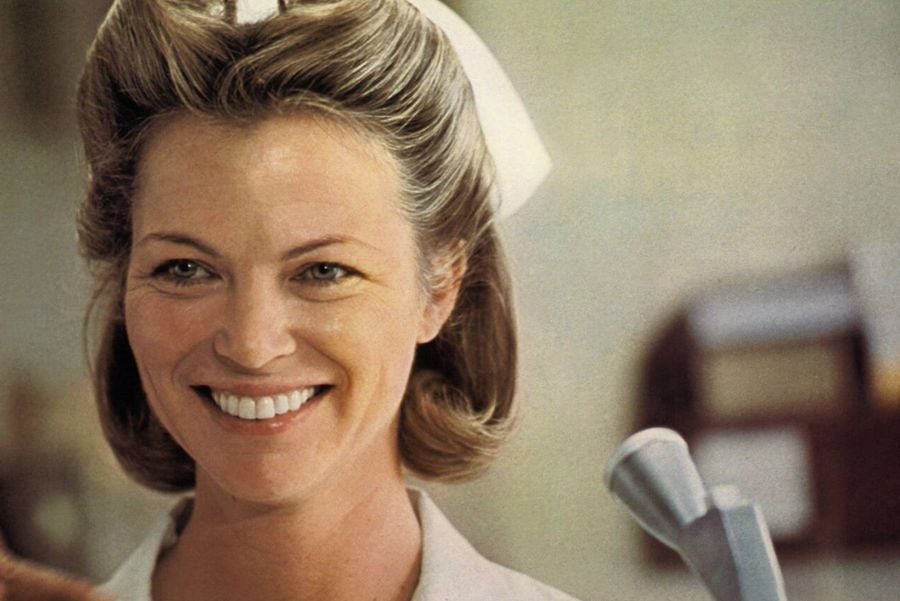
In another Oscar-winning performance, Fletcher counters Nicholson’s character’s antics with draconian order and alarming modes of therapy. Although it wasn’t implied nor ostensibly intended by Kesey, Nicholson decided to add his own plot twist to the story, a furtive dynamic to his character. The actor was always keen to add more and more layers ot his performances, and used Ratched for another secret plot point.
If you ever noticed a degree of sexual tension between McMurphy and Nurse Ratched in the movie, I commend your perception because Nicholson had just that in mind. Nicholson, famous for his improvisational approach to acting, revealed his secret twist in a 1986 conversation with The New York Times.
“All right,” he began. “The secret to Cuckoo’s Nest — and it’s not in the book — my secret design for it was that this guy’s a scamp who knows he’s irresistible to women, and in reality, he expects Nurse Ratched to be seduced by him. This is his tragic flaw.” Perhaps owing to Nicholson’s own ‘scampish’ behaviour, this line seems to fall easily into his range.
But while it could have been just a minor inflexion on the face of Nicholson’s portrayal, for the actor, he believed it to be crucial to the story’s unfurling. “This is why he ultimately fails,” Nicholson explained. “I discussed this with Louise [Fletcher]. I discussed this only with her. That’s what I felt was actually happening with that character — it was one long, unsuccessful seduction which the guy was so pathologically sure of.”
Michael Douglas, who produced the movie after acquiring the rights from Kesey through his father, Kirk, remembered his struggle with Fletcher’s character in a 2017 interview with The Guardian.
“Making Ratched a human being was no small feat,” he remembered. “You know nothing about her history, unlike McMurphy. I didn’t want to make her a monster — I wanted to make her believable as a real person in those circumstances. I drew on the misuse of power, a prominent issue in those times with Nixon having been forced to resign. I saw very clearly how people can believe that they’re doing good and they know best.”
Watch the trailer for Miloš Forman’s One Flew Over the Cuckoo’s Nest below.
