


Revisit Jack Kirby’s rare ‘2001: A Space Odyssey’ comic book

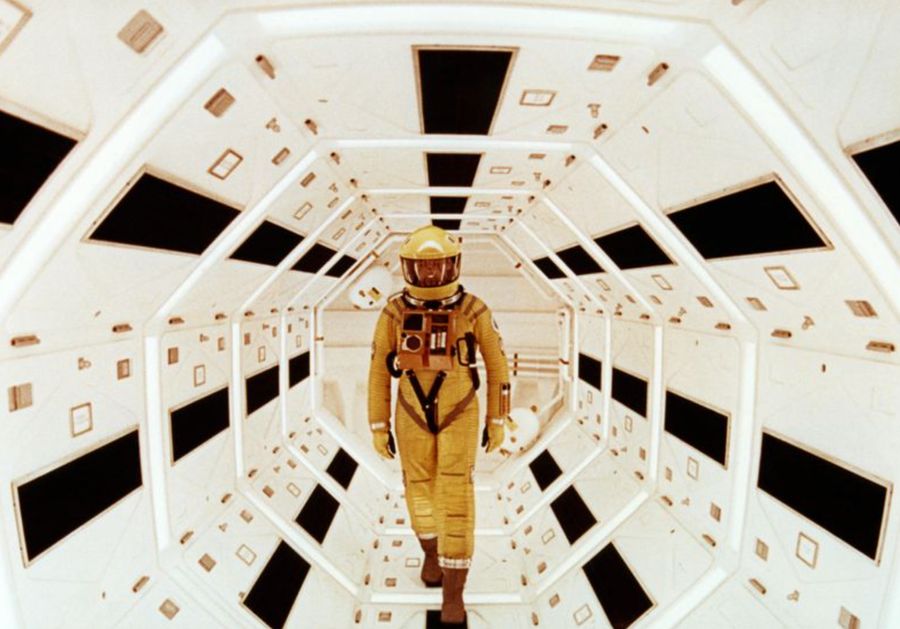
It’s common knowledge that Stanley Kubrick’s 2001: A Space Odyssey is one of the best-loved and most influential science fiction films of all time. Yet, as with many of Kubrick’s works, he took great inspiration from the realms of literature, in this instance, from a short story by Arthur C. Clarke entitled ‘The Sentinel’.
In fact, Clarke himself had been instrumental in creating 2001; he co-wrote the screenplay with Kubrick and penned a novelisation of the film during its production. The novel primarily focused on the events of the film and, as is often the case with literature when compared to cinema, more closely interrogated its themes, arguably superseding the movie on a number of different levels.
Interestingly, Clarke’s novelisation was not the only alternative work to come out of the screenplay for 2001. Jack Kirby is one of the big names in the world of comic books, and he is one of the most well-respected names from the golden era of Marvel Comics in the 1960s, having worked on X-Men, The Hulk and The Fantastic Four. In the 1970s, Kirby also adapted Kubrick’s film and Clarke’s novel into a comic book series.
It was 1976 by the time Kirby finished the adaptation, so he evidently had a profound wish to see the project through to completion. The initial result was a 70-page standalone book, although he subsequently separated the themes of 2001 into ten different issues. Given the medium of his work, he also felt it suitable to include alien monsters to add a bit of comic tension, even though they sure as hell didn’t crop up once in Kubrick’s film or Clarke’s novel.
Another facet of Kirby’s comic that strayed from the originals was its protagonist, a half-human, half-artificial intelligence being by the name of Machine Man, who, interestingly enough, was later included as part of the Avengers series. Evidently, Kirby had to consider the comic book audience, likely a young child rather than a philosophical, albeit high, adolescent. In that light, Kubrick’s tagline of ‘The Ultimate Trip’ became ‘The Ultimate Illustrated Adventure’.
So too, was Kubrick’s distinctively clear colour palette replaced by a mish-mash of colours and textures more suited to a ‘flick-through’ quick read. Also, where Kubrick’s three chapters were titled ‘The Dawn of Man’, ‘Mission to Jupiter’ and ‘Jupiter and Beyond the Infinite’, Kirby made them more palatable to children with ‘The Saga of Moonwatcher the Man-Ape’, ‘Year 2001′: The Thing on the Moon’, ‘Ahead Lie the Planets’ and ‘The Dimension Trip.
Rather than showcasing the ‘Starchild’ at the film’s end, Kirby instead chose to give the post-human being a storyline of their own. He wrote, “The New Seed is the conquering hero in this latest Marvel drama. Why? Because he has staying power, that’s why. He will always be there in the story’s final moments to taunt us with the question we shall never answer. The little shaver is, perhaps, the embodiment of our own hopes in a world which daily makes us more than a bit uneasy about the future… in the meagre space devoted to his appearance, he brightens our hopes considerably. He is a comforting visual, almost tangible reminder that the future is not yet up for grabs. And wherever his journey takes him matters not one whit to this writer. The mere fact that the chances of his making it are still good is the comforting thought.”
Kirby’s comic book is a light-hearted and fascinating entry into one of the best sci-fi storylines ever conceived. Check out some images of the work in the video below.
