


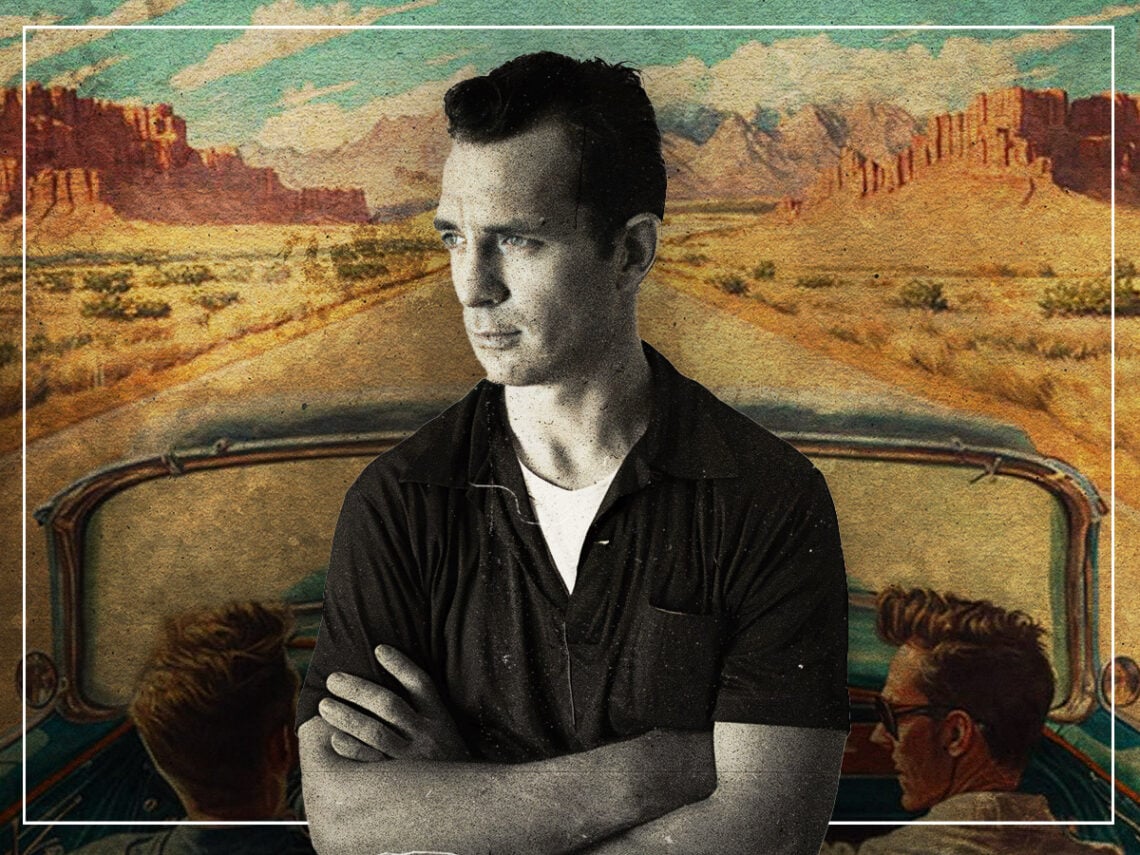
Jack Kerouac’s favourite neighbourhood in the world

“I was halfway across America, at the dividing line between the East of my youth and the West of my future,” Jack Kerouac writes in On The Road. The novel has become an American classic and a vital text for the Beat movement, spearheaded by Kerouac along with his peers Allen Ginsberg and William S. Burroughs. But in the 1950s, as he began to craft the piece, this was his diary, and the road led him to San Francisco.
In that one line alone, Kerouac perfectly summarises the connections between physical and mental places, both past and future. The writer was raised in the East, in a sheltered suburb in Massachusetts. Even when he left behind the comfort of his family home, he stayed along the same coast. In 1940, he moved to New York to go to Columbia University. This was a turning point.
When thinking of the Beat poets and where they might consider their favourite neighbourhood or most significant locations, it might be expected to be right there on the Upper West Side of Manhattan in New York City. It was there that a literature-changing gathering of the minds occurred between Kerouac, Allen Ginsberg, William S. Burroughs, Neal Cassady, John Clellon Holmes, and the rest of the original Beat Rat Pack. Encouraging one another to push the limits of form and content, expanding prose and poetry into new and exciting places, New York was the birthplace of the Beats.
But for Kerouac, the road not only made his name but utterly ruled his life as a young man. By 1947, he cast off on an adventure that would carry him from the East into the West of his future, towards San Francisco. For the next few years, the antics of his journey would build up the basis of On The Road, casting his friend Neal Cassady as the semi-fictionalised Dean Moriarty. Their goal was put to paper: “Dean and I embarked on a journey through post-Whitman America to find that America and find the inherent goodness in American man. It was really a story about two Catholic buddies roaming the country in search of God. And we found him.”
You could say that Kerouac found God when he found San Fransico. If the purpose of God is to provide divine and limitless inspiration or to utterly reshape lives, the Californian city did that for Kerouac. After journeying there during On The Road and writing about its various dives, all of his works since were shaped by the city. In The Dharma Bums and Big Sur, he almost casts California as a character as it provides an essential base and meaningful surrounding to his stories once his epic journey across the country was done. In 1958, he said plainly, “San Francisco is the last great city in America.”
But it’s in Desolation Angels that he makes that love most evident and even more specific. Kerouac didn’t just love California or San Fransico. He loved the neighbourhood of North Beach, a town in the northeast of the city.
In chapter 78 of the book, he recounts the sights of the town using a sentimental lens. While guiding his reader through the area, he’s looking for his friends as he reunites with Ginsberg, Cassady and other notable Beat figures like Gregory Corso. After trekking from East to West, from past to future, North Beach houses his present as all the pieces come back together.
If the Upper West Side is put on the map as its place of origin, North Beach can be the place it was nurtured and maintained thanks to the City Lights Bookstore, which resides there. Founded by the poet Lawrence Ferlinghetti in 1953, City Lights also served as a publisher that dared to print the Beats’ work as censorship attempted to wipe it out.
“It’s the beat generation, it’s beat, it’s the beat to keep, it’s the beat of the heart,” Kerouac writes of his beloved neighbourhood as the spirit of his generation still lives on in North Beach.
