


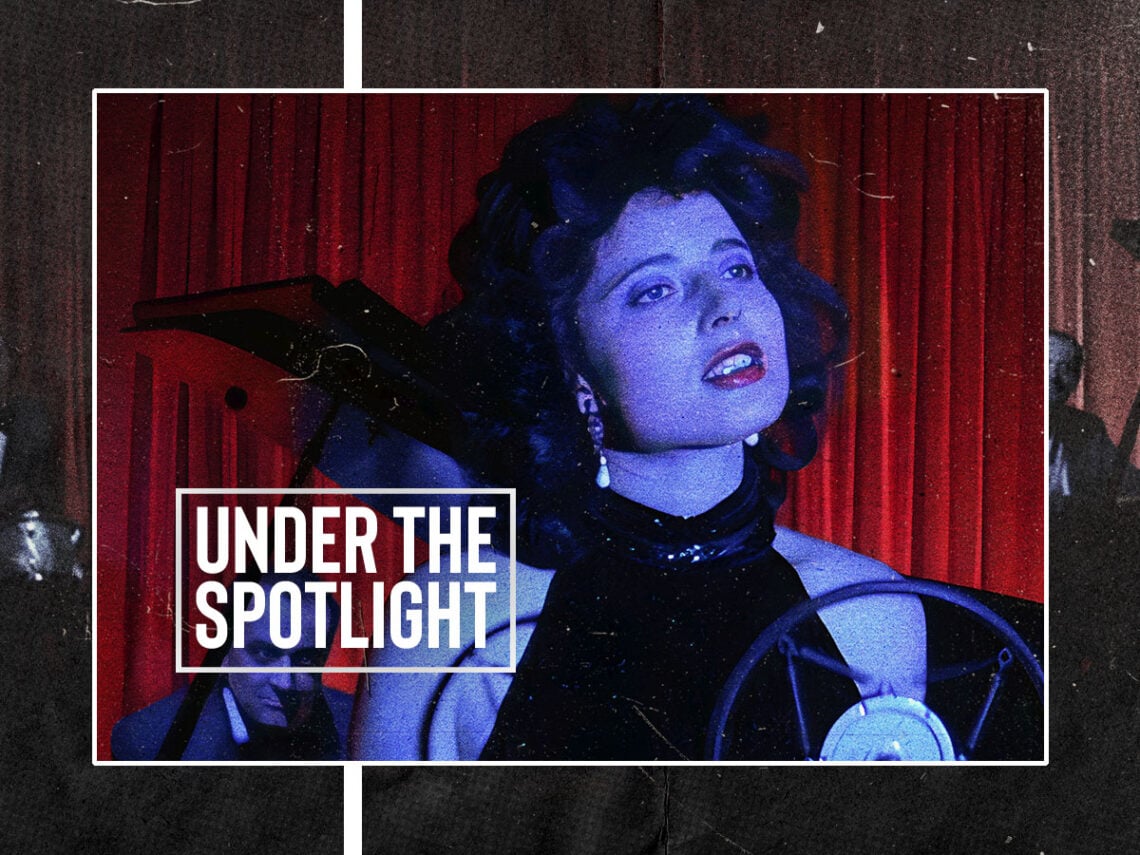
Under the Spotlight: Isabella Rossellini’s raw performance in ‘Blue Velvet’

After the critical failure of Dune, David Lynch bounced back with the release of Blue Velvet, a project which also featured Kyle MacLachlan as the movie’s leading man. Whereas the immensely hostile reaction to Dune threatened the filmmaker’s legacy, with Blue Velvet, he proved himself to be an essential voice in American cinema.
The movie follows MacLachlan’s Jeffrey Beaumont, a college student who finds himself caught up in a seedy criminal underworld after returning home to visit his father. What begins as curiosity, following his discovery of a severed ear, becomes a bizarre journey into chaos as he finds himself engaging in a sadomasochistic relationship with a lounge singer, Dorothy Vallens, who is tormented and abused by the horrific Frank Booth.
While every cast member gives outstanding performances in Blue Velvet, from MacLachlan’s naive yet morally dubious Jeffrey to Dean Stockwell’s lip-syncing Ben, it’s Dennis Hopper’s performance as Frank that is best remembered. His career-reviving role is maniacal and chilling. Hopper performs with such derangement that he gets under your skin, and it’s hard to shake the memory of his disturbing behaviour. However, Isabella Rossellini’s performance as Dorothy is frequently overlooked, yet her complexly nuanced execution of an emotionally damaged woman is central to the premise of Blue Velvet.
Born the daughter of acting legend Ingrid Bergman and Italian filmmaker Roberto Rossellini, she was always destined for the screen. However, Rossellini’s film credits were limited until this point. Instead, she was well-known as the face of Lancome. Regardless, Lynch believed she was perfect for the femme fatale-esque role and cast her anyway, and her confronting, visceral performance shocked many audiences who recognised her from beauty advertisements.
Dorothy is a tragic character whose life has been marred by abuse and fear. After she gives a mesmerising performance of ‘Blue Velvet’ at a smokey club, she returns home, where Jeffrey is scoping out her apartment, forcing him to hide in the wardrobe. However, once she discovers that she is not alone, wielding a knife at the scared Jeffrey, her demeanour impressively fluctuates between fear, anger and seduction in a short space of time. However, after shouting demands at Jeffrey and attempting to assert herself, she is beaten and raped by Frank upon his arrival, leaving her to cry on the floor.
Rossellini’s portrayal of Dorothy gives the abused character – who could easily become a vessel of male-inflicted pain and nothing more – genuine complexity and depth. You can identify her past traumas through the way she demands that Jeffrey hit her in bed, and her sheer desperation makes these scenes feel utterly heartbreaking. One of Dorothy’s final scenes sees her completely naked, dazed, and scared, holding onto Jeffrey as she cries and shouts. Her portrayal of such vulnerability and raw pain is incredible, emphasising the sheer corruption lurking underneath the characters’ seemingly idyllic suburban world.
According to Rossellini, she referred to the iconic image of the distraught girl in Nick Ut’s photo, ‘The Terror of War’, for this scene. She explained: “That woman had to have lost everything. She had to walk completely exposed. I took the gesture from that photo and used it. I hope I conveyed the same sense of despair. I wanted to be like raw meat.”
Since her performance in Blue Velvet, Rossellini has continued to have a successful acting career, reuniting with Lynch, her then-partner, for 1990’s Wild At Heart. It’s difficult to picture anyone else as Dorothy due to Rossellini’s complete immersion in the role. Although the character is subjected to abuse, she never allows Dorothy to become a lifeless, helpless victim. Rossellini’s multifaceted performance is just one of many reasons why Blue Velvet is one of Lynch’s greatest films.
