


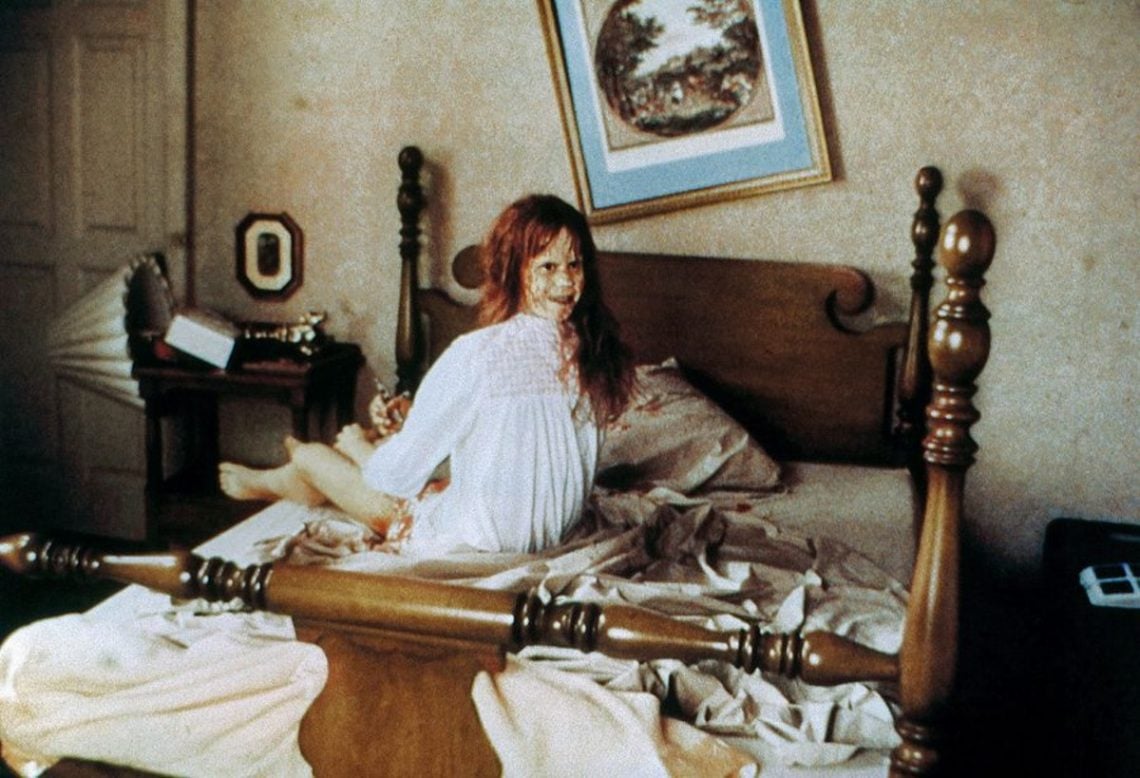
Is William Friedkin’s horror classic ‘The Exorcist’ actually cursed?

Can a film be haunted? The strange events surrounding The Exorcist have convinced many film fans that the answer may be yes. Released in 1973, the William Friedkin horror classic tells the story of an innocent young girl possessed by a demonic spirit. On release, it sent a shiver down the world’s spine and quickly became the subject of critical debate. For some, it was regarded as evangelical claptrap, while certain Christian groups regarded it as a repellant example of anti-Christian pornography.
The Exorcist was widely dismissed by critics, many of whom felt it was anti-intellectual. How strange, then, that it continues to haunt audiences to this day. Indeed, one wonders if its enduring popularity has more to do with what happened on set than the movie itself. No sooner had shooting commenced than strange incidents started taking place. A few days in, the home of Regan MacNeil burned down after a bird flew into a fuse box. The only part left untouched by the flames was – you guessed it – the bedroom used to film the possession scenes.
Things didn’t end there. Shortly after shooting wrapped, actors Jack MacGowran and Vasiliki Maliaros, whose characters are killed in the film, unexpectedly passed away. Cast members Linda Blair and Max von Sydow also lost family members during production. On set, Blair and her on-screen mother, Ellen Burstyn, were seriously injured. Worse still is the story of Jason Miller (Father Damien Karras), whose son was killed in a motorcycle accident during the shoot. But the violence wasn’t reserved for those involved in the production. In Rome, fans travelling to the cinema during a storm entered the building just as a lightning bolt hit the opposite church. In the UK, one woman passed out and broke her jaw, causing her to sue the studio.
All of this fuelled rumours that The Excorcist was somehow cursed, an idea supported by evangelical Christian groups who wanted the film banned. Indeed, TV evangelist Billy Graham went as far as to claim that the curse was embedded in the film’s celluloid. He also argued that the movie contained subliminal messages designed to warp the minds of Christian children everywhere. Freidkin also benefited from such rumours.
Audiences have always been drawn to the extremity of horror cinema, something that was exploited by the filmmakers of the 1950s and ’60s, who employed fake nurses to hand out sick bags to audience members. The idea that The Exorcist was cursed made sense on a narrative level. It was great for business too. Is it perhaps that the popularity of The Exorcist, a film almost universally panned by critics, is the result of an artful marketing trick?
