


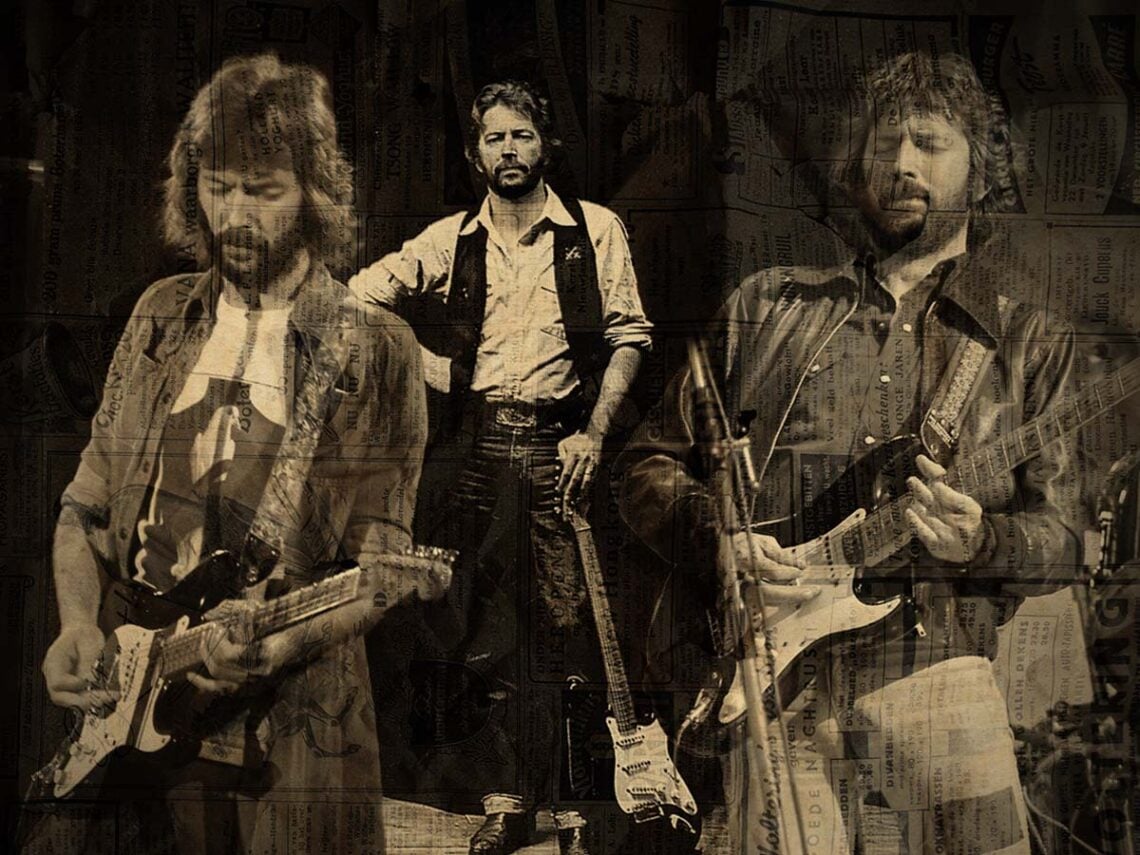
Is Eric Clapton really a guitar god?

One of my favourite Eric Clapton moments comes around halfway through Aretha Franklin’s ‘Good to Me as I Am to You’, from the ridiculously good 1968 album Lady Soul.
The record opens with a swaggering but brooding smattering of guitar notes from Joe South, you know how it goes, before the vocals kick in and the band struts and strides through the chillingly cool song.
Each layer of the recording, from Aretha’s unbeatable vocals to those backing singers, keys, the unbelievable drumming and crazy bass line, all of it is perfect. Jimmy Johnson complements it all with a series of soulful asides on his guitar as the song goes on, though still leaving space for Joe South and the rest of the musicians, his string-bending and stop-start style sounding more than a little inspired by the playing of Pops Staples.
Then there’s ‘People Get Ready’, a piano and brass-led gospel ballad where the guitars aren’t ever a main focal point of the song, but each tastefully supports the rest of the music and weaves into the fabric of the track, never trying to pull focus from Franklin, those horns, heavenly backing vocals or the message in the lyrics. This time, Joe South and Jimmy Johnson were joined by the monumentally talented Bobby Womack.
Lady Soul is not a guitar album by any stretch of the imagination, and across such timeless songs as ‘(You Make Me Feel) Like a Natural Woman’, ‘(Sweet Sweet Baby) Since You’ve Been Gone’ and ‘Come Back Baby’, the instrument is used in more of a supporting role and always plays in service of the song, rather than in service of the guitarists own ego, talents or name. But there is one song on the album where the guitar steps out of the shadows and instead serves the guitarist, his ego and his name, and that is ‘Good to Me as I Am to You’, and the guitarist is Eric Clapton.

Opening with a slow-burning and gutsy piano, Clapton soon wastes no time at all in playing more notes in the 20 seconds between his instrument fading into the mix and Franklin starting to sing than South, Johnson and Womack play all across the rest of the record.
His guitar is louder than theirs ever gets on the album, and sits jarringly outside of the mix rather than working within it. It sounds a little like when you plug in and play along with your favourite albums at home, not part of the band but adding your own licks and lines here and there nonetheless.
Technically, everything he plays is very good, if a little repetitive and derivative. This kind of playing probably went down incredibly well back home in England, where we don’t and haven’t ever had people capable of playing soul guitar and the blues as well as the true originators in America, but Stateside and on this session especially, Clapton misses the mark in a way that the other guitarists on the album don’t. He spends the entire time pulling focus from Franklin, caught in a loop of phrases and licks that he’s ripped all the way off of BB King and watered down like cheap whiskey.
Back to my favourite moment, though, it comes when Clapton has just hit a flurry of the same exact notes he’s been toiling away at, over and over, for around two minutes. “Listen to this!” Aretha yells out, and you think that maybe he’s going to finally get what he wants and have a moment in the spotlight to let loose, but actually, when the band kicks into the bridge, Clapton has gone quiet. He stops playing for almost a full minute, and the band really come together, really gets cooking, and collectively, they take off. It’s the best minute of the song, and that minute of silence from Eric Clapton is my favourite thing he’s ever done in the studio.
Taken out of his comfort zone, that is, out of a situation where all the other White English blues fans who understood the sound of the music, but not necessarily the way it ought to feel, had begun to worship him as a God, Clapton bombed. And if he really is a guitar god, then you can consider me an atheist and a true non-believer.
He wasn’t the best white blues guitarist of his generation (that’s Michael Bloomfield), he couldn’t hold a candle to Keith Richards, George Harrison, Jimi Hendrix or Duane Allman, let alone people like Clarence Carter, JJ Cale, or Bobby Womack, and he shouldn’t ever be mentioned in even the same breath as true bluesmen like BB King, Albert King, Muddy Waters or Robert Johnson and all the rest.
But by playing so many figures, licks, riffs and songs associated with all those greats that came before him, by appropriating the playing of far more talented, soulful and skilful guitarists, Clapton has unfortunately long-since been associated with each of them.

The phrase “Clapton is God” was first spray-painted onto a wall in Islington sometime between 1965 and 1967, when Clapton was playing with The Yardbirds and John Mayall & the Bluesbreakers. Maybe in Surrey and in Surbiton, we hadn’t heard anything like him before, but in Memphis and in Chicago, in New Orleans and in Alabama, everybody who plays the blues could play them better than Eric Clapton.
Nothing he ever did was innovative or original, and nothing he ever played had even half as much feeling as all of the people who really lived with the spirit and history of the blues deep down inside of them. How could he have done? He didn’t even play the best guitar part on the song that he’s most famous for, ‘Layla’! That’s Duanne Allman with the legendary riff and those searing, sliding notes throughout the song.
Clapton can flatter to deceive with the best of them, though, and knows that firing off a flurry of simple notes around the blues scale after a slightly more restrained buildup, or pulling a pained grimace while he bends a note high up the fretboard à la BB King, is a good enough substitute for actually playing anything interesting, exciting or memorable on his instrument.
And, let’s not forget his violent history of wife-beating and abuse (not to mention the cheating on both wives, lovers and friends), cultural appropriation, shocking and unforgivable racism and, more recently, his strange Covid conspiracies. Far from being anything close to a God, Eric Clapton is much more a devil in disguise.
I’m not allowed to write one-word articles, but if I could have, all you’d have seen under the headline ‘Is Eric Clapton really a guitar God?’ would have been the word ‘no’.
