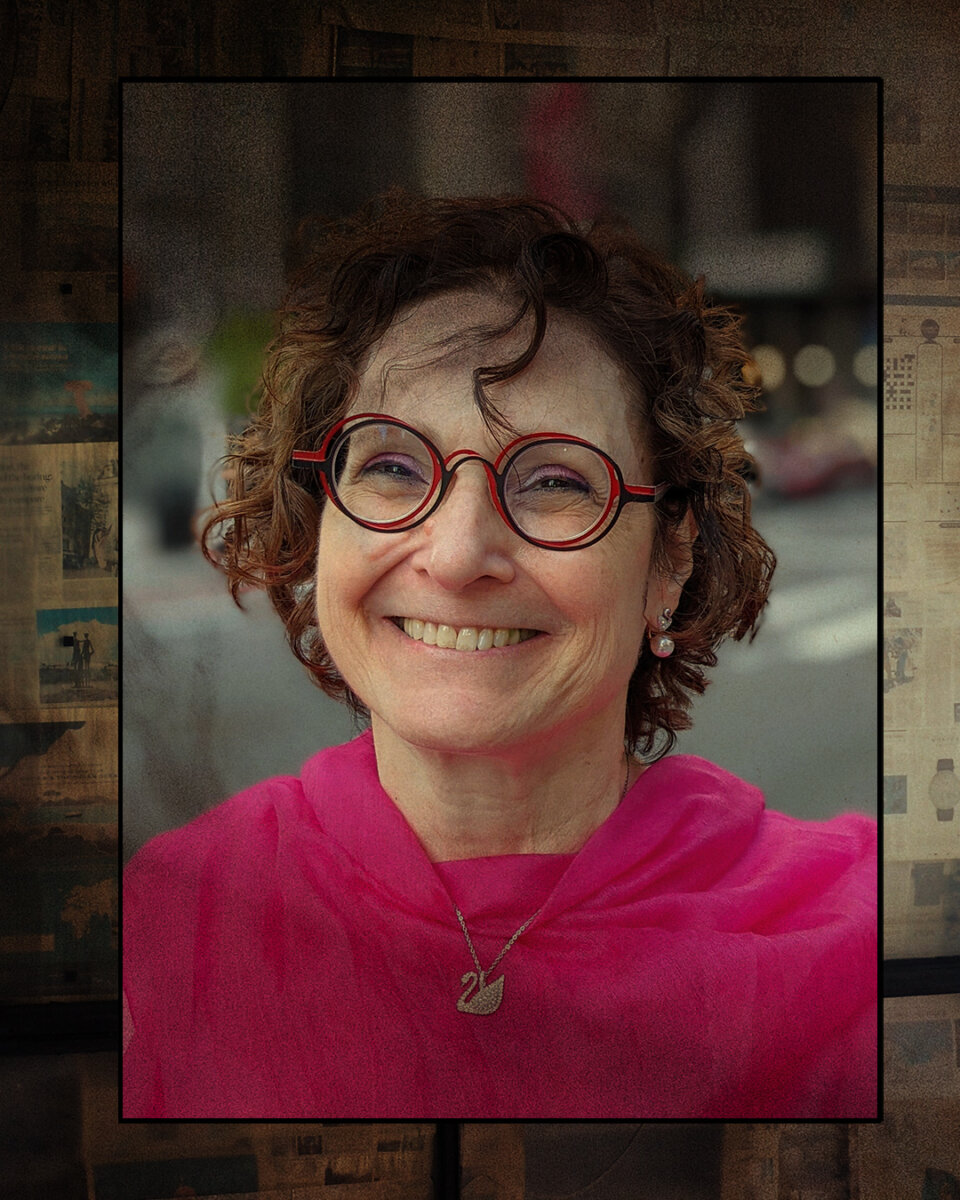
“The purge that’s underway is a huge concern”: In conversation with Jan Lisa Huttner

Women in the movie industry, their acceptance, their recognition, continues to be a contentious issue.
While female directors and female-centred content seem to have become more common, statistics provide a mixed message and suggest that improvement can be surprisingly slow in this area. A key figure in the effort to expand women’s place in film is Jan Lisa Huttner, a New York-based writer, film reviewer and columnist, popular speaker, and activist who, for over 20 years, has campaigned for more inclusion of women filmmakers and their equitable treatment, in everything from financing to award nominations. She is also the author of Penny’s Picks: 50 Films by Women Filmmakers 2002–2011 and film blogs, Films For Two and The Hot Pink Pen. Far Out was fortunate to have a chance to speak with her.
Huttner is creator of a cause now known as International SWANs (Support Women Artists Now), which was launched partly as an offshoot of her letter to the editor of the New York Times on the “celluloid ceiling” and the discounting of women artists. The letter drew a great deal of attention, and Huttner seized the opportunity, using contacts within the American Association of University Women (of which she was a director) to form SWAN, a project that will mark its 21st anniversary in October.
The project was built on some of Huttner’s former activities; she recalls: “I had actually done several speaking engagements at the state and the regional level, related to the issue of women filmmakers and how bad the statistics were at that time. They’re somewhat better now, but 20 years ago, they were really dismal in terms of women being able to get the green light to make their films, and then get support to distribute their films.” SWAN was a natural continuation of her efforts.
The position of women in the film industry has fluctuated over the years, where Huttner notes the “dismal” position of women in film has been better at some points, worse at others. There were many female directors and producers in the very earliest days of film, when movies were not considered a serious art form. Even more significantly, she points out, when movie-making was emerging in the early 20th century, “there wasn’t all that much money involved”.
“As soon as it started becoming more lucrative, the women were pushed out”, and film became, for many years, the domain of male producers and directors. More recently, things have become a bit more complicated. For example, university-based think tank, the USC Annenberg Inclusion Initiative points to a significant increase in the number of female lead characters in film, but little to no change since 2009 in the percentage of female characters overall.
The acceptance of women filmmakers, however, has progressed more slowly. Huttner and SWAN, therefore, focus largely on the issue of female directors, causing a considerable stir, initially, over the 2008 Academy Awards nominations for the very popular Slumdog Millionaire. The film had two directors, one male and one female. Danny Boyle received a nomination for the ‘Best Director’ (which he won), while co-director Loveleen Tandan did not. Huttner mentioned a second film, which received similar treatment, the 2002 drama City of God. Its male director, Fernando Meirelles, was nominated for the Oscar for directing, while his female co-director, Katia Lund, was not. In fact, director Tandan was not even invited to the Academy Awards ceremony that year, until the Academy was pressured to include her by organisations like the Women’s Media Centre.
“The official explanation at that time,” Huttner recalls, “was that there could be only one director [nominated] per film,” adding, “they’ve since changed the rules. It’s interesting, a lot of rules were changed in those two years.” Following a great deal of press over the Slumdog Millionaire situation, “the very next year, The Hurt Locker actually carried the first woman ever to the ‘Best Director’ slot, and I do think that those two things are very intimately related. The brouhaha created over Slumdog Millionaire translated itself into sympathy by some, and a sort of resigned ‘yeah, let her have it’.” The Academy reaction was not planned, or expected, by Huttner or her associates, and she adds, “The Slumdog Millionaire thing really did amaze me, because I stumbled into it very innocently, and then…it was like riding on some weird surfboard wave, and it carried me through.”
Public reaction to the Oscar protests also surprised her; it was not all positive by any means. “I didn’t get death threats, but I got a lot of really hostile mail,” Huttner recalls, “And ironically, I got a lot of very hostile mail from women. There was one woman, another woman critic, who said to me, ‘If you don’t shut up, you’re going to kill her [Loveleen Tandan] career and she’ll never work again’.”
While this may seem like a needless concern, the activist is uncertain: “It’s been over 15 years and she never did work again; I tried through various channels to find out what had happened, and I never did find out; and so, yes, I do worry about that, because [Tandan] disappeared, and she’d had a career before Slumdog. She had been a casting director primarily. She worked with Mira Nair, and also with [Sarah Gavron], who did Brick Lane, which is partly set in Bangladesh, so she was very well known.” Tandan’s co-director, Boyle, was interviewed by Huttner: “He said she was a great filmmaker; he didn’t hold back at all, I didn’t prompt him to say anything that he didn’t say, so the whole thing was just kind of weird”.
When the Slumdog controversy gained publicity, Huttner says director Tandan “did the very female thing”, distancing herself from the conflict. In her words, Tandan had protested, “‘No, no, I was just supporting Danny, I didn’t want to have any part of it’, and I respected that”. Still, the director’s sudden removal from film work puzzled her, musing, “She was actually invited to the palace to meet the Queen. She met Queen Elizabeth, and had quite a year, and then she vanished, and I don’t know the story.” Huttner also recalls the Oscar ceremony, which the director attended, “which was a big deal”.
“And yet, the day after the Oscars, and this is the truth, there were a million photos, and I knew she’d been there on the platform when the whole team went up, when it was named ‘Best Picture’. She went up to the platform; she was there. But when I went through all the pictures, in Newscom, in Getty Images, in Alamea, I went through all the pictures and she was not identified in a single picture! They did not acknowledge that she, the co-director of this film, was on the podium… From the point of view of the world press and the American press, she was not there.”
Was this a kind of blacklisting, due to the nominations controversy? “Blacklisting would be more intentional. It was invisibility. She had been disappeared from the story”. Huttner feels that accounts of the event continue to play down Tandan’s involvement.
“But then, a year later, there was Kathryn Bigelow getting an Oscar. Of course, part of the issue with The Hurt Locker is that the Academy gave an Oscar to a film directed by a woman, that had no women characters in it, none.” She underscored the lack of female presence, pointing out, “There’s one sentence, when the Jeremy Renner character is on the phone with his wife, one phone conversation, and you never even see her. There are a couple of Iraqi women who are speaking Arabic to each other when soldiers break into their home, but there’s no woman character in The Hurt Locker. So you say, well, they finally found a way to give an Oscar to a woman who directed a film that has no women in it. I took it; I was happy. But then, when she makes a film that’s female-centred [Zero Dark Thirty], she gets swift-boated.”
Bigelow was the subject of an earlier equity protest by Jan Huttner and others, involving her war drama Zero Dark Thirty. It was one of several high-profile movies directed by women, which received Oscar nominations in multiple categories, including ‘Best Picture’, but oddly not for directing, including well-received productions like Little Miss Sunshine, The Prince of Tides, Frida, An Education, Winter’s Bone, Selma, Greta Gerwig’s Little Women, Coda, She Said, and others. “It was astonishing,” Huttner says of the Zero Dark Thirty nominations.
She wrote three Huffington Post articles on the matter, which caused unexpected feedback. “I was getting so much hate mail. You just can’t believe it, and it was stuff like, ‘We gave her one Oscar already, why does she need another?’ In other words, we gave it to you to shut you all up, so why aren’t you shut up? Why isn’t that enough?”
Huttner admits she became a bit obsessed with the issue. “I ended up seeing Zero Dark Thirty three times, the third time with a yellow legal pad in front of me so that I could write all this stuff down, because the things that were being said about the movie were so preposterous.” That includes critiques of the film’s accuracy, its appropriateness, and sometimes outlandish interpretations of the content of the story itself, which began circulating online.
Is there a case to be made that the limited success of films made by women is a straightforward business decision? Do women tend to make films which are less marketable, less popular, and ultimately less profitable? Huttner responds by mentioning events marking the 30th anniversary of the release of Clueless, Amy Heckerling’s 1995 comedy loosely based on Jane Austen’s Emma. “The Morgan Library in Manhattan, a very famous place, have an exhibit on the 250th birthday of Jane Austen…a big exhibit called A Lively Mind. As part of that exhibit, they showed Clueless, and Mona May, the woman who designed the costumes for Clueless. That’s how popular and famous it is.”
During the exhibit, Mona May “was talking about how hard it was for Amy Heckerling, the director, to pitch the story of Clueless, even though it was based on Jane Austen’s Emma, very popular; and [Heckerling] was known for Fast Times at Ridgemont High, a very, very well loved movie that launched Sean Penn… but she had a lot of trouble pitching a story they didn’t want to take.”
The objection, allegedly, was that the movie, aimed at a female audience, would not attract audiences and would not be marketable. “And of course, it was,” Huttner concludes, “and 30 years later, it’s still a beloved favourite”. She went on to point out that Jane Austen herself was not appreciated as an author or her work financially successful during her own lifetime.
The subject of marketing led Huttner into a discussion of the ‘Barbenheimer‘ phenomenon, about which she takes an unusual perspective. She considers Oppenheimer overrated. Despite her academic background in the history and philosophy of science, she was unimpressed by the presentation of the atomic breakthrough and concluded simply, “This was not a good movie”. She considers Christopher Nolan’s earlier work in Dunkirk to be superior to the more high-profile Oppenheimer, and maintains that, despite being considered the more serious and significant film of the two due to its subject matter, its popularity was boosted by the simultaneous release of Barbie, not the other way around. In that sense, evidence of the marketability of a female-themed movie was misperceived.
While determined to focus on the gender gap in the movie industry, the reviewer acknowledges inequity in other areas, but also takes note of overlaps. “The ‘Oscar So White’ campaign, which everyone remembers as a turning point, had to do with Ava DuVernay and the release of Selma. And, of course, Ava DuVernay was a Black woman, but I’ve been saying for years, why is Oscar always blue [as in, blue for boys, pink for girls]? The ‘blue’ part of that controversy seemed to bypass everyone, and all they focused on was the fact that Oscar was white. not that Oscar was blue.”
Huttner’s reviews have, in the past, also pointed out some of the more obvious examples of erasure, as when a character based on a real person is altered to make the character white, or non-Jewish, “for marketability”, she suggests, but she does not make that her central focus.
“This is a big issue for some people,” she acknowledges, “To be honest, I have enough to do. I can’t take on all the battles of the world”. Referring to DuVernay, she recalls, “she’s actually been quite open about it; she’s actually said in interviews, ‘If I have to choose, I’m a Black person’ [as opposed to a woman].” Huttner, who is also Jewish, says, “I have the opposite reaction: my reaction is, If I have to choose, I’ve chosen women. I mean, women are themselves over 50% of the world population, and they’re also the ones who ensure the next generation of boys.”
Referring to her two books on the message and characters of Fiddler on the Roof, she adds, “It’s not like I haven’t worn my Judaism on my sleeve. But if you’re going to force me to choose…I’m going to say, ‘You know what? I can’t. My commitment is to women and girls in particular, and women and children generally.”
She once suggested that men and women tend to view movies differently, focusing on different aspects of the film. Asked whether female filmmakers tend to produce different stories than male ones, to be seen in different ways, she agreed that that is the case: “You’re never going to get me to say that I don’t love men and men’s point of view,” she cautioned, “It’s not like my own cultural experience is limited to things by and about women.”
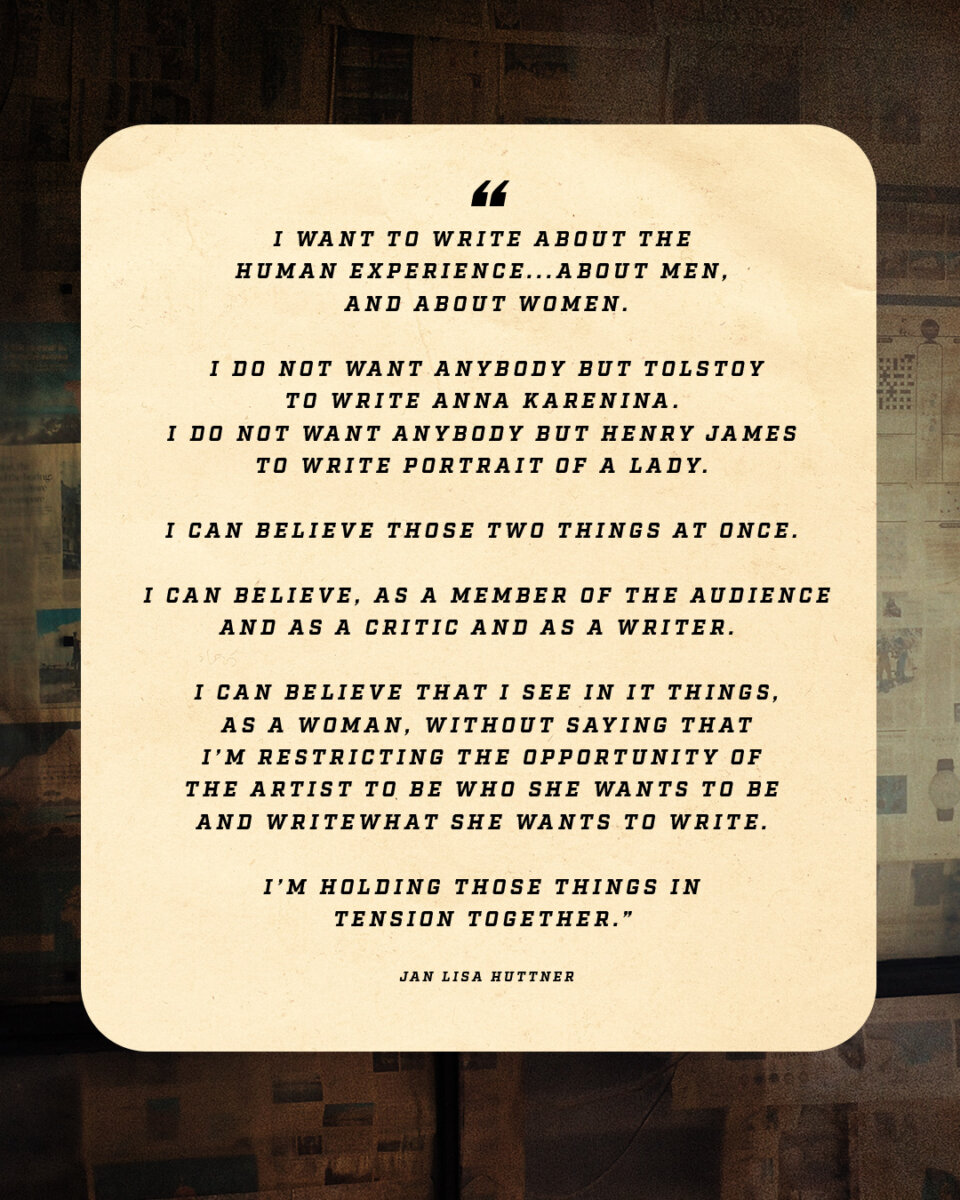
She quotes from an interview with screenwriter Barbara Turner (who wrote the screenplay for Pollock), who rejected the idea of writing as a woman, and insisted, “I want to write about the human experience…about men, and about women”. Huttner agrees: “I do not want anybody but Tolstoy to write Anna Karenina. I do not want anybody but Henry James to write Portrait of a Lady. I can believe those two things at once. I can believe, as a member of the audience and as a critic and as a writer. I can believe that I see in it things, as a woman, without saying that I’m restricting the opportunity of the artist to be who she wants to be and write what she wants to write. I’m holding those things in tension together.”
All the same, she maintains that men and women experience art, including movies, differently, giving a personal example of watching the Charlize Theron sci-fi adventure Aeon Flux with her husband of many years. Her husband was unimpressed because the “rules” of the fictional world were not clear to him, while Huttner enjoyed the movie due to the complex relationships between the characters, which her husband had all but overlooked. “So yes, I do absolutely think that women are focused more on interpersonal dynamics and relationships, in general”.
In the same way, she suggests that women filmmakers tend to produce different films, or to write or select different scripts, than men generally would. “I do think women have a right to see the films that relate to interpersonal dynamics, especially women dealing with other women: mothers and daughters, sisters, friends, that are generally films written and/or directed by women.” This, she feels, is something that remains constant despite social change. “Which is why you go to see Clueless or Barbie with your girlfriends, but if your husband wants to see Oppenheimer, you’re like, ‘Okay, we’ll do Oppenheimer‘. That’s a fact, too.”
On the question of whether things are improving for women filmmakers, Huttner feels there is some cause for optimism, not necessarily because the field has become more welcoming but because the film industry itself is going through significant change. In a talk she gave about 20 years ago, she stated that women’s presence in film was actually declining at that point. Of the top 250 films that year, over 90% had been directed by men; 83% had no female screenwriters; and only 60% of movies had any female protagonists. Determining whether or not there has been improvement has become complicated. One issue is the spread of quality movies from the cinema to parallel sources, like streaming services, which may expand opportunities to directors who, for whatever reason, can’t get studio backing.
Another is the matter of which movies are taken into consideration. A lengthy interview Huttner conducted with Martha Lauzen, executive director of the Centre for the Study of Women in Television and Film, led her to rethink some assumptions.
“The issue had to do with the cutoff at 250, and how you defined the pool of movies you were looking at. People thought it was across the board, only so many percent of women are making films, and that wasn’t true. What was true was that the films women were making, for primarily marketing reasons and budget reasons, were not ever going to be achieving that list of the top 250 based on box office.” In short, women may well have been producing or directing more movies, even successful movies, without appearing in the statistics, due to the way the data was compiled.
Even more significantly, “the market has changed. It’s no longer big-screen focused”. SWAN itself has expanded beyond cinema releases, and Huttner sees the shift as allowing for more diversity in filmmaking: “Theatrical movies are difficult for everyone, as is the market for theatrical movies, unless they’re superhero movies and spectacles and that kind of thing”. Women may not have made advances at this level of cinema, but the platform switch has been beneficial as “a lot of the women filmmakers that I have known over the past 20 years have found great homes in streaming and series”.
She gives the example of director Deborah Kampmeier, who was nominated for multiple Spirit Awards, and for the John Cassavetes award “for really mega-low-budget films”. Since the shift in platforms, Kampmeier is now directing episodes of the extremely popular The Gilded Age. “A number of women, really great women filmmakers [have found] opportunities in streaming, and in these mini-series and multi-year series”. Invoking the pandemic years and Covid-19 quarantines, she says, hastened the change: “Once we all went into lockdown, there were no more theatres, there were no more Friday release dates; everything is much more fluid”.
“About six or seven years pre-pandemic, [SWAN] was seeing every film in New York that was either written or directed by a woman, every single one,” she recalls, but it became increasingly difficult to find obscure films in cinemas. Now “the whole economic model has changed with streaming and how things are measured; you could no longer say ‘what are the top 250 movies?’”
While streaming offers a wider range of opportunities to filmmakers, she is disappointed by the lack of availability, or even unavailability, of certain material, including slightly older, female-directed movies, through streaming services, apparently due to financial considerations. “Netflix made all these promises to us, Amazon made these promises, but they don’t want you to see any of this old stuff, because they want you to watch their new stuff,” she noted.
The critic mentioned one cause of the downturn in film opportunities in the US, particularly for women and minorities. While acceptance of women in film is “definitely better than it had been, now, of course, we’re in Trumpsylvania, and they’re cutting back grants. It’s unbelievable what has happened in the months that Trump has been president. It’s really catastrophic”. She is referring to funding being cut for such innocuous and well-established entities as the Emily Dickinson Museum, exhibits being abruptly cancelled at the Whitney, and the stemming of capital into the arts in general. “Things had really been improving across the board for women”, but “the purge that’s underway is a huge concern”.
Nevertheless, Huttner maintains that largely, “I’m a glass-half-full kind of person. In some ways, there are more opportunities than ever for women”. It’s hard not to don those more optimistic glasses in this uphill torment and fight for the best.