


‘Immigrant Song’: The story behind Trent Reznor and Karen O teaming up for the greatest cover of the 21st century

In the Early Middle Ages, Europe lived in fear of invaders from the north.
Seafarers whose almost supernatural ability to traverse the waves was second only to their terrifying prowess in battle. A grim spectre of certain death hung over anywhere unlucky enough to be coastal and facing the Scandinavian countries. The people living there went about their lives in the knowledge that at any given night, they might look out to sea to find those tell-tale torches in the distance, and know they had mere minutes to uproot their entire lives before some seven-foot-tall beast of a man would do it for them.
Considering those raids were over a 1000 years ago, the historical records we have telling us about them are murky at best. There’s more than enough historical evidence to suggest that the Vikings were actually no more violent than any other society active in the eighth to 11th centuries. Yet the spectre of ‘the land of the ice and snow’ being one violent and full of terrors still lingers. For proof of this, look no further than the most recent invading force to come out of Scandinavia.
Nordic noir seeks to present a world as bleak and violent as those reports of early Viking raids, as if they’re seeking to take back control of their cultural narrative. Trying desperately to retain a sense of edge long since lost to Abba and the exploits of Thor in the Marvel Cinematic Universe, shows like The Killing and The Bridge have had an astonishing cultural footprint, as have authors like Jo Nesbø. However, there is one series that looms to cast its dual language shadow over all of them, and it’s Stieg Larsson’s Millennium series and, in particular, its first novel, The Girl with the Dragon Tattoo.
The term bestseller barely covers the impact that Dragon Tattoo had. To those who only know it by reputation or by the adaptations (which we’ll get to), saying it has sold 30million copies in the 20 years since its release in 2005 would probably make sense. That would be a lie. It had sold 30m copies by 2010, five years after its release. After a successful film adaptation was produced in its native Sweden, Hollywood came a-calling for what they would eventually call ‘The Feel Bad Movie of Christmas’. They were not kidding.
What cover did Trent Reznor and Karen O create for the film?
Daniel Craig was cast as Mikael Blomkvist, and after one of the biggest casting projects in recent Hollywood history, Rooney Mara was cast as the eyebrow-less Lisbeth Salander (narrowly beating out Scarlett Johansson). Rounding up by tapping in David Fincher, the man behind Seven and Zodiac, was a sign that producers were willing to go balls to the wall with this adaptation. That none of the edges were being shaved off, and this was not going to fucking betray its source material like all the other shite that did.
Another sign that the film was going with a dark, uncompromising tone was the hiring of Nine Inch Nails’ Trent Reznor to helm the score for the movie, alongside his composition partner Atticus Ross. The pair received an Academy Award for their work on Fincher’s masterpiece The Social Network, hence it was all business as usual for them. Yet, despite how intense, atmospheric and goddamn effective Reznor and Ross’ work is, there is only one track of theirs I find myself coming back to.
Fincher approached the film as a nightmarish version of a James Bond movie, and not just because he had a literal James Bond fronting the damn thing. He envisioned the film having a title sequence, one that would serve as a twisted take on a Bond tradition. This idea for the song to match the flipped vibe came early in the production timeline, as Fincher described in a commentary track he recorded for the film.
He said, “I was riding in a van in Sweden, I had my iPhone with me, and I was listening to Led Zeppelin, and this song came on… I just liked the idea of an anthemnal, incredibly famous track that could be wailed by a woman. He did a version just to the music, and I listened to it, and I thought it’s so evocative of what I think Lisbeth’s…not thinking…her marrow, what’s happening down deep inside her bones.” The finished project is harrowing, uncomfortable and pretty much my favourite cover ever. One that just inches up to the Led Zep original for me.
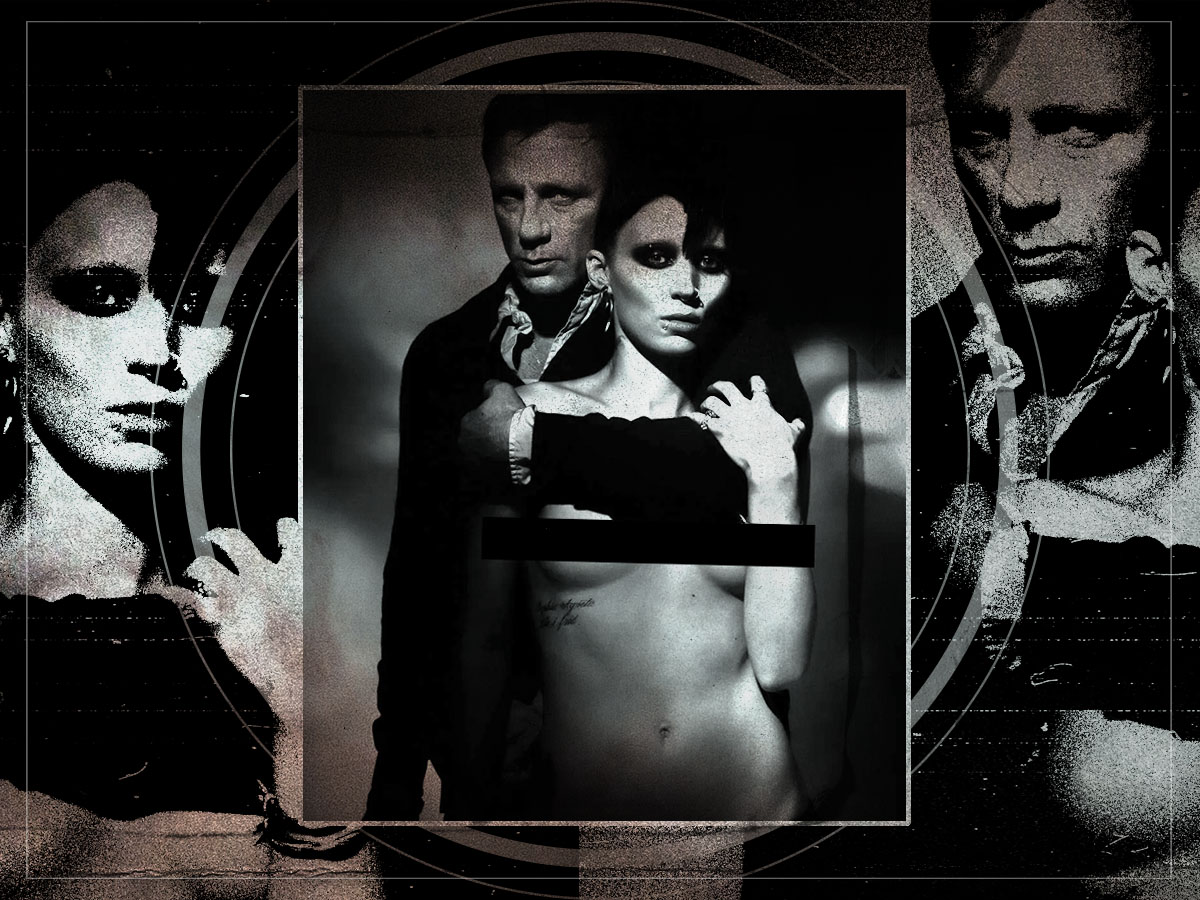
That may sound sacriligious, but in a way, that’s the point. From the work of Stieg Larsson to David Fincher to Trent Reznor, every aspect of this project is one that seeks to confront the treatment of women in its past. The Girl with the Dragon Tattoo, as a story, is one that seeks to remove all hint of glamour and beauty to the crime drama, a genre built on the backs of brutalised women. As previously mentioned, Fincher treated this film as a James Bond photo negative, and the treatment of women by that franchise is a much longer, even more depressing article all of its own.
Then, you get ‘Immigrant Song’. On the surface, it’s a spectacular take on the source material. A brutal, unforgiving blast of treated guitars, distorted synths and thudding percussion that replaces the tribal swagger of the original with an almost martial precision. As a piece of pop music, it’s absurdly exciting. An intoxicatingly dark thrill ride that any fan of Trent Reznor and Nine Inch Nails could mosh to alongside ‘March of the Pigs‘, ‘Head Like a Hole’ and ‘The Perfect Drug’.
Yet, you dig a little deeper into what Fincher is really saying, and his specific desire to give this song to a woman to sing and the true, black fury at its heart is exposed. The skeletons in the closet of Led Zeppelin are numerous. Acts of cruelty, control and abuse are commonplace, most often towards women. Unforgivably, they’re sometimes towards girls. By giving this song to Karen O and framing her not even as the thoughts of Lisbeth Salander but the very soul, the very being of a survivor of sexual assault, something genuinely transcendent is unlocked.
I’m not even sure words can be put to it, much less my own. I’m reminded of words spoken by JG Ballard in his novel Crash: “I wanted to rub the human face in its own vomit, and then force it to look in the mirror”. Everything about The Girl with the Dragon Tattoo is an attempt to do that to men, forcing them to really see the way they treat women.
With their cover of ‘Immigrant Song’, the team of Karen O, Trent Reznor and Atticus Ross create a work that transcends its surroundings. A black diamond of a cut that truly elevates its source material by lashing out at not only its creators, but the society that deifies them.

Never Miss A Beat
The Far Out Led Zeppelin Newsletter
All the latest stories about Led Zeppelin from the independent voice of culture.
Straight to your inbox.