


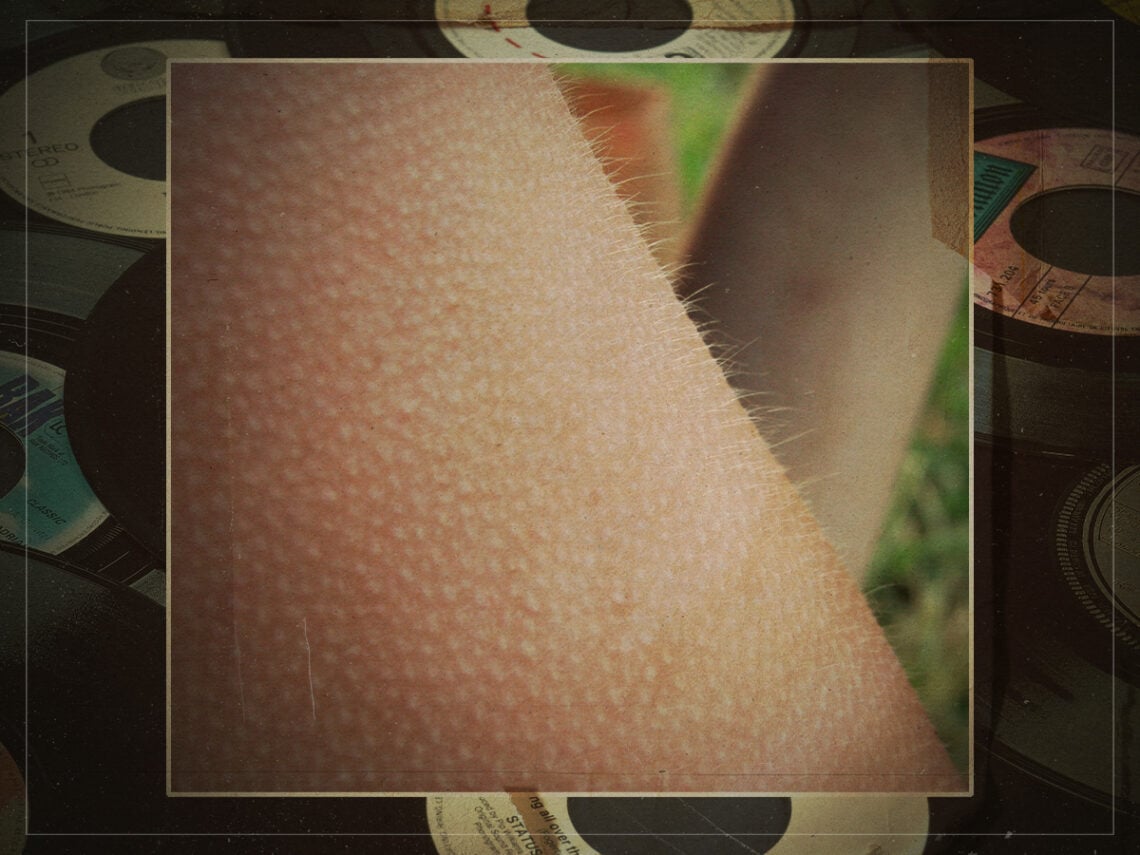
If you get chills from music then you have a special brain

We’ve all listened to a jaw-dropping vocal vibrato or an intoxicating guitar solo only to feel the hair on our arms standing to attention, or have we? Scientifically, half of those reading these words will have no idea what I’m on about.
According to a 2016 study conducted at Harvard Medical School, a group of neuroscientists divided 20 participants into the suggestively named categories: ‘chill’ and ‘no chill’, and then played them some music. Their results confirmed that getting physiologically aroused from a musical experience is for those with greater emotional intelligence.
“Survey results confirmed that substantial individual differences exist in the tendency to experience strong emotional responses to music,” the study observed, published in Social Cognitive and Affective Neuroscience, adding, “The more frequently a person reports experiencing chills, the larger the volume of white matter connectivity,” which is the brain’s communication channel, crucial for cognitive function.
“Higher white matter connectivity was observed in people with high emotional empathy, whereas lower white matter connectivity was observed in people with social-emotional impairments,” the study further explained.
This research revealed that only about half of humans get a vivid bodily response when listening to music, which those who experience regular goosebumps at their favourite songs cannot wrap their heads around. The study observed skewed reactions to listening experiences, with participants going from more abstract responses like awe, to more visceral lump-in-the-throat, heart-racing reactions. For context, getting the chills sat squarely in the middle, as a more ‘average’ response.
The study does go on to clarify, however, that the tendency to perceive strong emotional reactions to music may or may not be tied to responses to other kinds of artistic stimuli, such as visual art. “Perhaps one of the reasons why music is a cross-culturally indispensable artefact is that it appeals directly through an auditory channel to emotional and social processing centres of the human brain,” it concluded.
Although it must be said that their survey was quite small-scale, it is an incredibly challenging phenomenon to research. People who get chills are frequently influenced by memories tied to a song, and those are impossible to flesh out in a laboratory setting.
The elements that build out emotional reactions to music include dynamic contrasts in melody, shifts in tempo, potent vocal performances, instrumental solos, harmonic progressions and unexpected modulations. Past research had already shown that people who are more open to unpredictable experiences are more likely to get a more excitable reaction from music, as was studied at Eastern Washington University. Other studies have even connected emotional reactions from music to higher levels of curiosity and even creativity.
Although we’ve gone so far as naming the phenomenon of chills that come from a piece of music, or from any other aesthetic experience, for that matter, we don’t know what the evolutionary purpose of Frisson could be. But the studies around its possible benefits are acquiring more academic interest, and neuroscientists like the authors of this Harvard study are investigating this human quirk in greater depth.
