


Revisiting the iconic horror flick ‘Candyman’ 30 years later

Released in October 1992, Candyman is an American gothic supernatural horror film written and directed by Bernard Rose, who had previously directed the dark fantasy horror Paperhouse. The film stars Virginia Madsen as graduate student Helen and horror icon Tony Todd as the notorious Candyman.
Based on Hellraiser writer Clive Barker’s short story ‘The Forbidden’, the film follows a Chicago graduate student completing a thesis on urban legends and folklore. Through this, she discovers the legend of the “Candyman”, the ghost of a black artist who was murdered in the late 19th century for his relationship with the daughter of a wealthy white man. The legend claims anyone who stands in front of a mirror and chants his name three times will be murdered by the ghost.
Candyman received generally positive reviews upon release and grossed over $25 million in the US. The film’s narrative and focus on the character of Candyman have earned it a place of esteem in critical circles. It is cited as a contemporary classic of horror cinema, as featured on numerous best horror lists in the 30 years following its release.
Its success prompted two sequels, Candyman: Farewell to the Flesh in 1995 and Candyman: Day of the Dead in 1999. A direct sequel of the same name was released in the summer of 2021, directed by Nia DaCosta and produced by contemporary horror master Jordan Peele.
Candyman is a beloved and re-watchable horror because of its successful harmony between its stylistic techniques, tone, and messaging. A standard horror can either have a great atmosphere of suspense or images of blood and guts, attracting specific fans who enjoy one or the other. However, Candyman defies any restrictions by having both and having both well.
It is atmospheric and builds its tension well. Furthermore, it displays a visually stimulating use of carnage in the kills, appeasing various horror fans. To elevate this, it reads as an intelligent social commentary, being one of the original social horrors since commentary in the genre is rather popular in recent releases.
Rose’s direction and adaptional writing are successful by being unsettling and effective in their themes and context, not just through its jumpscares or creepy visuals.
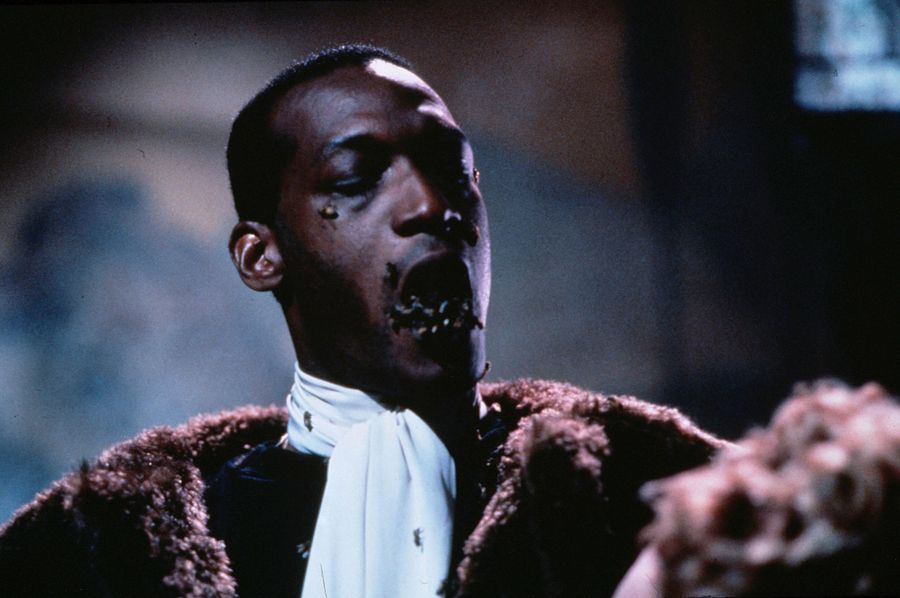
Candyman’s backstory is just as horrifying in context as his design. His story reads that after he fell in love with and impregnated a white woman, her father sent a lynch mob after him. They cut off his right hand and smeared him with honeycomb stolen from an apiary, attracting bees that stung him to death.
This is channelled through his appearance in having his cut-off hand replaced by a hook and swarms of bees festering in his skin and pouring out his mouth. Not only do these details terrify his victims as horrific sights, but they also symbolise the racist abuse the Black community has historically been subjected to.
This exemplifies how Candyman’s scare factor resides in its visual design and social execution. It can also be identified in contemporary successes such as Peele’s Get Out and Netflix’s Squid Game, as both use social issues as scares in stylistic manners.
Todd’s portrayal of Candyman, whose human name was Daniel Robitaille, is the anchor of this combination. As a horror ‘villain’, he is set out as different from Jason, Michael or Freddy, as his backstory is a case of mistreatment that leads to sympathy in his actions. Furthermore, Todd’s performance is infamous for his deep, chilling voice and intense magnetic stare, giving Candyman a deeper characterisation when compared to other horror killers. He commands each scene he features in magnificently, as his terrifying actions and presence capture the audience’s attention and fear.
The story is executed engagingly, dodging any cliches and defying restrictive expectations. Audiences can never expect what happens next upon first viewing, making Candyman such a unique horror experience given some tired companion releases during the early 90s.
Overall, as previously stated, horror and thrillers have adopted social critiques with some firm passion and frequency, and Rose’s Candyman is one of the blueprints among George A. Romero’s Night of the Living Dead and Wes Craven’s The People Under the Stairs. Its blend of atmosphere and visuals alongside this commentary is timeless in effect, with one of horror’s most underrated yet brilliantly complex villains.
Re-assessing the film under events in the last 30 years, the social commentary rings even more true. For example, the folklore addition of saying Candyman’s name echoes the Black Lives Matter movement’s Say Their Name to honour black victims of police brutality.
Alongside Get Out’s representation of black culture being exploited and Spiral: From the Book of Saw commenting on the corrupt police system’s mistreatment of people of colour, Candyman’s presentation of black experiences still resides in society today. This maintains the film’s legacy 30 years on and proves it as an intelligent and scary work of horror.
