


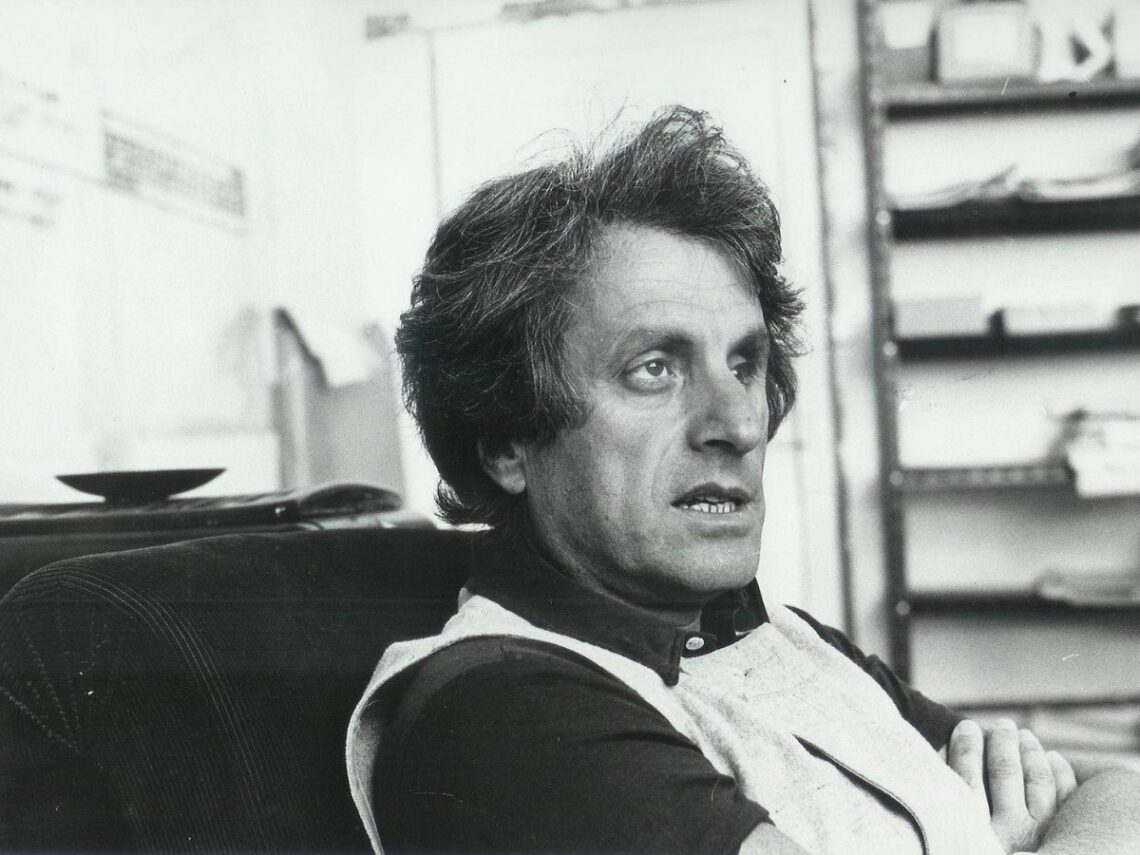
Iannis Xenakis: the avant-garde pioneer who inspired Lou Reed’s ‘Metal Machine Music’

Like an only child who isn’t troublesome, there must be someone out there who claims to enjoy Metal Machine Music without lying, but I’m yet to meet them. Lou Reed‘s wailing racket of looped noise is an assault on the ear that even pathological minds repel. Alas, this dramatic shortcoming in his back catalogue can’t be held over the coals too much because it was spawned by the same radical ethos that irrevocably altered music for the better several times over; it’s just that when you dare to be brave sometimes you eat the bear and sometimes the bear eats you.
When he was explaining his peculiar effort, Reed cited that he had been listening to a lot of Xenakis. Who was this man, and what sort of mind could inspire this from Reed, many uninitiated punters asked. Was he an expert at scraping his knife across his plate? Well, Xenakis – in his own avant-garde way – just so happens to be one of the most pivotal players in modern music theory, who, in a much softer sense, has gone on to influence pretty much every new record around.
As a young man, Xenakis fought against the British army as they tried to restore the Greek monarchy after the Second World War. He was a member of the communist students’ company in the left-wing Lord Byron sub-division of ELAS. While battling tanks on the streets, he was struck in the face with a bit of shrapnel. Somehow, he miraculously survived with only a minor facial disfigurement and a blind eye.
However, his troubles were far from over. In 1947, the political landscape had unfurled in such a way that now the Greek government were rounding up all former left-wing agitators. Xenakis feared for his life and fled Greece on a fake passport. This would be the pivotal moment of his life.
He would later write: “For years I was tormented by guilt at having left the country for which I’d fought. I left my friends—some were in prison, others were dead, some managed to escape. I felt I was in debt to them and that I had to repay that debt. And I felt I had a mission. I had to do something important to regain the right to live. It wasn’t just a question of music—it was something much more significant.”
He was sentenced in absentia to death by the new right-wing government. This only heightened his sense of mission. He wanted to make an impact. Music would be his avenue. However, much like Reed, he wasn’t just satisfied producing pretty melodies or songs to pass the time, in a progressive way, he wanted to somehow further the fabric of music, to shift its boundaries.
He had trained as an architect, and he saw the direct link between that study and music. In truth, the two have always been entwined. The structure of grand cathedrals were designed in such a way that when choirs sang, their voices were amplified to produce a godly sense of awe in the congregation. Well, Xenakis went beyond that and began implementing elements of architectural theory into harmonic theory. However, he was promptly told that his music conflating parallels fifths and octaves with structural design was “not music”.
He eventually found a tutor willing to tolerate his weird sounds in Olivier Messiaen, who fatefully recalled in his writings: “I understood straight away that he was not someone like the others. […] He is of superior intelligence. […] I did something horrible which I should do with no other student, for I think one should study harmony and counterpoint. But this was a man so much out of the ordinary that I said… No, you are almost thirty, you have the good fortune of being Greek, of being an architect and having studied special mathematics. Take advantage of these things. Do them in your music.”
And so he did. Pythagoras had stated long before that music was the language of maths and used octaves to display this. Xenakis decided that the maths didn’t have to be harmonic. In essence, in the same way, that a building can find structural support through shape alone – as The Philips Pavilion which he designed shows – he looked to reinvent music. The Spanish composer Francisco Estévez would later tell Nathan Thatcher that Xenakis’ music was “mathematical formulas translated . . . into beautiful, exciting, and above all, convincing music.”
That is, indeed, the most important part: that it was musical and made you feel. Sadly, this is where Reed when slightly wrong, focusing on the avant-garde as something outside the norm rather than something that propels the centre to move towards it. As Xenakis would later profoundly write: “Art, and above all, music has a fundamental function, which is to catalyze the sublimation that it can bring about through all means of expression.”
Continuing: “It must aim through fixations which are landmarks to draw towards a total exaltation in which the individual mingles, losing his consciousness in a truth immediate, rare, enormous, and perfect. If a work of art succeeds in this undertaking even for a single moment, it attains its goal. This tremendous truth is not made of objects, emotions, or sensations; it is beyond these, as Beethoven’s Seventh Symphony is beyond music. This is why art can lead to realms that religion still occupies for some people.”
Lest we forget that it is this emotive importance that proves paramount beyond the methods of his deconstruction and reconstruction of music constituents. Metal Machine Music is surely a lesson in that.
