


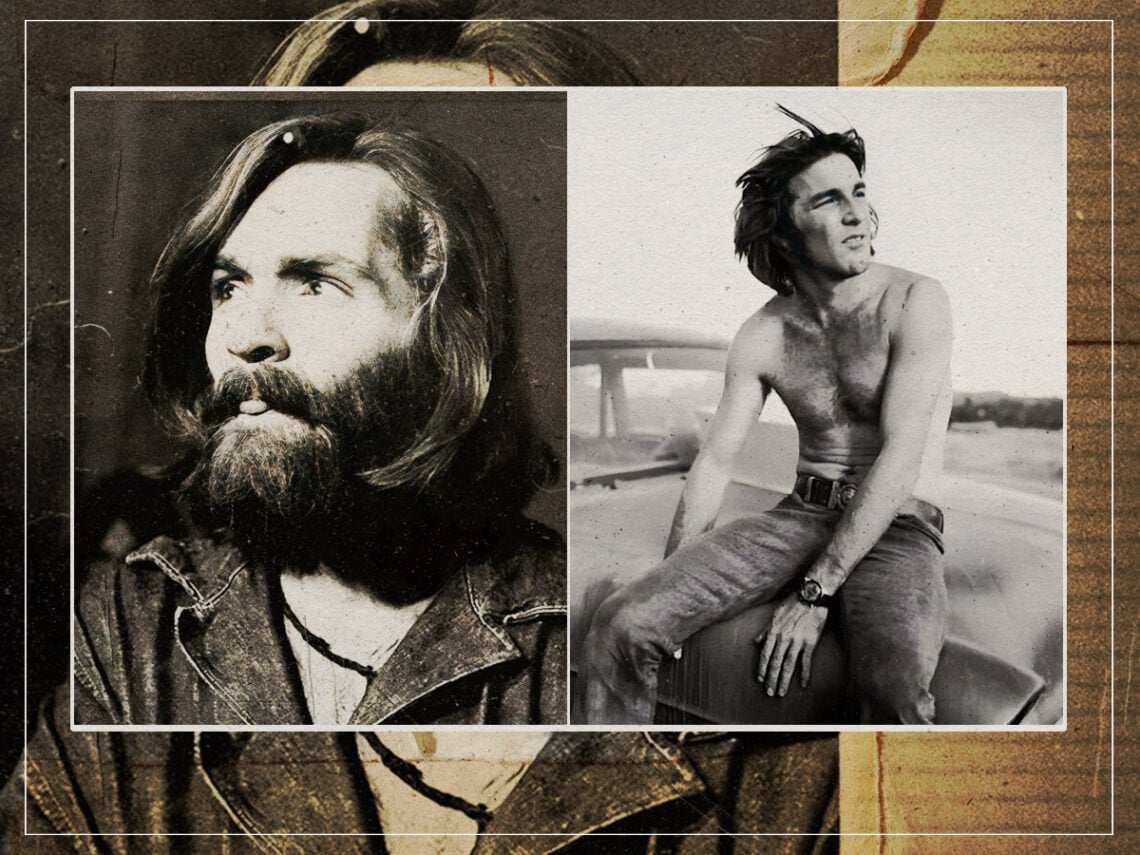
“I know why Charles Manson did what he did”: Dennis Wilson wanted to reveal the truth about the murders

The official narrative behind the Charles Manson murders is so manic that you barely bother to question it. The story of the slayings that shocked the world is so bewildering that prying at it is like looking for implausibilities in the plot of The Wizard of Oz. Approached with a sober mind, it feels more like a fictitious allegory for the counterculture era in Hollywood than anything that closely resembles realistic criminology. Perhaps that’s because the story we know is a lie?
As the convicting DA, Vincent Bugliosi, put it to the world: Manson was a lifelong petty criminal who sought salvation in the fame that music now offered as soon as he learned how to strum a guitar. Seeking stardom, he ventured to Hollywood, where he amassed a harem of followers thanks to years of practised deceit, which imbued him with shamanistic superpowers. This, along with a ready supply of psychedelic drugs, led to perfect conditions for an indoctrinated cult and their evil leader to arise.
The crimes that followed then supposedly came about after Manson mused that The Beatles’ so-called White Album was a coded parable for the forthcoming apocalypse. The song ‘Helter Skelter’ specifically related to the moment that Manson would instigate a racial uprising. As per a prophecy he had foreseen in the bible, he would instruct his ‘family’ to kill white Hollywood elites, make it look like the murders were a racially motivated attack, thus kickstarting a race war, at which point he and his family would retreat underground at some undisclosed location in Death Valley, and return when the war had ended to rule the world and restore order.
Aside from the inherent insanity of this scenario, there are a few things that simply don’t add up. For instance, the home targeted in the family’s first slayings, 10050 Cielo Drive, owned by Roman Polanski and Sharon Tate, was known to Manson rather than being a random wealthy residence. Terry Melcher, a music industry mogul who had once offered to record and produce an album for Manson before scrapping the project after a single session – effectively dashing his potential big break – had lived there previously. However, it was not only known to Manson that he no longer lived there, but he actually knew where his new home was.
Thus, there is an odd intersection of randomness and reasoning, revenge and race war at play, that proves difficult to reconcile. Why would Manson say to his family, ‘Let’s kickstart a race war, and while we’re at it, I guess there’s no harm in putting the willies up Terry Melcher too. We may as well kill two birds with one stone in a very obscure fashion.’ Furthermore, if your motive is to start a race war, why would you be so bafflingly vague as to simply write ‘Pig’ on the victim’s door in blood?
Tom O’Neill spent 20 years investigating these inconsistencies, and in his book Chaos, he presents a compelling case that the narrative we know was perhaps, at least in part, an invention of Bugliosi’s own making. That is not to say that Manson and the family weren’t behind the killings, but rather that drug cartels, celebrity embarrassments, espionage, revenge and more were part of a messier entanglement surrounding the murders than the streamlined, peacocking mania of the Helter Skelter Scenario.
One of the problems in getting to the bottom of the long-weaving case is that Manson was so well connected. Half of the Rock and Roll Hall of Fame and Screen Actors Guild had crossed paths with him at parties in the Hollywood hills. This meant that there was an unprecedented wealth of witnesses that could offer insights into the case, but the fact that many of them had reputations to protect meant that very few were forthcoming with information. However, there was one notable name irrefutably linked to such an extent that he couldn’t escape questioning on the matter.
In April 1968, Dennis Wilson, the long-haired Lothario and only Beach Boy who could actually surf, was cruising along a sunny Malibu street when he was thumbed down by two female hitchhikers. They just so happened to be Patricia Krenwinkel and Ella Jo Bailey, members of the Manson family. Wilson, of course, was unaware of their sinister connections at the time. He picked them up, and his life changed forevermore.
It wasn’t until he spotted the same duo hitchhiking once again a few days later that he would first hear the name Manson. “I told [the girls] about our involvement with the Maharishi,” Wilson explained to the Record Mirror, “and they told me they too had a guru, a guy named Charlie who’d recently come out of jail after 12 years.”
That ominous red flag was soon on Wilson’s doorstep as he returned home from a routine recording session. The diminutive 5ft 6in criminal was waiting on Wilson’s driveway, enthused by the possibility that The Beach Boys might open doors to the music industry for him. Meanwhile, inside the house, a dozen members of the family cavorted. This was, strangely, a welcome that Wilson seemed rather pleased with—it embodied the liberated edge that The Beach Boys had been searching for, not to mention the free orgy on offer.
He soon struck up a firm friendship with Manson. However, there is also a slight retrospective hint that he perhaps knew Manson might have been trouble. As he coyly told the Record Mirror in a piece controversially titled ‘I Live With 17 Girls’, “I don’t know why I’m telling you all this.” Nevertheless, he did divulge that the two shared a creative kinship that he couldn’t deny: “When I met [Charlie], I found he had great musical ideas. We’re writing together now. He’s dumb, in some ways, but I accept his approach and have [learned] from him.”
However, he didn’t just serve as a creative mentor for Manson. He also helped to bankroll the family. “If anything, they’re supporting me. I had all the rich status symbols,” he said at the time when his financial support of the family was brought into question before their grisly crimes came to the fore. “Then I woke up, gave away 50 to 60% of my money. Now I live in one small room, with one candle, and I’m happy, finding myself.” Alas, one day, he found himself enough to realise he was in too deep with the wrong crowd.
He simply up and left his own property, leaving the task of evicting Manson and the family – a crew he had once been inseparable from – to his landlord. Like many things in this case, the whys and wherefores of this fallout (or sudden realisation) have been lost to the passage of time. However, the truth of the case, according to Dennis Wilson, very nearly surfaced.
After the murders, Wilson fell into a spiralling depression, exacerbated by a reliance on drug and alcohol abuse. Nevertheless, unlike many associated with the case, he wouldn’t simply shun the subject. And on one startling occasion, he told Beach Boys biographer David Leaf, “I know why Charles Manson did what he did. Someday, I’ll tell the world. I’ll write a book and explain why he did it.“ This remarkable quote seems to corroborate O’Neill’s view that the official story is a distortion of the whole truth.
Empowering this notion is the fact that Wilson was, indeed, very well placed to know the real narrative. After all, he once chillingly told the San Francisco Chronicle, “Me and Charlie, we founded the family.“ Alas, he never got the chance to reveal what he knew, or perhaps more aptly put, he never took the chance. In the 12 years between Manson’s conviction in 1971 and Wilson’s death in 1983, he turned to downing substances rather than spilling the truth.
While Wilson would continue to make music following Manson’s arrest, that all came to an end with the Beach Boy’s MIU Album in 1978. Mike Love had been keen for the group to pursue a connection with the Maharishi International University on which to hinge their new album, but this was precisely the sort of seedy spiritualism Wilson had tried to get away from for years, resulting in a feud. In the end, Wilson barely featured on the album, but he later wished he didn’t feature at all. “I hope that the karma will fuck up Mike Love’s meditation forever,” he growled. “That album is an embarrassment to my life. It should self-destruct.”
This was the end of Wilson as a creative force. The final five years of his life after the MIU Album debacle were spent in a destructive haze of substances. He had been on a creative high after the success of his solo record, Pacific Ocean Blue, and Love’s disastrous effort that followed proved to be one comedown too many. The band that had made him also broke him.
He spent the final years of his life in and out of rehab. His final release from a clinic came just in time for Christmas in 1983. He spent some time on his friend’s boat with the intention of diving in search of the possessions he had thrown off his own boat in the same harbour years earlier. Tragically, this pursuit cost him his life as he drowned on December 28th. He was 39. He was also perhaps one of the few remaining people who could confirm the true story of the murders that changed the world.
