


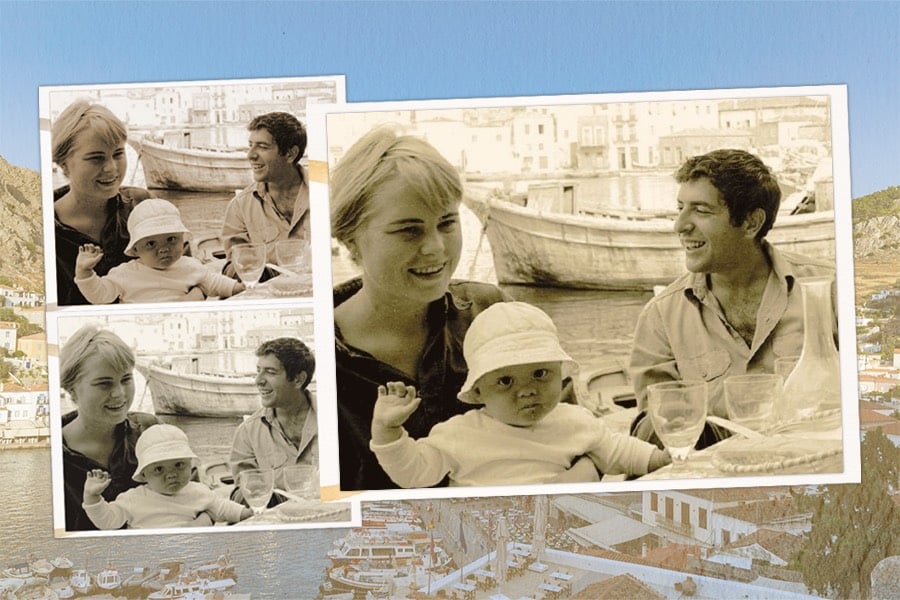
Hydra: Exploring Leonard Cohen’s Greek Island utopia

It is an oddity of culture that a tiny speck of land with a population of 1,966 people has had a huge bearing on modern western art. However, with the crystalline azure slumber of the sequined sea, the moody mountain backdrop, and the hodgepodge sprawl of scattered terracotta rooves, it’s not hard to envision how it enchanted so many artists with its singular beguiling beauty and the entrapping charms of a thousand shifting dreamy muses and not one single street name. And of all the words to describe it, dreamy, for once, will always be the one doing most of the legwork; as Leonard Cohen said of the idyllic spot himself: “There is nowhere in the world where you can live like you can in Hydra, and that includes Hydra.”
In the 1960s, this fleck of paradise, seemingly floating in the Aegean Sea like a leaf blown onto a pond, was a swarm of bohemian artistry. Cohen and a coterie of his glossy-eyed cronies had washed up on its shore and begun to plunder its beauty for their poems, songs, paintings or whatever creative endeavours they spent their languid days doing. Cohen, with a $2000 grant from the Canadian Arts Council, had been drawn to the island when during a particularly gloomy April in Hampstead, UK, after he met Barbara Rothschild at a party, and she told him of a mansion she knew of with much better weather.
Many others must have heard this same tale because when he got there, the place was awash with so many other ex-pats finishing novels or song collections that it appeared to have been colonised by some chino-clad army. Unlike a swarm of house DJs overtaking a beleaguered Spanish hot spot, this gingham parade of quill-dippers did not plot a hostile takeover. They threw parties where every living thing on the island, including the feral cats, received an invite and seemingly remained happily hungover until the next one. The legacy of this still remains in the tranquil mix of tourists, artists and locals.
Perhaps the most befitting paradigm of this tranquilly mixed-up milieu comes from the tale of the photojournalist James Burke who travelled to the island for LIFE magazine to capture the booming art colony from the ground level using all of his battlefield photography knowhow. He soon got to work relishing in the apparent ever-present muse of the island, taking around 1570 photos and inadvertently capturing the start of Cohen’s music career — but no LIFE feature ever arrived. Although there were surely times when locals were less than pleased with the influx, in the calming breeze of the sanguine coastline, the constant harmony of the place is an easy fiction to accept without eyes burning the back of your head. And equally, taking nearly 2000 photos for a non-existent feature seems worryingly plausible.
However, all wayward photographers and bewitched tourists aside, it is undoubtedly the spirit of Leonard Cohen that remains on the island like a numen. It was here that he wrote the poem ‘Days of Darkness’ with its fabled line, “Greece is a good place to look at the moon, isn’t it,” and it was the shifting scenery here also that inspired one of his greatest songs with ‘Bird On the Wire’. Upon his arrival, Cohen was greeted by the realisation that there were no electrical wires on the island, no telephones and no regular electricity. As the popularity of the island began to grow, telephone poles began to appear, and, of course, the subsequent wires. “I would stare out the window at these telephone wires and think, how civilisation had caught up with me and I wasn’t going to be able to escape after all,” Cohen once explained. “I wasn’t going to be able to live this eleventh-century life that I had thought I had found for myself. So that was the beginning,” he added.
That may indeed have been the beginning of the end for Cohen but for far more complicated personal reasons than any old wire. And such was the brilliance of his work, those wires in question, that on paper might sound like blights on the island’s beauty, are now transfigured into tendrils to the past and his time here with Marrianne, that tourists happily gawp at in deck chairs, no doubt listening to him croon: “Like a bird on the wire, like a drunk in a midnight choir, I have tried in my way to be free.”


Now, that air of escapism still drags us dreary Cohen fans to the island in manageable droves. You can grab a ferry from Athens port of Piraeus to Hydra and arrive by about midway through ‘Dress Rehearsal Rag’ as you listen to his golden first trio of records en route. Thereafter the huge amphitheatre of the bay remains as it was, with the addition of fairy lights and a few well-concealed mod cons.
And following the trail that any given local will instruct, you can find the home that Cohen’s family still owns. “It has a huge terrace with a view of a dramatic mountain and shining white houses,” Cohen once said when describing the home to his mother. “The rooms are large and cool with deep windows set in thick walls. I suppose it’s about 200-years-old and many generations of seamen must have lived here.”
Adding: “I will do a little work on it every year and in a few years it will be a mansion,” he added “I live on a hill and life has been going on here exactly the same for hundreds of years. All through the day you hear the calls of the street vendors and they are really rather musical.”
In the same letter to his mother, Cohen detailed his working routine in what proved to be a dynamic period of creativity: “I get up around seven, generally, and work till about noon. Early morning is coolest and therefore best, but I love the heat anyhow, especially when the Aegean Sea is 10 minutes from my door.”
On route back down from steps of his often flower and note enshrined doorstep, the Rolo Café winks the same ice-cold beer eye that it ensnared the likes of Cohen with long ago, as the calls of vendors once more drift up towards the pine-forested valleys and migratory birds recite the same melodies that Cohen once stole. Bar the hum of air-con, all is as bohemian enchanting as it ever was. And the cave along the way that Joni Mitchell lived in with a hippy commune of her own for a period can wait until tomorrow, much like everything else on Hydra.
