


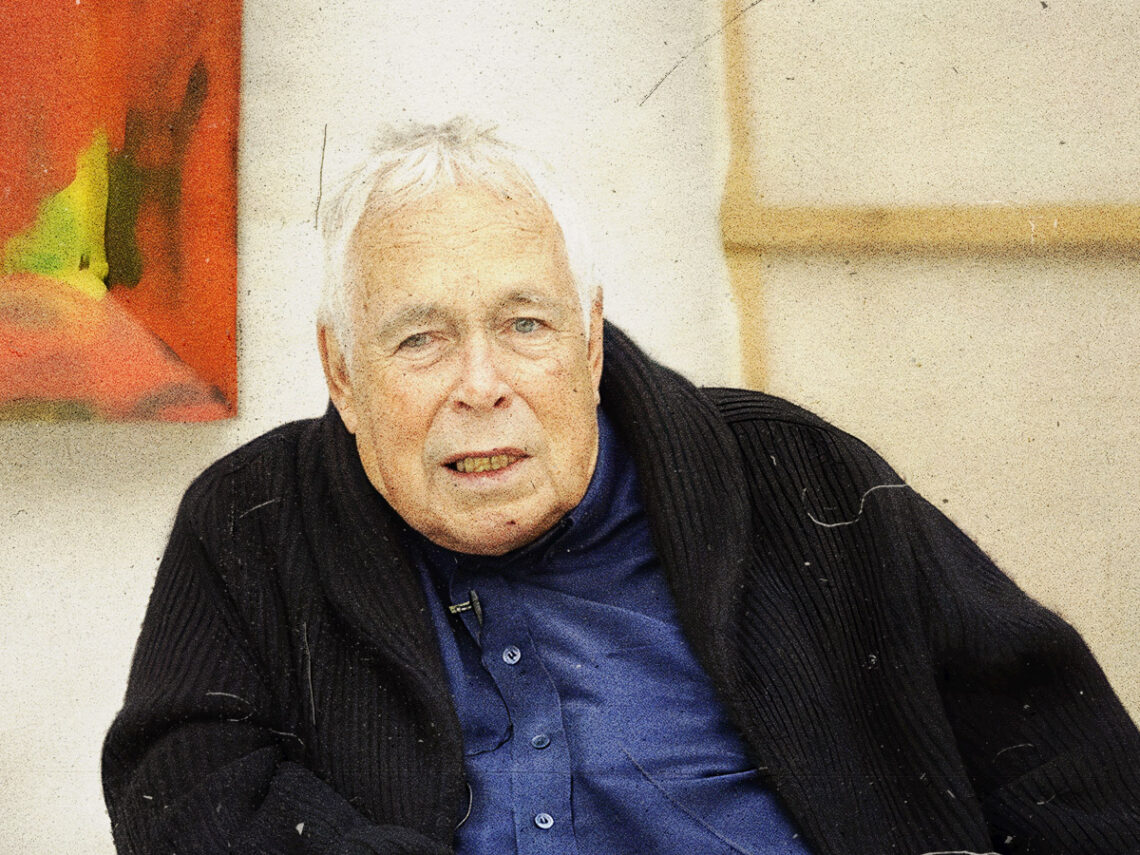
Turner Prize winner Howard Hodgkin on the “agony” of painting

Most five-year-olds are idlers – unmotivated to find a purpose in life, their vision just starting to focus and develop. Usually, their role is to exist, to play, to observe, blind to time and future – shapes, vivid colours, and forms coming at them in a dream-like manner. For young Howard Hodgkin, it was clear that these human pigments he was experiencing were to be his life’s work.
At five years old, he decided to become a painter. Nearly 50 years later, Hodgkin was on the London Paddington Tube platform, ready to commit suicide.
Despite being born in London in 1932, Hodgkin was evacuated with his mother and older sister to Long Island in the US in 1940. New York’s influence on the artist’s work is palpable, especially because abstract expressionism ran rampant through the city. Hodgkin looked into Stuart Davies’ visions of bold colour, daubs of bright paint juxtaposed with graphic shapes. The effervescent and playful American effect encouraged his compulsion to paint. His displacement had administered a dose of ambition and colour that he brought back to the UK.
However, Hodgkin’s deracination and restlessness caused him to oppose formal education. The vibrant and energetic colours he imagined took off alongside him as he ran away from school – twice. Until a teacher at Eton displayed Ustad Mansur’s A Chameleon, which was the catalyst for his enthusiasm for Indian art. A Chameleon was somewhat symbolic of Hodgkin himself, a product of his displaced environments, his skill for colour, and his ability to paint and shift emotions. “I am a representational painter but not a painter of appearances. I paint representational pictures of emotional situations,” explained Hodgkin. The image of the chameleon fervently gripping the only branch that can withstand its weight parallels the artist’s cynical and painful approach to painting. In an interview with the New Statesman, he explained his conflicted relationship with painting that had him stepping over the yellow line at Paddington station: “It’s what I do,” he said. “I have no other skills. [But] it’s always been agony.”
Hodgkin was trapped between the lonely repercussions of being an artist and his devotion to painting. Unfortunately, Hodgkin is not an unusual case; while collectives and artistic groups are steadily on the rise, the hyper-individualism that has been marketed as the ingredient to success is sometimes a deadly standard. Artists are encouraged to fit the stereotype of a tortured but genius hermit and recluse. Mentally ill artists are romanticised by their audiences, often dehumanising and neglecting the artist while celebrating their art.
Hodgkin’s emotional claustrophobia was as heavy as his brushstrokes, but his interest in discerning colours lured him to India. With his history of running away and moving, he finally found a place he could run towards. He reinvented himself as a collector – praising it by musing: “Collecting brings with it an almost automatic series of introductions, social contacts, with dealers, scholars and occasionally with fellow collectors”.
His work Painting India displays a fervent symbiosis of green, orange, and blue, the animated overwhelm of India through American and British perspectives. In the face of his childhood displacement, he explained to David Sylvester in 1984: “I think my main reason for going back to India is because it is somewhere else”. India’s frenzy of colour and vigour inoculated him against the enclosed spaces he had tried to escape.
Hodgkin remained on the platform. The tube hastened by. The artist’s paintings remained confined between a vehement hatred of art and an ode to painting and colour.
