


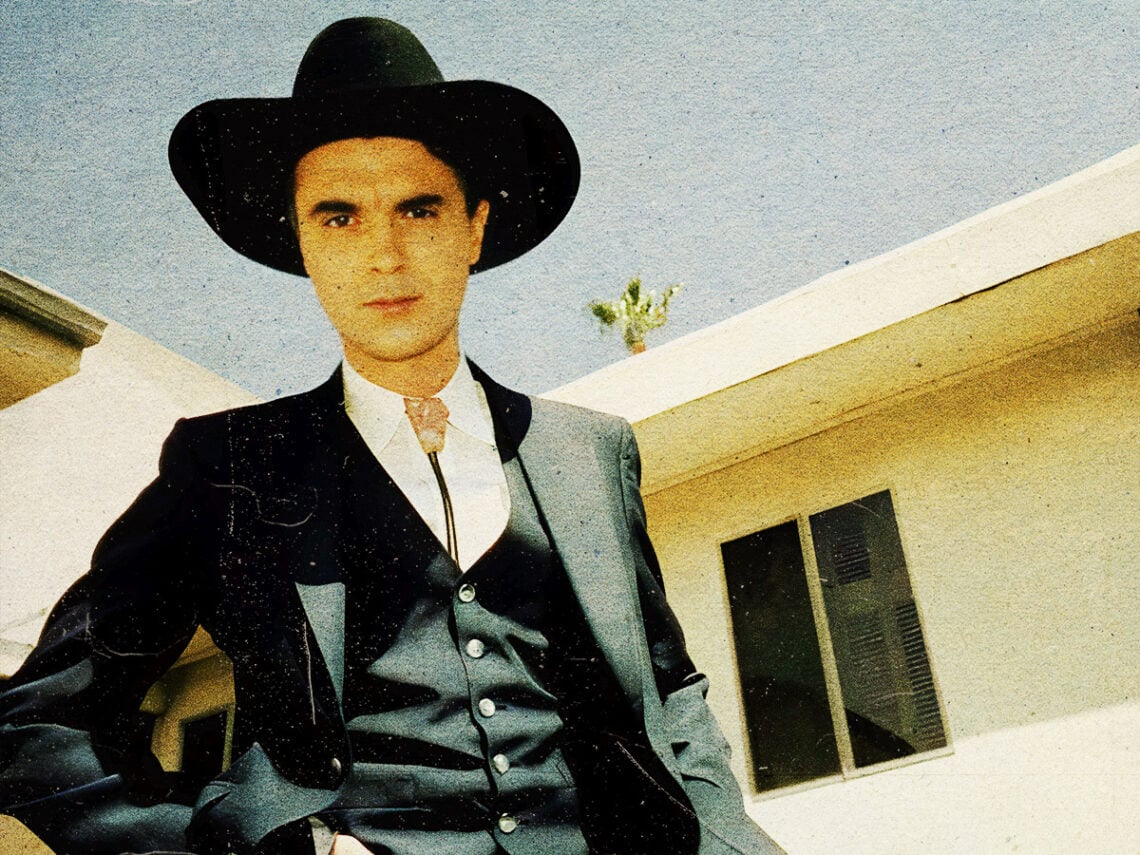
How Woodie Guthrie impacted a young David Byrne

David Byrne is an artist known for his exceptional dynamism and unwavering commitment to artistic exploration. Undoubtedly, he stands as a figure who consistently delves into new and uncharted territories, pushing the boundaries of his creative pursuits. Byrne’s career has largely been marked by an innovative spirit that refuses to tread familiar ground or linger in the shadows of past achievements.
Rejecting any inclination to emulate others, Byrne has consistently championed originality as his guiding principle. As the frontman of Talking Heads, he ascended to the pinnacle of the New York music scene, quickly outshining his contemporaries. Yet, Byrne’s commitment to his craft goes beyond the mere prospect of periodic greatest hits tours for financial gain; his artistic integrity stands as a testament to a deeper dedication to his creative vision.
Instead, the singer persistently channels his talents to diverse pursuits, whether contributing to Broadway with his show American Utopia or engaging in discussions at the BBC studios about his experience as a castaway on a desert island. In this way, the musician has always been up for discussing the lasting impact of others, wherein the concept of ‘usual’ remains a distant notion.
As a kid, Byrne recalls being exposed to many artists, notably the esteemed works of Woody Guthrie. “In 1950s Baltimore, my parents were pretty open,” Byrne recalled in a Pitchfork feature. “They read The New York Times and listened to Woody Guthrie records, so you can imagine what kind of a household that was. They were immigrants from Scotland, and their taste included a lot of American folk music like, Woody and Pete Seeger, both of whom made children’s albums, so that’s what I would hear.”
In fact, listening to his music at a young age taught him an invaluable lesson about filtering opinions through your work as an artist: “Later, I heard their other songs, which obviously had a political slant and a story to tell and a point of view. That was something to realise at a young age: that a song could do that.”
Born in Scotland, Byrne’s family relocated to North America when he was just two years old, as his father pursued employment as an engineer. Family tensions were further exacerbated by religious differences, with his father being Catholic and his mother Presbyterian, prompting them to seek a fresh start in a new location.
Discussing the influence of Scottish folk music, Byrne explained: “The Scottish influence was a big part of my parents’ record collection. They didn’t have Scottish bagpipes or anything; they were more interested in Scottish roots music: Woody Guthrie, Ewan MacColl, and different people from that era, who were writing folk songs that were vaguely political but also beautiful. I realised that this sounds very palatable and pretty on the surface, but there’s something darker going on underneath.”
