


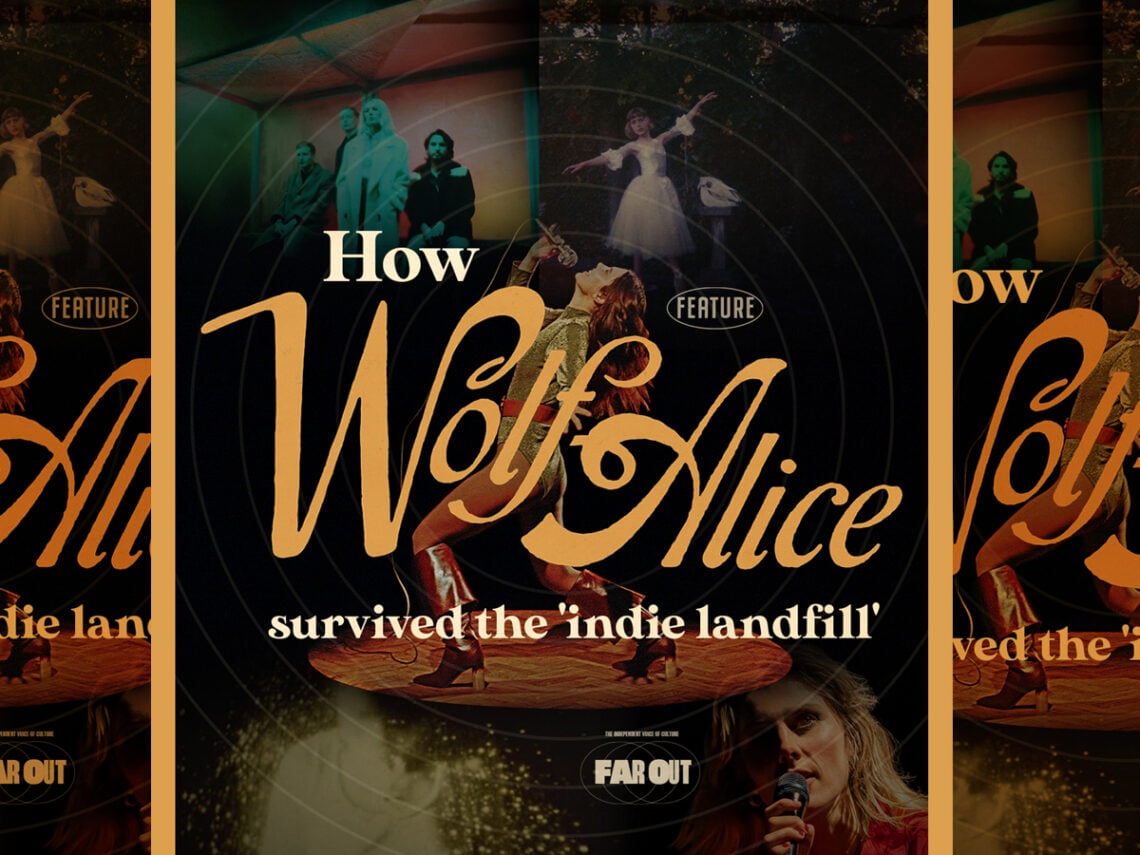
How did Wolf Alice survive the indie landfill?

In 2013, a lot of new bands emerged as the year proved itself to be a golden harvest for indie, launching a whole new generation of acts like Swim Deep, Peace, Palma Violets, Sundara Karma and so on.
Most sank, but one soared, so what did Wolf Alice do differently?
The place the rest sank to has come to be coined the ‘indie landfill’ by many critics, occupied by the kind of music we all used to love for a brief period, but has now become its own genre, defined by its resting place. The term arrived in the late 2000s, but mostly the early 2010s, when record labels kept signing more and more and more indie acts. After the indie sleaze era of the 2000s had reaped major rewards with the likes of Arctic Monkeys and The Strokes, it was a classic case of the suits wanting more and thinking they could get it through simply by replicating the same formula.
Suddenly, there was too much material for a declining interest. There was enough attraction for some quick hits as it felt like each band got their moment, or were granted one big song like ‘Honey’ for Swim Deep, ‘Lovesick’ for Peace, and ‘T-Shirt Weather’ for Circa Waves. For some, it dredged up enough interest to give them a good run around a debut album. But as the years passed, nothing else seemed to hit. Each release brought in less and less attention, and each band seemed to stagnate. Now they’re doomed; people only want the old hit, and already, they’re a nostalgia act.
There was some benefit to that prolific period, though. If landfill indie did one thing for the UK, it was helping bands from outside of London get their moment, as it especially seemed to look towards the Midlands, where the scene in and around Birmingham was especially brimming with talent. That’s where Swim Deep and Peace both emerged, and along with them, as support on their tours, they brought another act: Wolf Alice.

Led by Ellie Rowsell, Wolf Alice had an immediate advantage. It’s rare to write in any musical piece that being a woman in a male-dominated and enduringly misogynistic world might be a benefit, but here it truly was. As the music industry desperately tried to launch a new Alex Turner, they were pumping out boy band after boy band. Hence, with Rowsell’s presence behind the mic, the band already had a way to set themselves apart and keep safe.
However, Wolf Alice’s survival comes down to much more than that, one of which is perhaps the case of the slow game. While their peers bloomed to immediate success with a punch arrival, in most cases with one of their first ever singles enduring as their biggest, Wolf Alice took a moment.
‘Fluffy’ did well as an opener; ‘You’re a Germ’ did even better. Each new single grew their audience, but it was really on their second album when there was a noticeable spike as the release of ‘Don’t Delete the Kisses’ levelled things up. Even since then, it’s consistently grown as each new era has brought a new hit, the latest being ‘Bloom Baby Bloom’.
Their growth rides on the back of evolution, the lack of which is another trap their peers fell into after the initial success of their launch, which was that they often just kept doing the same thing, or evolved too late when the stagnation had set in, and people had stopped paying attention.
Their peers seemed to date quickly; listening back to some of the other 2015 records, they already feel vintage, whereas somehow, My Love Is Cool feels fresh, likely because each new song unveils something different. Wolf Alice could never stagnate because they were never easy to pin down, morphing across the course of one debut into several different acts. From heavier punk to angelic folk, they’ve shapeshifted ever since.
With so much variety in their discography now, where tracks like ‘Play the Greatest Hits’ versus ‘No Hard Feelings’ could not be more different, it means that they defy easy categorisation. More importantly, it means that they’ve always defied the categorisation of the class they first emerged in. They don’t sound like a 2010s band or like another cookie-cutter act of its time, so when the reaper came for the rest, Wolf Alice were spared.
