


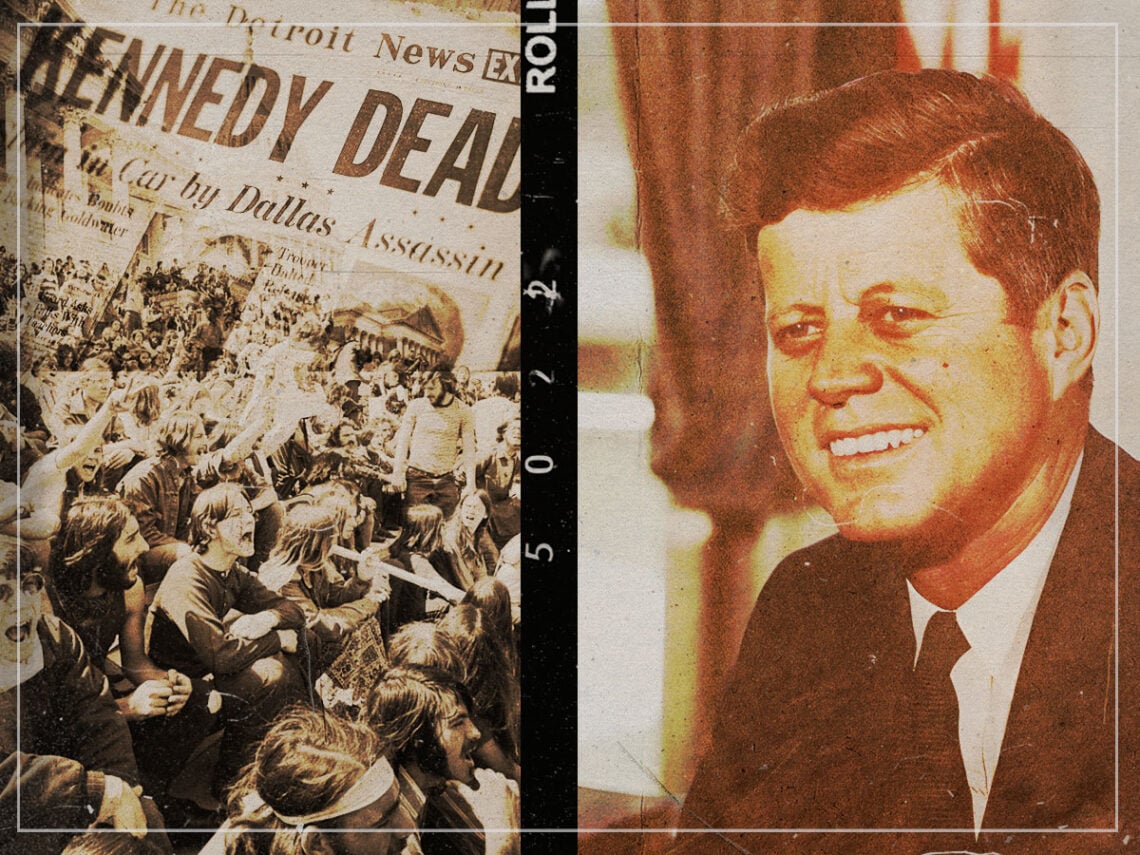
“Twas a dark day in Dallas”: How the assassination of JFK kickstarted counterculture

“Then they blew off his head while he was still in the car
Shot down like a dog in broad daylight
Was a matter of timing and the timing was right,” – Bob Dylan, ‘Murder Most Foul’.
In many ways, Lee Harvey Oswald was the original progenitor of the counterculture. His wicked crime changed culture irrevocably. William S. Burroughs would eventually write: “Artists to my mind are the real architects of change, and not the political legislators who implement change after the fact.” And at the height of the counterculture, as an artistic revolution unfurled, Burroughs’ words seemed patently apparent, but nothing gave these sacred artists more impetus than the man who shot down the President. The response to a villain was suitably heroic.
These artists were young kids who, in their childhoods, had to routinely partake in ‘Duck and Cover’ drills at school. This was the act of hiding under your desk and covering your face and neck in a futile bid to avoid death in the event of a looming nuclear attack. They had grown up in homes tormented by the scourge of the Second World War that had resulted in 80 million deaths, some three per cent of the global population at that time. Racial divides surrounded them, and the stilted ways of conservatism were seemingly suffocating progress. So, the times were always set to change; Oswald just lit the fuse.
The dawn of pop culture had hinted at revolutionary rumblings, but while Elvis’ shaking hips might have been liberating, they didn’t communicate much in the way of radical contrarianism vying against the status quo. Now, with the death of JFK, there was just cause to raise your head above the parapet if you so dared… and thousands did. The age of Aquarius began to unspool in a flash, as though it sped from the barrel of Oswald’s gun.
A revolution was afoot. It was, on the surface, a strange metaphysical revolution. Even the keen minds of the day were somewhat bewildered by it. Buffalo Springsteen sang, “there’s something happening here, but what it is ain’t exactly clear”, and Hunter S. Thompson retrospectively mused: “Maybe it meant something. Maybe not, in the long run, but no explanation, no mix of words or music or memories can touch that sense of knowing that you were there and alive in that corner of time and the world. Whatever it meant.”
This nebulous nature was borne from the fact that it was a revolution heralded largely by the arts. Politically, it was diverse; one hippy to the next had their own set of tenets, but it sure as shit wanted change. Vitally, there were signs of hope amid the unrest that proved it may well be possible. The atrocity of JFK’s assassination coincided with a few key advancements: the invention of stereo sound rendered music immersive, an upsurge in vinyl meant that Dylan’s profound messages could be piped into living rooms, car radios became commonplace, the patent for LSD expired making it temporarily legal, the first all-transistor radios were released and fitted in cars, and most importantly, the pill came out. All of this happened in a mere matter of months, surrounding a death that silenced a nation.
And then The Beatles arrived. “President Kennedy had been murdered only a little over two months before our arrival in the United States, and his assassination had ricocheted throughout the world, so we figured the atmosphere might still be subdued,” McCartney explains in his new book,1964: Eyes of the Storm. “But the minute we landed in New York, we knew instantly that we were not in store for any kind of funereal time. It was a Friday in early February when we touched down, and it felt like thousands – and later, through television and The Ed Sullivan Show – millions of eyes were suddenly upon us, creating a picture I will never forget.”
Philosophically, he muses: “Although we had no perspective at the time, we were, like the world, experiencing a sexual awakening. Our parents had fears of sexual diseases and all sorts of things like that, but by the middle of the 60s, we’d realised that we had a freedom that had never been available to their generation.” Despite the harrows that had come before them, Macca concludes, “We were in Wonderland.” From the dark times, they would guide the children of the revolution towards a brighter dawn, as Dylan croons in ‘Murder Most Foul’: “The Beatles are comin’, they’re gonna hold your hand.“
They were tapping into the beat of the zeitgeist, and they were far from alone. As Jarvis Cocker writes in The Guardian regarding Tom Wolfe’s gonzo exploits in The Electric Kool-Aid Acid Test: “How do revolutions happen? How does an idea spread from one mind until it takes over an entire society? This is the only book I can think of where you can see that process at work. Written at almost the same time as it was happening, not in some fog of nostalgia or revisionism many years later. A revolution can’t be just a pet project of the intelligentsia – it also has to connect with some obscurely felt impulse and desire felt by the public at large.”
This domino-tumbling revolution was fuelled by energy being unearthed and unleashed through new technologies and the new artistic mediums that they burst into life. The vigour of advancement was one thing, but the wild world progress was breaking into only amplified it further. This collision was collated by Bill Holt for his experimental album Dreamies. Like many people, he had grown up amid the stilted conservative world of the ‘50s, but suddenly, that preordained lifestyle seemed out of place.
Growing up, he says his life was “very much like a frozen dinner, all prepared for you by others. Then, out of the blue that orderly world is shattered. The shattering started with the assassination of President Kennedy.” And then young kids were plucked from the streets by the draft and shipped off to die unfairly in their droves. If that isn’t going to cause a cultural shake-up, then nothing will.
So, societies came together. Ideas were passed around like a doobie in Kingston, germinating a vitalised response to the times, and that response was spearheaded by great artists—great artists who appreciated the true essence of the zeitgeist because they had grown up in the shadow of war and the scared shackles that followed defying future liberation until the kids took the reins after a dark day in Dallas that suggested it was high tide they did, indeed, have a crack of the whip.
Music rising to the peak of cultural prominence was perfect for this because kids could declare themselves the main engines of it, and they offered up their naive assertions with youthful immediacy at once. While adults were mournfully silent, kids who had had enough came roaring to the forefront, righting the vulgar wrongs that Oswald had effectuated, with guitars as warm guns, upholding the folk legacy that these machines killed fascists.

Never Miss A Tale
The Far Out Bob Dylan Newsletter
All the latest stories about Bob Dylan from the independent voice of culture.
Straight to your inbox.