


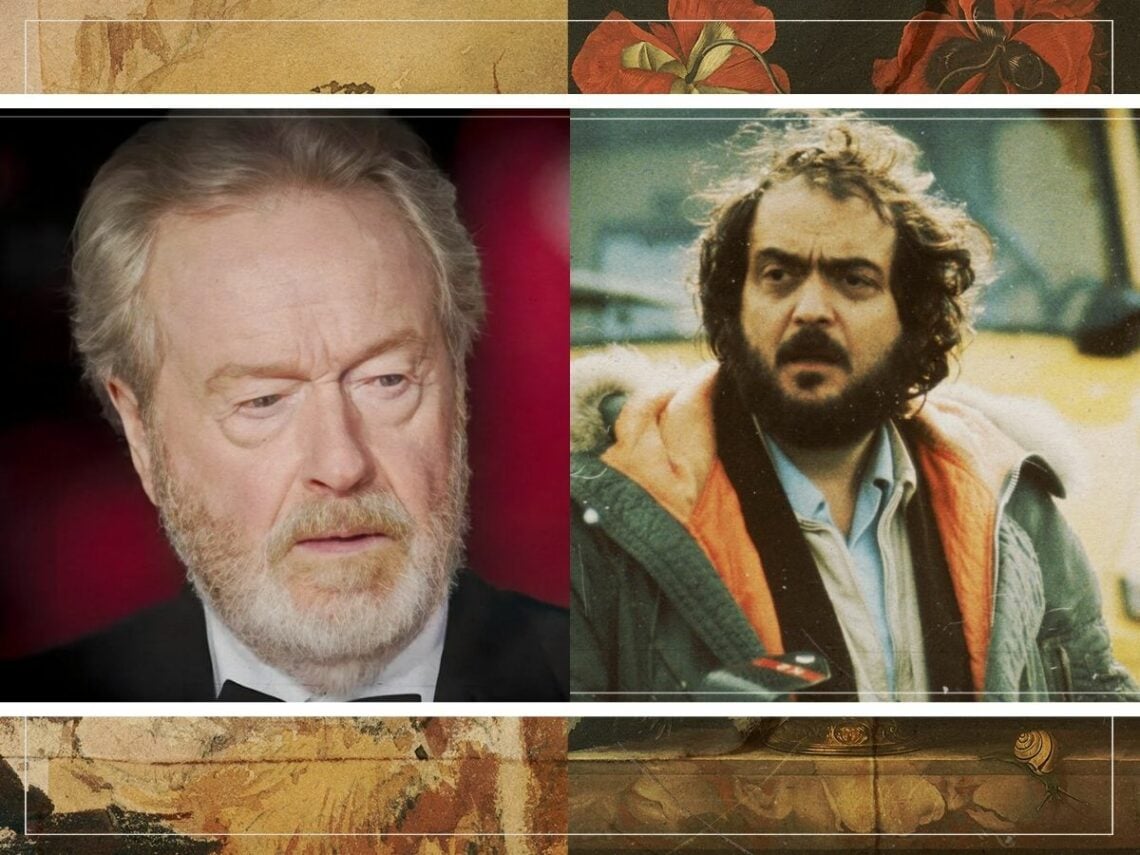
How Stanley Kubrick altered Ridley Scott’s perception of existence: “I am a firm believer”

Veteran filmmaker Ridley Scott is no stranger to influencing the public perception of what extraterrestrial life could be like having landed the job of directing the 1979 science fiction horror classic Alien. But while he played a huge part in codifying one of the more terrifying visions of extra-planetary life, capturing the xenomorph as an unstoppable leviathan in the style of Spielberg’s Jaws, his exploration of the alien was not done there.
2012’s Prometheus came more than 30 years later and features Scott digging into a thorny mythos partly of his own design, which places the genesis of humanity in the hands of alien progenitors.
Although it took him decades to develop his pet theories on ancient aliens, Scott has long held some firm beliefs about humanity’s solitude in the cosmos—or lack thereof. According to the man himself, there would be no alien engineers or space jockeys in Ridley Scott films without the work of another iconic director.
Speaking to The Guardian in 2020 on the press tour for the television series Raised by Wolves, Scott began to wax lyrical about the prospect of alien life as put forward by Stanley Kubrick in his ur-text for modern science fiction, 2001: A Space Odyssey. Specifically, on Earth being alone: “Come on, that’s ridiculous. That is ridiculous – being it. Right? And I am a firm believer in what Stanley Kubrick brought about in 2001: A Space Odyssey, that we were definitely pre-visited. For sure.”
It’s an idea many scientists would label improbable due to the sheer breadth of the universe, or at least occupy an agnostic position. In a characteristic bout of brash charisma, Scott appears to have the answers: “Of course we were. You think we are it, that we were just a biological accident over a billion years? I don’t think so. There’s too many items to have been put together – to turn ‘two and two makes four’ into a multiple gigantic mind-blowing equation. I think there was a guidance system somewhere way back there that put us on the path.”
It’s an idea presented on a grand scale in Prometheus, where an astronaut crew discovers that a race of technologically superior humanoids planted human life on Earth millennia before and aren’t very pleased with what we’ve become. In retrospect, it’s a film with Scott wearing his Kubrick admiration on his sleeve – especially when the monolith of 2001 and its ape-uplifting powers are considered. Scott caught the film when it first came out in an empty theatre: “A 70mm print mid-afternoon in London. It was empty because people didn’t really get it. I just sat there blown away.”
It’s a film that Scott has put down as one of his main inspirations, showing him what he could do with the camera. But even before that, Scott was no stranger to science fiction, having been a big fan of H.G. Wells as a child.
In a way, the engineers of Prometheus can be traced back to two works that entranced Scott – there’s the world-making hyper-intelligence of whatever hidden power lies behind the monoliths in 2001, matched with the single-minded brutality of the Martians in The War of the Worlds, Wells’ foundation alien invasion story.
But back in the late 1970s, when Alien was preparing for liftoff, Scott wasn’t at the top of the list to direct despite his extraterrestrial bonafides: “I was fifth choice, by the way. I wasn’t first choice, I was fifth choice to direct Alien.”
Screenwriter Dan O’Bannon originally expected to be allowed the role, while the studio shortlisted other names like eventual producer Walter Hill, John Boorman and Robert Altman – an idea that Scott found laughable: “If you’re stupid enough to ask Altman to direct a science fiction… What? You’re kidding me? Give me a break. Are you out of your fucking mind?”
