


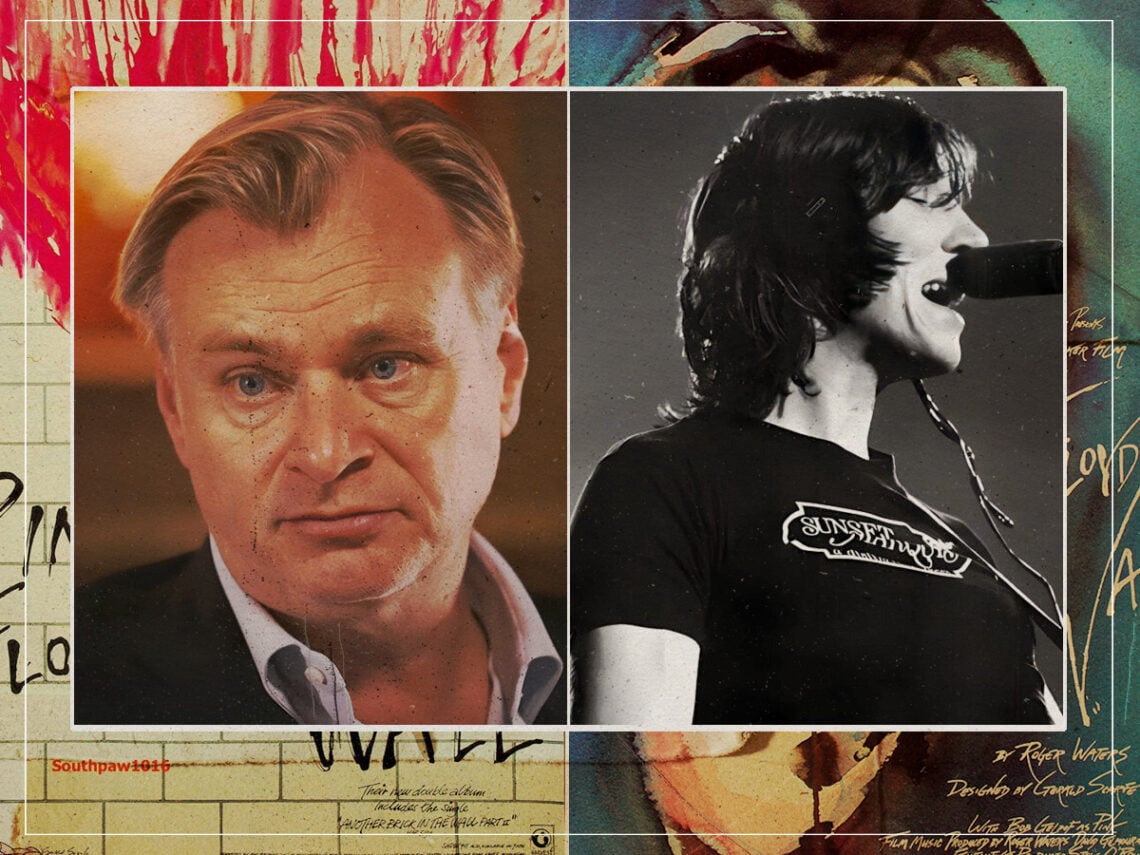
How Pink Floyd album ‘The Wall’ influenced Christopher Nolan’s filmography: “What the fuck is that movie?”

He may be known for turning up to work every single day wearing a crisp, immaculate suit and carrying a thermos full of tea, but Christopher Nolan has always been a bit of a rocker in his spare time.
As difficult as it is to imagine a young version of Nolan sporting a leather jacket and headbanging to his heart’s content or being propelled along a gathered throng on the cusp of a crowd-surfing wave, one of the best-selling and most influential rock albums of all time has been flexing its muscles over his filmography for well over a decade.
The Academy Award-winning director has carefully curated an array of movies that trade heavily in metaphor, deconstruct the notion of time itself, and pose major questions on the very essence of existence and the human experience. With that in mind, it’s not too much of a shocker to discover Pink Floyd’s The Wall has had a significant bearing on his back catalogue.
The surrealist adaptation of the titanic concept album bearing its name, The Wall was scripted by Roger Waters, directed by Alan Parker, and starred Bob Geldof in the lead role of Pink. The musician embarks on a chemically-infused odyssey spurred into action by his lingering trauma and increasing paranoia, with detachment from reality a recurring motif as events spiral into the realm of the phantasmagorical.
Hardly a like-for-like comparison to anything Nolan has directed, then, but the heavy reliance on repeated audio and visual symbolism has nonetheless seeped into his work. It goes without saying that Inception digs deeper into the subconscious on a literal level than any of his other films, but despite naming The Wall as a key inspiration on the heist thriller, the director explained that trying to echo the unique vibe of Pink Floyd’s musical drama simply wouldn’t work under the context he’d created.
“Well, there are certain areas, when you’re talking about dreams, the analysis of dreams and how you might examine them in the film that you do want to avoid,” he said. “Because they would probably be either too disturbing for the sort of action film genre that we’re working in, or funny.” To find that perfect balance, mastering the tone he envisioned for Inception was key so that humour emerged organically from the situations as opposed to knocking out zingers for the sake of it.
Even when casting his eye over what inspired him to be a filmmaker in the first place, Nolan’s interest in multiple timelines was partially born from reading Graham Swift’s Waterland for the first time, but his curiosity in sheer, unfiltered style was shaped in part by the experience of Parker’s dazzling psychedelic smorgasbord for the eyes and ears.
“I happened to read that around about the same time as I watched Alan Parker’s Pink Floyd: The Wall, which is a truly remarkable, impressionistic film,” he told the British Film Institute. “Like, what the fuck is that movie? It’s quite marvellous. The way he uses the production design, the different timelines, the intermingling of memory, dream, things like that, it was very influential on me.”
It goes without saying immersive production design, fractured timelines, chronological jumps, dreams, and memories have all become key components of Nolan’s work dating back over two decades, with Pink Floyd having a much larger say in shaping his creative trajectory than a lot of people would likely imagine.
