


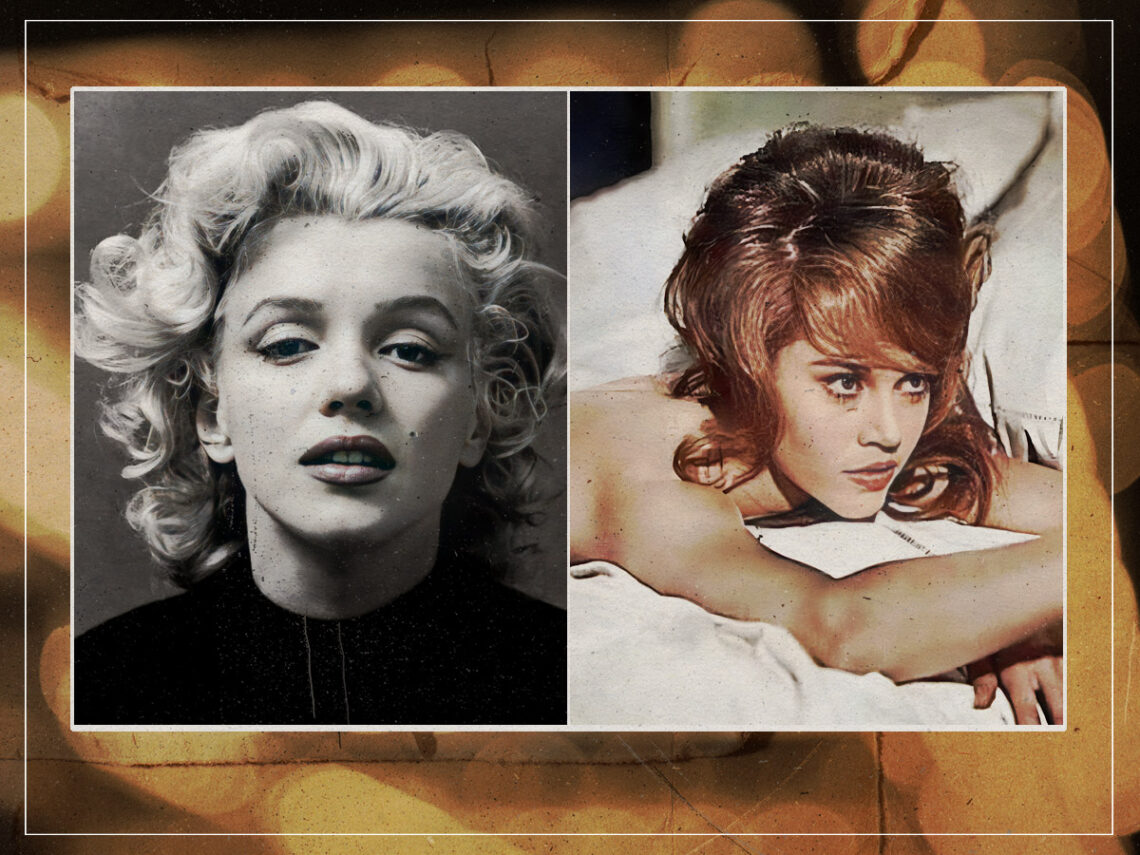
How Marilyn Monroe inadvertently convinced Jane Fonda to become an actor

With six decades of work behind her, a consistent voice for the voiceless, and an advocate for equality, it’s hard to imagine a world without Jane Fonda as the iconic actor we know today. Having starred in over 50 films—including Barbarella (soon to be remade with Sydney Sweeney) and Barefoot in the Park, her second collaboration with Robert Redford—Fonda’s career was shaped by unexpected turns. She credits a series of job firings and a private acting class, where she found herself sitting next to Marilyn Monroe, as the pivotal moment that made her take the profession seriously.
“My stepmother, who was not a very nice person, wanted me out, and I didn’t know what to do,” said Fonda when talking about herself at age 21. Jobless after being fired from her secretarial job and living at home with her father, Henry Fonda, an actor whose own career spanned five decades and had garnered accolades of his own thanks to seminal performances in films such as 12 Angry Men.
Despite the acclaim and esteem held by her father, it was Susan Strasberg, the daughter of director and practitioner of ‘The Method’, Lee Strasberg, who gave her the convincing push to attend one of her father’s classes. “He accepted me into his private classes, and I sat in the back of the room for a month next to Marilyn,” Fonda recalls.
‘The Method’, now known as simply ‘method acting’, was the naturalistic approach to on-screen acting that began to take root in the 1950s and ‘60s. An emerging new generation of actors, such as Marlon Brando, Paul Newman, James Dean and Jack Nicholson, all took this approach of inhabiting the role they were performing and attempting to simulate the experiences of their characters rather than merely mimic them.
Monroe was also an advocate of this acting approach and would often be accompanied to set by Paula Strasberg to help her prepare before scenes—famously infuriating to many directors of the projects she worked on.
It was in these classes that Fonda found her desire to join her father’s industry come to the surface. Sat next to perhaps the most iconic leading lady of cinematic history and spurred on by encouragement from a leading practitioner who was shaping what cinema was becoming. Fonda says of Strasberg, “Eventually I did a thing for him, and he said, ‘A lot of people come through here. You have talent.'”
That permission to believe in herself as an actor allowed her to take her first steps into becoming a formidable on-screen talent whose work would help to define American filmmaking of the late 20th century and give us powerful examples of why Strasberg’s approach was so revolutionising to actors and their craft.
It is hard to say whether Jane Fonda would have had the storied career she has achieved without the month spent next to Marilyn Monroe. All we know is that the time she spent in that room was unmistakably impactful: “It was like the top of my head came off. My life changed”.
