


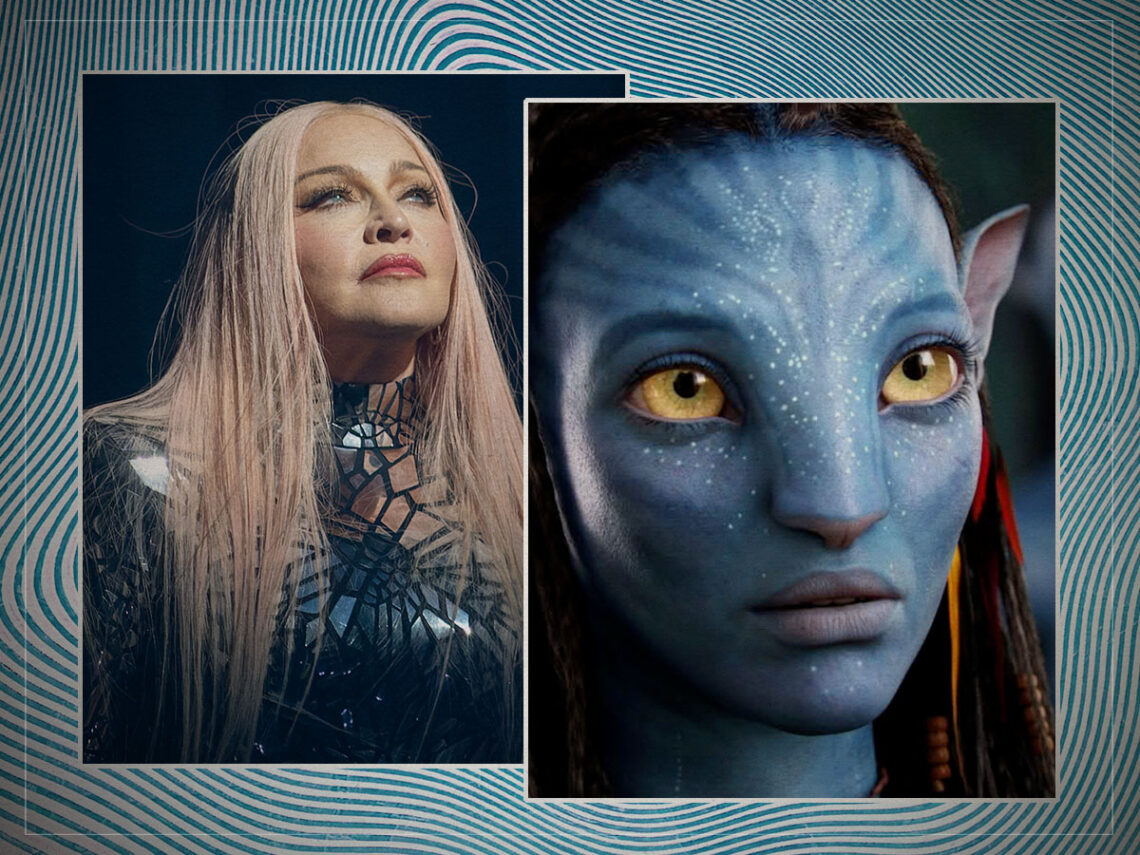
How Madonna became an unlikely inspiration for James Cameron’s ‘Avatar’

When the first Avatar was released in cinemas across the world in 2009, its state-of-the-art visual effects, immersive worlds, and a whole new language that took years to create stunned audiences.
Director James Cameron’s science-fiction epic traversed worlds, with the moon of Pandora bursting to life on the screen, creating a whole new realm and exploring themes of imperialism, resource extraction, and eco-warfare.
He also brought us beloved characters like Jake Sulley, played by Sam Worthington, Neytiri, played by Zoe Sladaña and Kiri, played by Sigourney Weaver, who have been revived in the second film, Avatar: The Way of Water, with the third, Avatar: Fire and Ash, due to be released December this year.
Cameron spent years perfecting the world of Pandora, working with a team to produce groundbreaking visual effects combining computer-generated imagery with practical effects, which are now standard tools in filmmaking. But, back then, techniques like advanced motion capture, stereoscopic 3D, ‘performance capture’ and real-time depth compositing redefined three-dimensional cinema. These effects also revolutionised the way CGI-generated characters could be portrayed onscreen, giving the Na’vi, Pandora’s native species, realistic human facial expressions and allowing audiences to feel immersed in the action.
Additionally, one groundbreaking technique in particular that upped the ante for special effects in films and gave the Na’vi creatures such uncanny expressions of human proportion took its inspiration from an unlikely source.
Cameron noticed that during Madonna‘s performance at a concert, her microphone never left her face, “bouncing around” and following her across the stage for the entire show, a common feature at big concerts. The director thought to himself, if Madonna can have the microphone constantly within her orbit, why couldn’t the same be done for a video camera?
In this way, the video camera stays with the actor, capturing the performance, and that image is given to the visual-effects company, which can render it frame-by-frame to an almost “pore-by-pore level”.
Speaking to the New York Times before the initial film’s release, Cameron’s producer, Jon Landau, explained, “Motion capture to us has always been lacking one very key letter in front of it: E”. So Landau and Cameron came up with the name, “E-motion capture”—the ability to capture the close-up emotions of characters through CGI in a way that was impossible before.
While previously, actors only wore sensors that translated their body movement into a digital character, Cameron decided to include these sensors on the face, hence the comical photos of Avatar actors in front of green screens with black dots splattered across their visage. This gave the animators more freedom to create original looks without losing the Na’vi’s human expressions.
Inspired by concert technology, it was a technique which would cost millions, involve hundreds of test runs and take years to perfect, but ultimately the effort paid off, with the original Avatar raking in $2.923billion worldwide and becoming the highest-grossing film of all time. We have Madonna and her bouncy microphone to thank, at least in part, for that.
