


Last bite in Soho: How London ate in the swinging ’60s

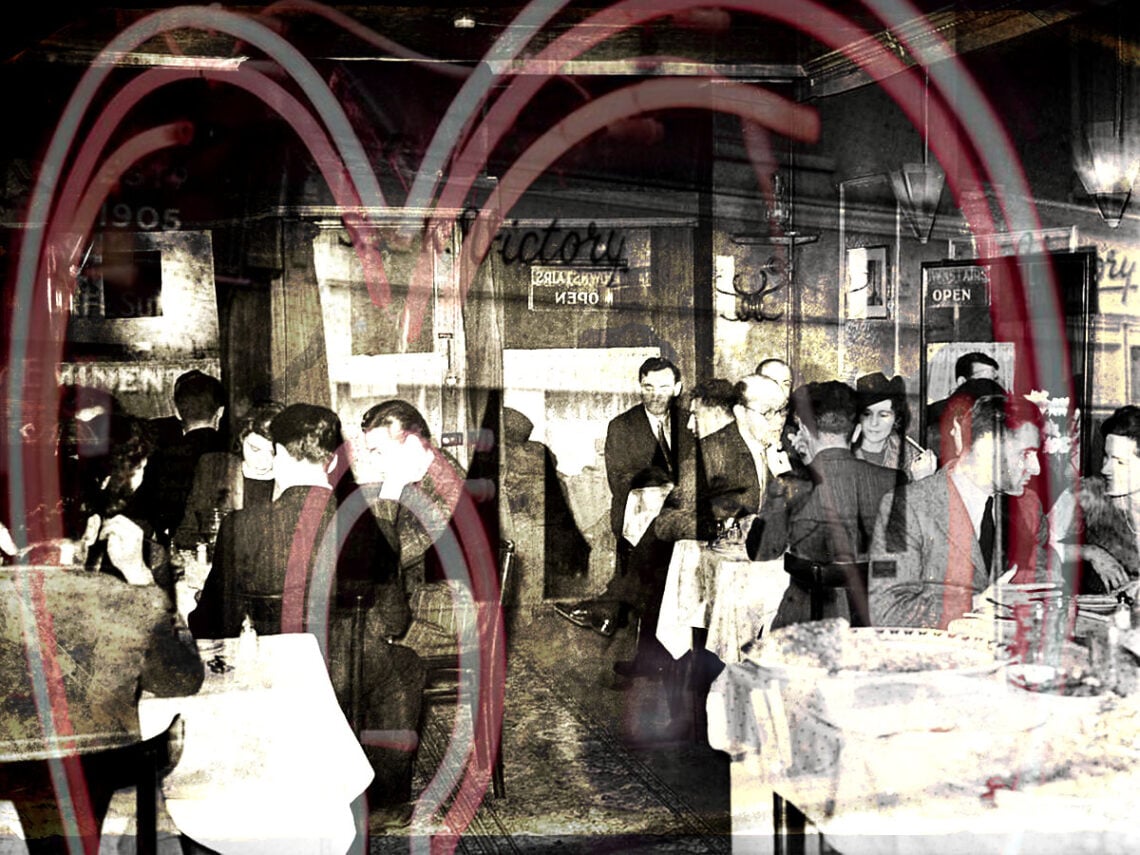
Restaurants were as much a part of swinging London as discotheques and chic boutiques. This was a city of new styles, new faces and new ideas, and the innovation of London’s restaurant scene is just one of the many transformations that swept across the city in the 1960s.
The ’60s forced what had been a rather staid culinary scene into overdrive, powering the expansion, diversification and democratisation of London’s dining culture. During the interwar period and in the years immediately following the war, eating out had been a luxury experienced only by the elite. With the arrival of a newly-affluent population of young movers and shakers in the 1960s, however, eating out became a popular and frequent pastime for ordinary people.
Suddenly, food was not only accessible but fashionable: eating out in the right spot could mean dining next to Laurence Olivier, Mick Jagger or one of The Beatles. That’s not to say London’s journey from culinary backwater to metropolitan melting pot was always a smooth one. Many restaurant owners found London diners highly resistant to the idea of foreign food and frequently received orders for roast beef and spuds despite attempts to introduce them to new culinary concepts.
As you’ll see below, the most successful ’60s restaurants were those that developed a cachet among the city’s movers and shakers, as was the case with the decidedly unpretentious Polish Bistro 555 in Battersea, South London, which attracted the likes of Vivien Leigh, Jane Asher and Paul McCartney. More often than not, a restaurant’s reputation was more about the people who ate there than what those people ate, and when the celebrities eventually moved on, so did everyone else.
Here, we’ll be donning our best garb and hitting the town for a whirlwind restaurant tour of Swinging London. I just hope we get a table – the best places are always packed.
How London ate in the swinging ’60s
You Can’t Always Get What You Want: food after the war
The war did terrible things to English food. Rationing created scarcity, giving birth to a staid culinary culture. Even in 1964, London’s dining establishment was something of a closed circle, catering to the tastes of an elite few. Maro Gallati, the owner of Caprice in St James’, viewed his establishment as a sort of club where “everybody seems to know everybody”.
Such diners tended to err on the side of caution, with Gallati, the man responsible for bringing haute cuisine back to postwar London, recalling how his celebrity customers favoured English staples like steak and kidney pudding, tripe and onions, and Baron Rothchild’s personal favourite: “treacle tar and roly-poly pudding”. As John Davis writes in his fantastic book Waterloo Sunrise, “austerity had eroded London’s standing as an international culinary centre, but its elite restaurants retained the formality and snobbery of prewar dining: as one anonymous diner put it, ‘in London you put on formal dress to have Welsh rarebit.'”

Trattoria Revolution 1
As the austere 1950s gave way to the affluent ’60s, London’s culinary scene exploded. In the capital, the old world was being erased for something shiny and new, with the rejection of old modes of dining giving way to a huge growth in the number of restaurants in spots like Beauchamp Place, just off Brompton road. In the mid-1950s, Beauchamp Place had been somewhere you were more likely to see respectable ladies shopping for couture (with milliners, dressmakers and furriers accounting for 48 of the 118 businesses in the area) than a couple sharing a meal.
By 1966, the only place with more restaurants per square mile than Beauchamp Place was Soho, the epicentre of the trattoria revolution. The catalyst of his culinary explosion was Mario Cassandro and Franco Lagatolla’s Trattoria Terrezza, which opened on Romilly Street in 1959, just a lemon’s toss from Lina Stores, a traditional Italian delicatessen established in 1944. Today, small-scale Italian restaurants are a common sight in Britain. But back in the ’60s, these informal, affordable restaurants were a relative novelty.
In the beginning, people were less attracted by the promise of authentic Italian food than the atmosphere of intimacy and exclusivity such restaurants engendered. Italian food was new and exotic, yes, but the success of Trattoria Terrezza was largely down to the colourful interior design of Enzo Apicella, the sense of what Davis calls “attainable exclusivity”, and the fact that diners might feasibly catch a glimpse of Princess Margaret, Elizabeth Taylor or a Beatle.
Mario and Franco went on to open their sister restaurant, Trattoo, in Kensington, which was followed by Trattoria on Chancery Lane. While they were contemplating expansion in the US, some of their own employees were looking to emulate their success, with Alvero Maccioni opening his King’s Road spot, Alvero’s, in 1966, by which time trattoria had spread out of Soho and into areas. Indeed, trattoria was so fashionable by that point that Maccioni was advertising his restaurant as a nonmembership club.

Let It Bistro
While London’s trendy trattorias certainly caught the public eye, just as popular were the French-style bistro that became so representative of the ’60s restaurant scene in the capital. These were not bistros in the traditional sense – the French equivalent of workman’s cafes – but small informal restaurants with candle-lit tables serving an approximation of fine French cuisine.
The clientele of such spots was made up of young professionals from Chelsea and other newly-gentrified areas. Indeed, Bistros were almost always situated in Kensington or Chelsea, helping to cement the area’s reputation as a nest of wealth. The Au Pere de Nico on Lincoln Street, Chelsea, for example, had countless celebrity patrons, including Mick Jagger, Laurence Olivier, Diana Rigg, Harold Pinter and the poet John Betjeman. These establishments were not as pretentious as you might expect, usually sporting jokey interior decor and retro pub advertisements. The atmosphere was, by all accounts, refreshingly relaxed. As The Evening Standard’s Quentin Crewe put it: “Anyone in a hat would look rather ridiculous”.

Don’t Let Me Down: expansion in the ’70s
By the late 1960s, the public had grown disenchanted by the chic trattoria, with many coming to regard them as snobbish, overly-expensive and pretentious. Then there was the fact that the customers who could actually afford trattoria often had very conservative tastes. Even when Italian food was considered the height of chic, customers remained “wedded to beef”, as Davis puts it.
Some Italian restaurants resorted to pure gimmickry. The Roman Room, on Brompton Road, for example, was described by Quentin Crewe as “aggressively Roman with pillars, statues, enormous candles burning on the tables, waiters clad in the appropriate style and one delectable girl slave”. The Brush and Palette in Queensway was even more crude, engaging a “group of delectable girls who pose very decently and properly in the nude for the amateur artists in the restaurant to paint or draw”.
What many proprietors were coming to realise was that the same faddishness that had propelled the ’60s restaurant boom was now dismantling it. Many of the restaurants that had once been symbols that a young professional had “made it” were no longer the least bit fashionable, offering dull food and casual service. Charco’s off the King’s Road, for example, was full every night in its heyday. From the late ’60s onwards, it was barely mentioned at all.

’60s restaurants today
While the faddish restaurants of the ’60s were unequipped to weather the harsher economic climate of the 1970s, many pre-war fine-dining establishments survive today, including The Caprice, The Connaught, L’Escargot, the Savoy, Scott’s Simpson’s and Wiltons.
One of the most successful ’60s restaurants was Daphne’s in South Kensington, which Crewe, writing in 1966, described as a surprisingly “fashionable restaurant” considering the food “though good, was expensive, and the place was cramped”. In that same review, Crewe ponders whether the establishment’s popularity is down to the sense that “Daphne knows she is going to succeed”. She was right to be confident – Daphne’s is still open to this day.
While most of swinging London’s Italian restaurants bit the dust in the 1970s and ’80s, some were cheap enough to run that they were rendered pretty much indestructible. Pizza Express, which was founded in 1965, became a model for similarly affordable pizza restaurants serving identikit pizzas made from dough baked in central kitchens.
Today, the spirit of London’s ’60s restaurant scene lives on in places such as Pastaio in Carnaby Street, Stevie Parle’s homage to the ’60s trattoria. Bar Termini in Soho also honours the abundance of Italian eateries that once speckled the area. Then there’s Lina Stores, an Italian delicatessen which opened in 1944 and genuinely deserves its fantastic reputation.


Never Miss A Beat
The Far Out Beatles Newsletter
All the latest stories about The Beatles from the independent voice of culture.
Straight to your inbox.