


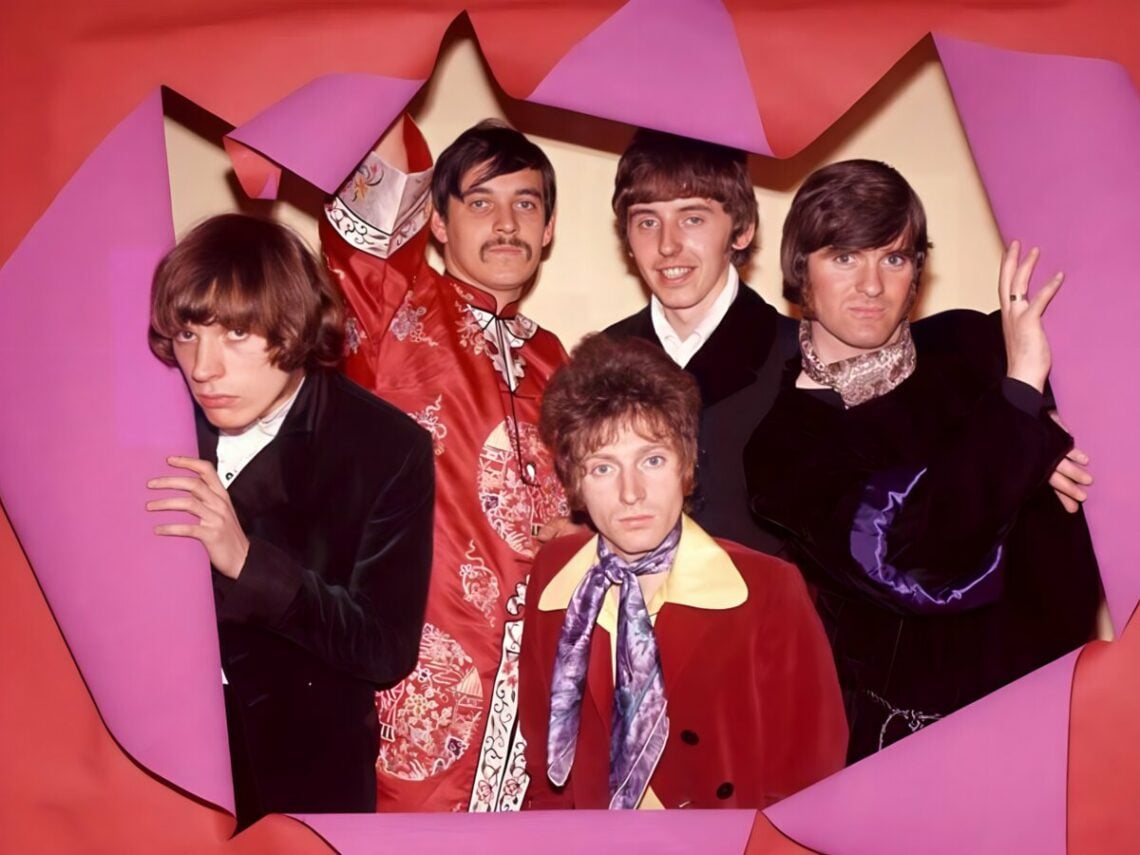
How Keith Reid wrote the lyrics for the seminal Procol Harum song ‘A Whiter Shade of Pale’

Sensual and highly impressionistic, the lyrics for ‘A Whiter Shade of Pale’ are unlike anything written for a pop song before or since, offering a synesthetic snapshot of life at its most vibrant. The man responsible for imbuing this late 1960s anthem with its Proustian charm was the late Procol Harum lyricist Keith Reid. Here, he explains how those captivating lyrics came together.
‘A Whiter Shade of Pale’ was one of 15 songs Keith Reid and Gary Brooker wrote for Procol Harum’s debut album. “We were really excited about it and liked it a lot,” Reid told Songfacts. “And when we were rehearsing and routine-ing our first dozen songs or so, it was one that sounded really good.” By that time, Reid had managed to nurture “a whiter shade of pale”, a line he happened to overhear at a party, into a complete set of lyrics. He would later compare this process to putting a jigsaw together, with the songwriter starting with the final image and working his way backwards.
The dreamlike quality of Reid’s lyrics owe much to the French filmmakers of the 1950s and ’60s. “I used to go and see a lot of French films in the Academy in Oxford Street,” Reid told Uncut in 2008. “Pierrot Le Fou made a strong impression on me, and Last Year In Marienbad. I was also very taken with surrealism, Magritte and Dali. You can draw a line between the narrative fractures and mood of those French films and ‘A Whiter Shade Of Pale.'”
Equally influential were ’60s music icons like Ray Charles, The Beatles and Bob Dylan, with the latter informing Reid’s joyful, occasionally anarchical approach. “My main influence was Dylan,” he explained. “I could see how he did it, how he played with words.” Reid did the same, rejecting concision in favour of mood. “‘A Whiter Shade Of Pale’ was just another bunch of lyrics,” he later revealed.”I was trying to conjure a mood as much as tell a straightforward, girl-leaves-boy story. With the ceiling flying away and room humming harder, I wanted to paint an image of a scene.”
Reid’s pursuit of that goal gave birth to a kaleidoscopic narrative where dreams and reality become increasingly imperceptible. “I wasn’t trying to be mysterious with those images,” Reid said. “I wasn’t trying to be evocative. I suppose it seems like a decadent scene I’m describing. But I was too young to have experienced any decadence, then, I might have been smoking when I conceived it, but not when I wrote it. It was influenced by books, not drugs.”
That’s the beauty ‘A Whiter Shade of Pale’ – it’s just so well balanced. Reid could easily have ended up with a jumble of non-sequiturs, but what he we get is a recognisable story with relatable characters who happen to exist within a topsy-turvy world. “There’s characters and there’s a location, and there’s a journey,” Reid said. “You get the sound of the room and the feel of the room and the smell of the room. But certainly there’s a journey going on, it’s not a collection of lines just stuck together. It’s got a thread running through it.”
Reid’s first version of ‘A Whiter Shade of Pale was twice the length of the recorded version, with four instead of three verses. “The fourth wasn’t any great loss,” he said, “but you had the whole story in three. When I heard what Gary’d done with them, it just seemed so right. We felt we had something very important.” They were right.
